

California has long been hailed as the land of innovation and opportunity, but now, the state is at the center of a heated debate over wealth, fairness, and the future of its economy.
Democratic lawmakers and a major healthcare workers’ union are pushing a controversial wealth tax on the state’s billionaires to address income inequality and fund healthcare. They say the revenue from the tax is needed to offset the cuts caused by President Donald Trump’s tax bill and argue hospital closures and job losses could be on the horizon if the state doesn’t see a mass infusion of cash.
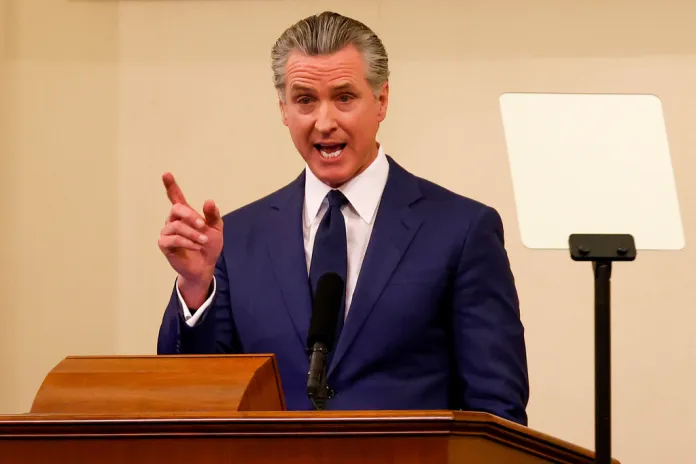
Gov. Gavin Newsom (D-CA) has already threatened to use whatever political capital he has left to block it, arguing it will hurt California in the long run and kill off innovation.
The proposal, which faces formidable political and legal obstacles, calls for California residents with more than $1 billion in assets to pay a one-time tax equal to 5% of their total assets. For example, someone with $1 billion in assets would be required to pay $50 million in taxes over five years.
Advocates argue that a tax on billionaires is necessary to address the growing wealth gap, that the state’s economic identity isn’t easily shaken, and that most of its 216 billionaires won’t leave.
Supporters emphasize that the tax will be structured to address fairness concerns. Billionaires concerned about asset valuations can submit independent third-party appraisals. If paying the full 5% at once is difficult, the law would allow payments to be spread over five years, with interest applied. For those whose wealth is held in illiquid assets, such as private start-ups, the tax can be deferred rather than forcing a sale.
But as the debate heats up, so does the exodus of billionaires who say the state’s taxes have gone too far and that they have no problem spending their money elsewhere. At least six have already left, packing up their fortunes and relocating to low-tax havens such as Texas and Florida, and igniting fears that California’s golden goose economy might be flying away.
High-profile names such as Venture capitalist and GOP mega-donor Peter Thiel, as well as Google co-founders Larry Page and Sergey Brin — the world’s second- and third-richest men, respectively — have taken steps to cut ties with California. Page, 52, has moved many of his business interests out of the state, including his family office. He recently paid $173.4 million for two homes in Florida.
It was reported this week that Facebook founder Mark Zuckerberg and his wife, Priscilla Chan, were among the latest billionaires to buy a home in South Florida. The couple has a home in Palo Alto, California, the cradle of Silicon Valley.
Big businesses leaving the state could significantly alter the state’s economic landscape, reducing investment opportunities for smaller, emerging businesses. Seven Summers, who owns a jewelry store in Santa Barbara, told the Washington Examiner that high-net-worth individuals looking for the exit sign also affect him and slammed Democratic lawmakers supporting the tax.
“I think it’s a ridiculous idea to enforce heavier taxes on people who have already paid taxes into the system and a grand amount of taxes at that,” he said. “You’re going to take our highest earning people, and you are going to push them out. I cannot believe something like this could be on the ballot.”
Summers said he was “encouraged and surprised” that Newsom has come out strongly against the proposal and said the argument by some that businesses would stay in California because of the weather and social scene was “laughable.”
“People who make those comments don’t know business,” he said. “They think people are going to stay in California and do business here because it has nice weather? Who does that? No business looks at the view and says, ‘Whoa, I’m going to hang out here because I like what the vibe is.’ They are going to do the numbers, and then, when they see just how inhospitable California is to their bottom line, move.”
Newsom has gone so far as saying he will break with members of his own party and risk angering unions to kill the measure.
“This will be defeated,” the outgoing governor said. “There’s no question in my mind. I’ll do what I have to do to protect the state.”
While Newsom has said there is room for a national conversation on wealth taxes, he does not believe one would benefit California anytime in the near future. “We live in a competitive reality with 49 other states,” he said.
San Jose Mayor Matt Mahan, a Democrat, has also vehemently opposed the tax, arguing that it would ultimately cost most Californians.
“We need a rising economic tide to lift all boats, not a political plan that will sink California’s innovation economy,” Mahan wrote on social media.
But the damage may already be done.
Billionaire investor Vinod Khosla wrote on X that “even people who don’t expect this initiative to pass are still planning to leave because there will be another one is the argument.”
TEXAS’S BAN ON BALLOT HARVESTING UPHELD BY APPEALS COURT
David Sacks, a venture capitalist serving as Trump’s crypto czar, has already predicted Texas for the win.
“Austin will replace [San Francisco] as the tech capital,” he said.
