Socialism in practice means more power for the Trump administration, experts say

Published August 31, 2026 6:00am ET


Support for socialism is growing in the United States, but what voters believe could be a system that rewards ordinary people with more power could end up reducing their quality of life and handing the Trump administration more control, experts say.

A recent CBS News poll shows 58% of Democrats view socialism positively, compared to just 32% of Democrats who say the same of capitalism. Favorability toward socialism among Democrats rose from 50% in 2010 to 66% in 2025, according to historical data tracked by Statista. The view is particularly on the rise among young people, who will hold the power in both parties down the road. A CNBC poll with Generation Lab published in August found that nearly half of all Americans ages 18 to 34 have a favorable or very favorable view of socialism. 
Socialism: more power to the people or government?

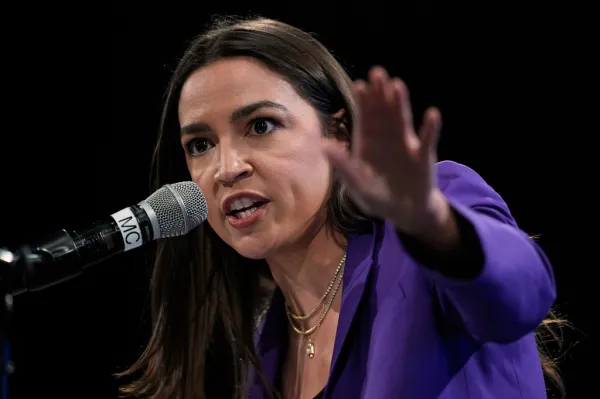
Prominent socialist-styled leaders such as Rep. Alexandria Ocasio-Cortez (D-NY) and Sen. Bernie Sanders (I-VT) have framed the system in terms of human dignity, arguing it marks the expansion of basic rights they believe include housing, healthcare, and education. The system promotes economic fairness that targets “corporate greed” and those they believe hold unnecessary wealth, they say.

“No American should be too poor to live,” according to Ocasio-Cortez.

When pressed to define socialism in the CBS News poll, respondents most frequently referenced government control or government ownership. Respondents tended to emphasize more of the outcome they believe socialism brings, rather than the working process of how the system is implemented. 

By its dictionary definition, socialism is “a theory or system of social organization that advocates the ownership and control of the means of production and distribution, capital, land, etc., by the community as a whole, usually through a centralized government.”

Leading socialists in the U.S. have framed their proposals as ones that will return “power to the people,” denouncing the “extreme concentration of power” they believe an oligarchy holds in the U.S.

Experts told the Washington Examiner that in practice, officials in Washington would have more control over issues ranging from artificial intelligence to healthcare if socialism were implemented at the federal level in the U.S. In areas like healthcare, President Donald Trump and Health and Human Services Secretary Robert F. Kennedy Jr. would have more say over “who gets what type of medicine and where,” Adam Michel, the director of tax policy studies at the Cato Institute, said during an interview. When it comes to the free housing, healthcare, and education that socialists push for, Michel said, “You can believe those things, and even want them for everyone.” But implementing that vision would necessitate “lots of centralization of power.” 

“What people mean when they say socialism … most of them are just hearing like, do you like good things, which is different than the sort of academic notion of the state has taken over or is the primary owner of all of the organizations that produce the things that we need for life,” Michel said. “It necessarily comes with controlling people’s personal lives and decisions … When you’re talking about the ideal, you don’t have to deal, you don’t necessarily have to confront all of that actual sort of machinery of implementation.” 

Dr. Gary Wolfram, the director of economics at Hillsdale College, agreed. When the DSA talks of “collectively owning the key economic drivers,” there has to be some entity that makes those decisions, “and that’s going to be the government,” he said. 

“How else would it be all collectively? We wouldn’t all get together and make a decision,” he said. “I mean, even if the state of Michigan got together and decided ‘oh yeah we’re going to build this,’ everybody in the state of Michigan would all get together and decide how big the data center is going to be, how much electricity can it use, right? So you couldn’t do that.” 

The root of why some people gravitate toward socialism and others toward capitalism lies in a fundamental difference in what they believe to be fundamental rights, Michel said. 

Capitalism operates on “positive rights,” generally found in the Constitution, that include the right to your personal property, the right to your person, and the right to be free from other people’s infringement on your freedom of speech or on your freedom of movement. Socialism operates on “negative rights,” or the right to be free of something or be provided something by someone else. 

“My right to health care is then dependent on someone providing it to me,” Michel said. 

Would socialists’ billionaire tax work?

Michel raised questions about how socialist ideals could be implemented on a mass level. Proposals on the DSA’s website calling for free healthcare, housing, and reparations could amount to up to $200 trillion over the next 10 years of new spending, which could push federal spending to almost 60% at the low end and 92% of the economy at the high end, according to the tax expert. He cast doubt on whether expanding taxes on the rich would pay for socialist programs, arguing that even if the government raised $6.6 trillion by confiscating the wealth of everyone on the Forbes 400 list, it would cover less than one year of their proposed new spending. 

Wolfram warned that the leading socialist take on wealthy individuals underestimates the role they play in society. A world without the goods and services billionaires produce would be a world with less innovation, forced into a lower standard of living, he said. 

“People see the billionaires, but they don’t observe how they got there and what the world would be like if you couldn’t be a billionaire,” he said. 

His words come as attacks on the wealthy rise, from the likes of Sanders, Ocasio-Cortez, and Michigan Democratic Senate nominee Abdul el Sayed, who is also backed by socialists. 

“The truth is that right now in America, the people on top have never, ever in the history of our country, had it so good,” Sanders said during a “Fighting the Oligarchy” rally in Tucson last year. “These guys literally don’t know what to do with their money. They buy one mansion, two mansions, not enough. They’ve got five mansions. They want to get around? They own their own jet planes; they own their own helicopters. Send their kids to the best private schools.”

“What Republicans do is that they try to make working people like you and me feel like we’re just one step outside of that club, that if we just work a little bit harder, maybe we’ll be a billionaire too,” Ocasio-Cortez added at the rally. “Except those kinds of spoils aren’t earned, Tucson. They’re stolen.”

Wolfram argued that in reality, there is a trickle-down effect in a system that allows for billionaires, where the standard of living is raised for all who benefit from the goods and services they produce. In practice, changing to a socialist model that targets billionaires through higher taxes and other policies would reduce incentives to innovate, he said, making it less likely that the standard of living would continue to climb in arenas from healthcare to technology. 

“I think it’s a matter of, they see the billionaires, but they don’t see why you want to have billionaires. Why is the world different because people can become billionaires?” he mused. “They see the billionaires and say, ‘Oh, wow! We can just buy and tax those guys.’ Well, you might be able to tax those guys, but you’re going to change the incentives of the system, and so there’s going to be less improved healthcare.”

“The internet did not exist until 1993, and where does that all develop, right? It develops in market-based economies,” Wolfram added. “I tell my students, my mom never said, ‘I can hardly wait for the next Soviet washing machine to come out.’”

EL SAYED GETS SLAMMED FROM RIGHT AND LEFT AS HE REFUSES TO DISAVOW HASAN PIKER

In the U.S., average individual consumption, which is a measure of material well-being, is 70% higher than in European countries, Michel said, pointing to an analysis he did in 2024. 

“That’s one measure of how much better off an American is because we have a much smaller government that is less involved in our lives, and that those sort of both the heavy taxes on one side and all the distorting government spending on the other side across Europe ultimately means people work less, save less, invest less, and start businesses less, innovate less,” he warned.