

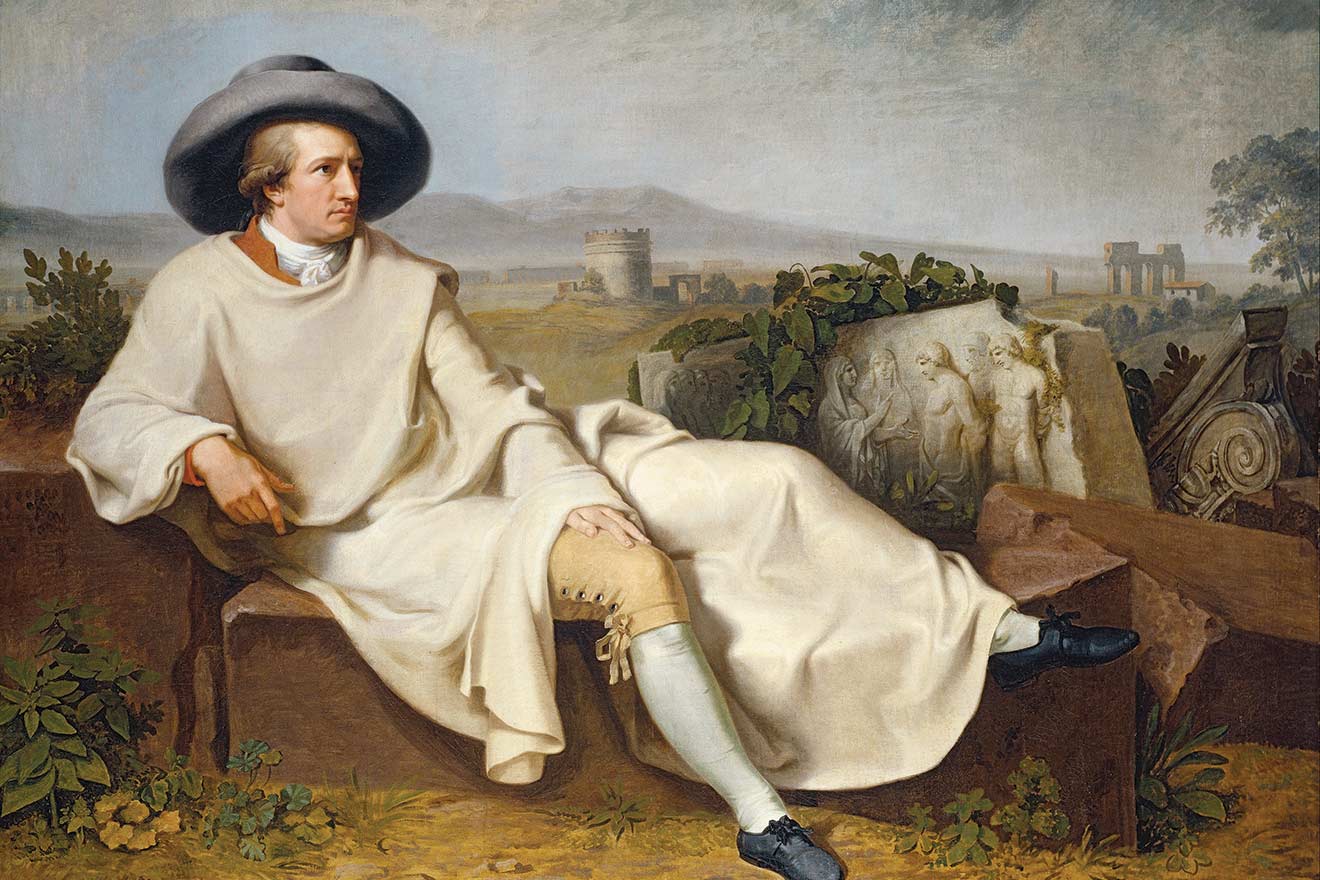
There have been very few Renaissance men since the Renaissance—and they weren’t exactly thick on the ground even in their glory days. No modern figure is more worthy of that appellation than Johann Wolfgang von Goethe (1749-1832), who was not only the greatest German poet, playwright, autobiographer, and novelist (beside Thomas Mann), but also a painter at a time when that required ability and expertise, a statesman who effectively took over the administration of a small dukedom in his mid-twenties, and a scientist who made suggestive discoveries in zoology and botany and mounted an audacious challenge to Newton’s theory of optics. And Goethe was also a prime virile specimen who relished the pleasures of the body as well as those of the mind. His secretary Friedrich Riemer goggled in wonder at the physical grace and power of the middle-aged Goethe, a born athlete who had gained in muscle and finesse by extensive youthful practice: “One must see him, how strong and firm he stands on his feet, with what bodily agility and sure step he moves. Early gymnastic training, dancing, fencing, skating, riding, even coursing and racing, had given him this mobility and suppleness; he could never make a false step on the worst path or be in danger of slipping or falling; easily and swiftly he passed over smooth ice, narrow foot-paths and bridges, and rocky steeps.”
Leonardo da Vinci proclaimed that it is easy to make oneself a universal man; after all, to do so required of him only to be born a singular genius and to devote all his energy to developing his preternatural mind, eye, and hand. With Goethe as well Nature was profligate in dispensing her manifold capacities and charms, but he would not indulge in swaggering bravado about how easily he accomplished what he did. Despite his reputation for insufferable serenity, late in life he said that he had never known an interval of restful ease; his entire life had been one of striving, of unrelenting effort to cultivate his various talents and to harmonize the naturally discordant aspects of his character. Not that he was unaware of the great good fortune in his endowment; he would speak of the “inborn merit” that a natural aristocrat possesses and of his winning “the big prize” in the lottery of birth. But it took a lifetime’s hard work for that inborn merit to become the superior merit of extraordinary achievement.
Stay informed.Stay ahead.
Join Washington Examiner for unlimited access to the news, analysis, and commentary that matter most.
Already a member? Log in
