

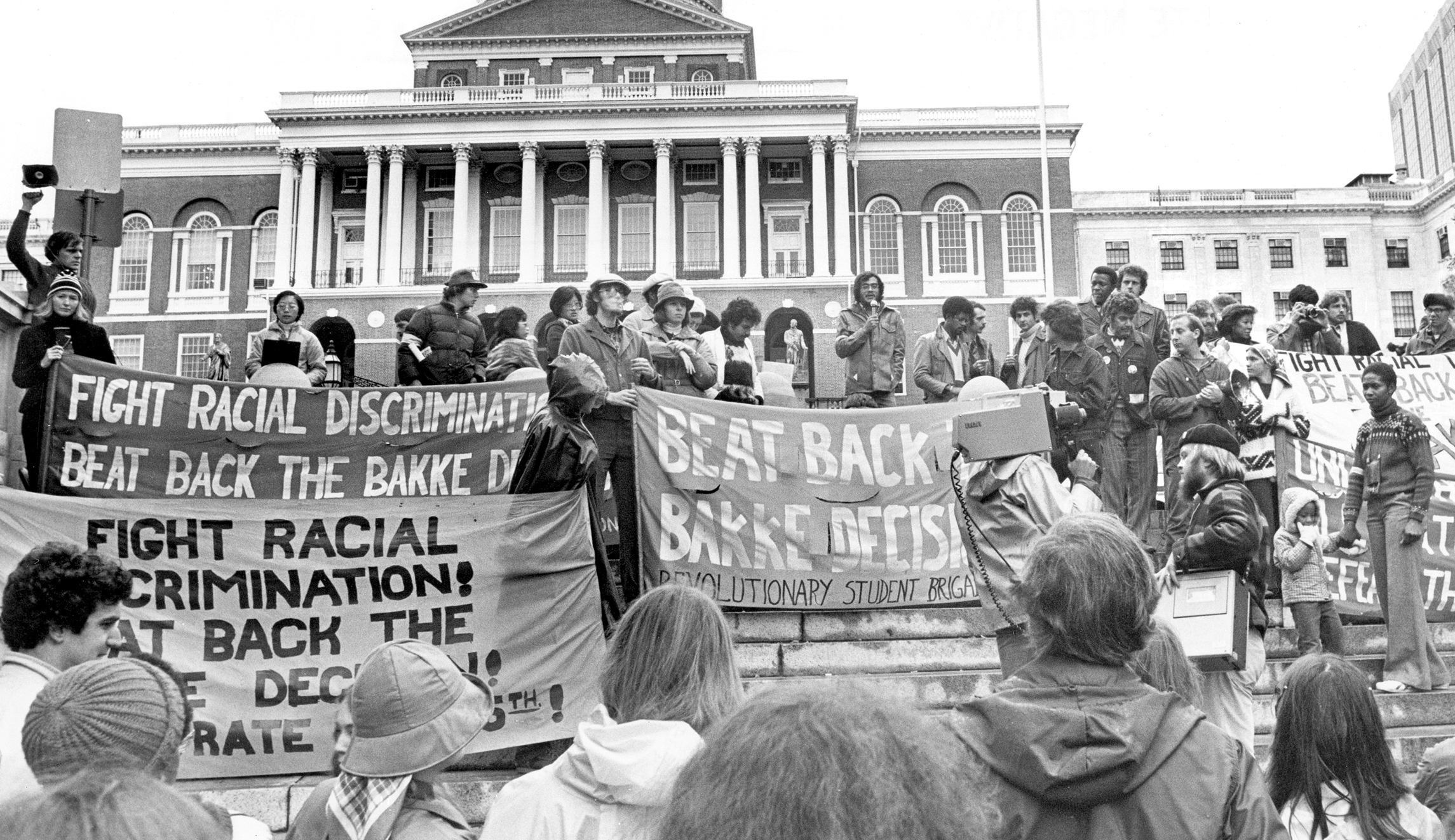
If Melvin Urofksy proves anything in his new history of affirmative action, The Affirmative Action Puzzle, it’s that there is little to say about the policy that has not already been said. From the start, the basic terms of the debate were set: Critics appealed to colorblind fairness and defenders to “compensatory justice” — which, Urofsky observes, was used as a synonym for affirmative action in its early days.
Then, a strange thing happened: Defenders of affirmative action changed their argument. Gradually, they stopped appealing to historical injustices and instead began arguing that racial diversity is good for its own sake. By the early aughts, Urofsky observes, slavery and Jim Crow were rarely mentioned in defenses of the policy.
Recommended Stories


The shift from the compensatory rationale to the diversity rationale is doubly strange because the latter seems, on its face, to be a false pretext. How can racial diversity be so important that universities must racially discriminate to achieve it but not important enough for them to ban racially exclusive campus housing? If diversity is so beneficial for students that we must ignore the colorblind language of the 1964 Civil Rights Act, then shouldn’t racially integrating historically black colleges constitute a national emergency? Even Ta-Nehisi Coates, no opponent of affirmative action, has said that the diversity argument is “kind of weak.”
There is a further dishonesty in affirmative action, one that resides in the name itself. “Affirmative action” is a euphemism. Which is to say it’s a bland substitute phrase chosen precisely because its blandness guards against the discomfort that would otherwise attend any frank discussion of the policy, not unlike using “enhanced interrogation” as a substitute for “torture.”
Calling the policy by its commonsense name, “racial preferences,” immediately invites the awkward question of who is and is not preferred. In the former category, one would find middle- and upper-middle-class American blacks, as well as black immigrants. In the latter category, one would find Asian Americans. The resulting attitude toward racism can only be described as schizophrenic: To applicants, universities say, “We have the right to reject you because of your race,” but to students, they say, “We have 12 different diversity task forces to ensure that you never feel unwelcome because of your race.”
To be sure, racial preferences have some benefits. Among them are the rising number of black and Hispanic professionals, the increase in minority representation in managerial positions, and so forth — in short, the creation of a minority elite. But less attention has been paid to the costs of these preferences, including the harm done to black and Hispanic students via the “mismatch” effect, in which minority students are admitted to better schools than what their grades and test scores merit and then struggle once enrolled. Urofsky cites the extreme example of the University of Michigan’s clinical psychology program, which during the 1970s implemented a rule reserving one-third of its slots for minority students. The results were disastrous. Less than one-fifth of minority students admitted under quotas completed their degrees, compared with two-thirds of students admitted on merit.
Even where graduation rates are similar across races, mismatch can operate in stealth by causing minority students to switch from harder majors to easier ones. A 2012 study of students at Duke University, where the black-white gap in SAT scores for incoming freshmen was 141 points, found that black male students were far more likely to switch out of hard science majors than their white counterparts.
Alternatively, one can see the folly of using racial preferences to promote group advancement by thinking in broad historical terms. Consider the history of white Anglo-Saxon Protestants. Because of the pervasiveness of formal preferences, “old-boys’ networks,” and other means of excluding non-WASPs from elite spheres of U.S. society, the era from the late 19th century until roughly 1965 could be loosely described as affirmative action for WASPs — and in fact has been described as such by historian Ira Katznelson.
Yet affirmative action did not keep the WASPs on top. As economist Thomas Sowell pointed out in Ethnic America, by 1970, Anglo-Saxons were not even one of the top five highest-earning ethnic groups in the country — trailing, among others, the Italians, the Poles, the Jews, and the Japanese, all of whom faced discrimination. Preferences certainly made it easier for the WASPs to dominate elite schools, coveted professions, and especially politics. But in the long run, they may have lowered WASPs’ incentives to acquire and master the skills they needed to succeed on their own.
The same point can be made another way: Racial preferences for disadvantaged minorities have been implemented all around the world, including in Nigeria, Sri Lanka, Malaysia, China, and India, where they have existed longer than in the United States. Yet I am unaware of a single affirmative action success story — that is, an example of a minority group actually being lifted from relative poverty to economic parity as a result of preferences. Maybe preferential policies have been failing to achieve their goals for contingent reasons in every case. Or perhaps the very logic of such policies is flawed.
What would happen if we ended affirmative action? We need not speculate; California did it in 1996 with Proposition 209. The black activist class predicted Armageddon. Armageddon did not happen.
What did happen was on balance good for minority students. On the one hand, black enrollment in the University of California system declined by 1 percentage point between 1995 and 2000. On the other, for blacks and Hispanics at the University of California, Berkeley, the graduation rate for the post-Prop 209 class “increased by 6.5% and 4.9%, respectively.” At the University of California, San Diego, “the average freshman GPAs for minorities all but converged with the GPAs of white and Asian students” within one year of Prop 209. As for the fear that there would be no black elite without affirmative action, Prop 209 “did not cause the number of women and minorities in more senior or higher paying positions to decline.”
In the end, Urofsky favors what he calls “soft” affirmative action — namely, proactive efforts to reach out to minority applicants and publicize job opportunities. He opposes “hard” affirmative action, by which he means strict racial quotas. The majority of people would agree. The real point of controversy lies between “hard” and “soft” affirmative action, in racial preferences that constitute more than mere outreach but less than strict quotas. On these, Urosfky does not pass judgment.
As a result, although the book is an excellent work of history, it leaves something to be desired. In his admirable even-handedness, Urofsky does not capture a crucial insight: Affirmative action is not a trade-off between colorblind fairness and compensatory justice so much as it is a way of appeasing a black activist class whose demands are constrained neither by prudence nor by a sound theory of racial uplift. Instead, these demands persist through this class’s ability, through brute rhetorical force, to provoke guilt in the conscience of white liberals.
Coleman Hughes is a student at Columbia University and a columnist for Quillette.
