

Secretary Chris Wright has found himself in a position unlike that of any other person who has led the Energy Department: at the center of an ambitious rejuvenation of a foreign country’s oil industry.
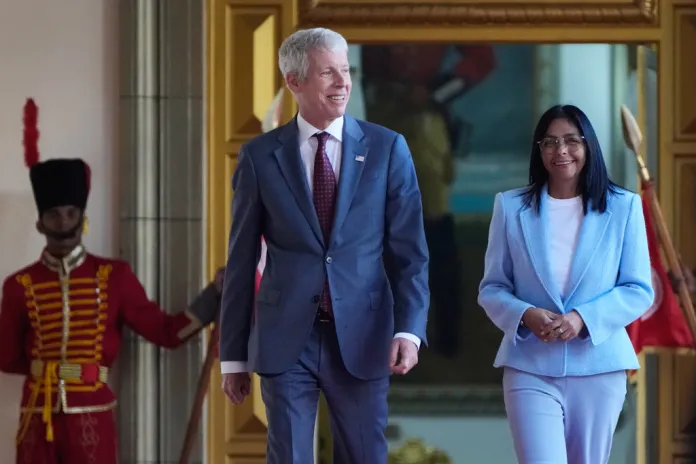
Wright, 61, became the highest-ranking Trump administration official to travel to Venezuela this week since the capture of former dictator Nicolas Maduro in January, underscoring the shift in the secretary’s priorities, making him a prominent figure in foreign affairs.
Wright, the founder and ex-CEO of oilfield services company Liberty Energy, as well as the founder of the hydraulic fracturing consulting firm Pinnacle Technologies, has become increasingly crucial to President Donald Trump’s plans to revitalize the oil industry in Venezuela over the last month and a half.
Less than a week after the removal of Maduro, Wright was the first to announce that the United States would be selling Venezuelan oil “indefinitely,” while controlling the proceeds.
The secretary acted as a public face for the administration in the days that followed as questions swirled around who would be in charge of Venezuela’s oil industry, where proceeds of oil sales would go, and how quickly U.S. oil firms could move back into the country.
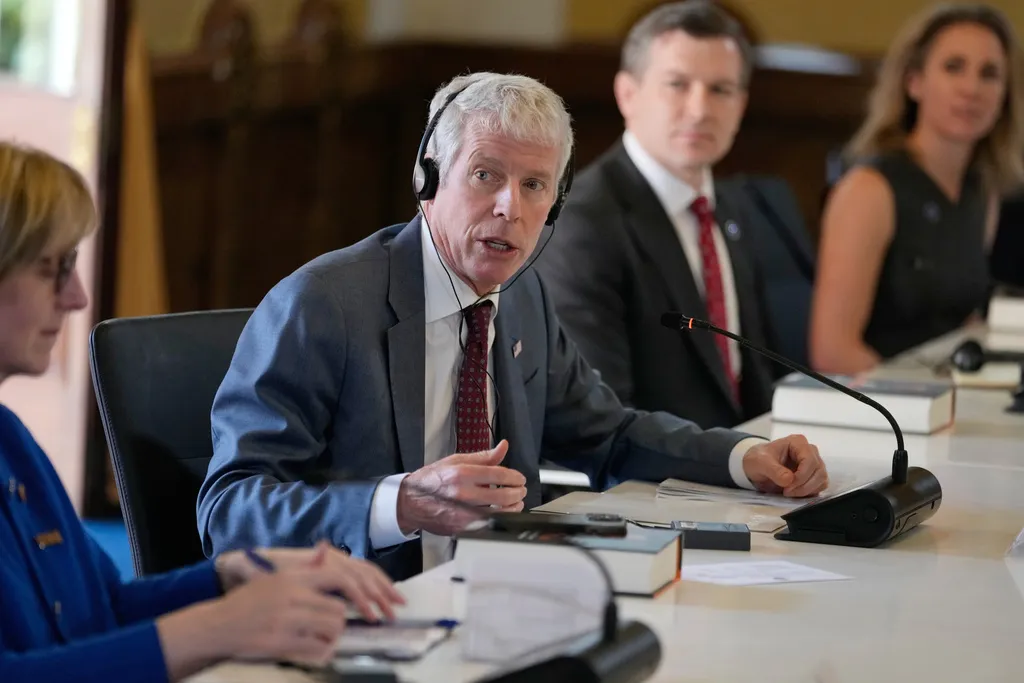
Wright, a graduate of the Massachusetts Institute of Technology, has indicated that the Trump administration plans to keep the U.S. closely involved in Venezuela’s oil sector, through rapidly expanding U.S. exploration and drilling operations, as well as handling the management of the sales of the crude into the global market.
An unusual role for the energy secretary
It is this long-term involvement in the country’s energy industry that breaks new ground for the role of energy secretary. Secretaries past rarely found themselves in any sort of similar situation regarding developing energy infrastructure abroad.
Traditionally, the role of the energy secretary is to oversee the country’s energy system, the nuclear weapons arsenal, nuclear power and waste, and the National Laboratories. Wright, though, has been at the center of the administration’s foreign policy agenda to stabilize Latin America.
“It is certainly a unique challenge I never had to face, I don’t know if any other secretary of energy had to face that,” Federico Peña, energy secretary under the Clinton administration, told the Washington Examiner.
“The question that arises in my mind: Is any secretary of energy situated with the right kind of resources to start selling, buying, and selling oil in the national marketplace?” Peña asked, contrasting the position with that of the secretaries of commerce and other departments.
Under his tenure in the late 1990s, Peña launched an initiative to develop oil and gas resources in the Caspian Sea and build export pipelines through Turkey to the Mediterranean to reduce reliance on regional powers such as Iran and Russia.
This initiative was in partnership with the governments of multiple other countries, including Azerbaijan, Kazakhstan, Georgia, Armenia, and Turkmenistan, and ultimately resulted in the Baku-Tbilisi Ceyhan pipeline, which became operational in June 2006.
As part of his initiative, Peña intended to bring in U.S. oil and gas companies to help in the development of the oil and gas fields in the Caspian Sea. Exxon Mobil does still hold a stake in the project, though this continued involvement is far smaller than the lofty goals the Trump administration has for U.S. oil majors in Venezuela.
The only other marginally similar incident that can be compared to Wright’s positioning is the U.S.’s involvement in rebuilding Kuwait’s energy industry following the invasion of Iraq in 1990, Neil Atkinson, ex-head of oil at the International Energy Agency and a former London-based employee of Venezuela’s state-owned oil firm, PDVSA, told the Washington Examiner.
Those efforts, however, were primarily led by the U.S. Army Corps of Engineers, rather than the Energy Department. The U.S. involvement was also considered to be a more rapid emergency restoration of Kuwait’s energy sector, rather than long-term modernization goals for Venezuela.
“You’ve had 25 years of degradation of the oil industry and indeed, in my opinion, the whole economy,” Atkinson said of Venezuela, describing the challenge around creating a secure situation for U.S. energy firms as “unique.”
“A vast amount of rebuilding has to be done,” he continued. “So the scale of the challenge to restore reliable electricity supply all around Venezuela, restore reliable food and fuel distribution, restore law and order across the country. It’s a massive challenge, because without that, the oil companies cannot go into Venezuela and do the job that they’re equipped to do.”
Venezuela’s oil
Venezuela is estimated to have the largest oil reserves in the world, around 300 billion barrels. The country extracts fewer than 1 million barrels of oil per day, however, less than one-tenth of the top producers in the world.
Wright, who spent his entire career in the oil and gas industry and was a pioneer of the shale revolution, has said that the U.S. oil majors could quickly increase these production levels, possibly by 50% within the next 12 to 18 months.
Often in the past, energy secretaries have encouraged the growth of the domestic oil industry by focusing on exporting more U.S. oil abroad. During the first Trump administration, then-Energy Secretary Rick Perry characterized increased exports of oil, gas, and coal as not just exporting energy, but “exporting freedom.”
Wright has now found himself in a position where the administration not only wants to increase exports of U.S. energy abroad but also directly encourages U.S. firms to ramp up production abroad over foreign adversaries such as Russia, China, and Iran.
“We are going to work together with the officials of Venezuela to evaluate all of the business deals that are in the country and evaluate what look to be in the best interests of Venezuela and Western Hemisphere,” Wright told Bloomberg TV while touring a Chevron facility in Venezuela this week.
As other agencies within the Trump administration are taking action to encourage private investment, such as the Treasury issuing general licenses to clear the pathway for new exploration and drilling activities, Wright has taken a more direct diplomatic approach to instill confidence in wary companies.
He became the first high-ranking administration official to meet with acting Venezuelan President Delcy Rodríguez and traveled to active drilling operations in the country’s oil fields.
Wright’s skillset
Some have pointed out that his extensive experience in the fossil fuel industry primed Wright to take on this public-facing role, as it is a skillset lacked by others highly involved in foreign affairs, such as Secretary of State Marco Rubio.
Richard Nephew, a senior research scholar at Columbia University’s Center for Global Energy Policy and former employee of the Energy and State departments, theorized that one reason Wright has taken the lead over someone such as Rubio may be due to Rubio’s past remarks lambasting the Maduro regime.
“I would hypothesize that there’s a little bit more sensitivity on Rubio’s personal part to go there and shake hands with people who are still holding political prisoners, and, still really, they are the Maduro government, just with a different person functionally in charge,” he said.
Nephew pointed out, though, that despite the administration’s intentions to address broader political and human rights issues in Venezuela, oil is at the center of discussions.
“Obviously, the president’s extraordinary focus in Venezuela has been on oil,” Nephew told the Washington Examiner. “And so, you know, Wright going and potentially making oil production and export a more reasonable thing is fitting with both the president’s agenda, and then also putting, again, potentially with Wright’s own personal inclinations.”
While it is not uncommon for an energy secretary to be at the forefront of foreign affairs, even former secretaries agree that no other has been so enmeshed in the rebuilding of another country’s energy sector.
Peña told the Washington Examiner that he is not surprised Wright has become so involved, as protecting the interests of the U.S. and the public is the “No. 1 priority” for any secretary of any department. That does not, however, take away how unique Wright’s position has become.
DELCY RODRIGUEZ CONSIDERING VISIT TO US AFTER MEETING WITH ENERGY SECRETARY
“A secretary of energy can be called upon to do unique things during unique times, and that’s not precluded by the traditional role of a secretary of energy,” Peña referring to past secretaries. “They’re all different at different times. And so he’s got his just like I had mine.”
The Energy Department did not respond to the Washington Examiner’s request for comment.
