

The escalating conflict in Iran is posing a significant risk to energy infrastructure across the Middle East and Persian Gulf, including crucial crude oil transit routes as well as facilities used to refine and produce oil and natural gas.
Over the weekend, the United States and Israel carried out attacks on Iran, killing Supreme Leader Ali Khamenei. The surprise strikes have threatened millions of barrels of oil in the global markets, as the Strait of Hormuz has been effectively closed off and Iran has retaliated by targeting other energy facilities in the region.
Analysts have warned that this conflict could disrupt the transportation of 15 million barrels of crude oil. And if the disruption lasts more than a few days, some warn it could raise crude oil prices into the triple digits.
HOW GULF STATES ARE RESPONDING TO IRAN’S RETALIATORY STRIKES
“Probably, three or four days is enough for the oil and natural gas market to have a heart attack, which would mean price is going up much more than they do right now,” Rystad Energy chief economist Claudio Galimberti told the Washington Examiner.
Here’s a closer look at some of the most important transit routes, export terminals, and other energy-related infrastructure at risk.
Infrastructure already hit
On Monday, Iran began to retaliate following Saturday’s attack, launching drones against Qatar state-owned energy giant QatarEnergy’s facilities at Ras Laffan and Mesaieed.
Following the attacks, QatarEnergy ended all liquefied natural gas production. The company has a total annual production capacity of 77 million tons of LNG.
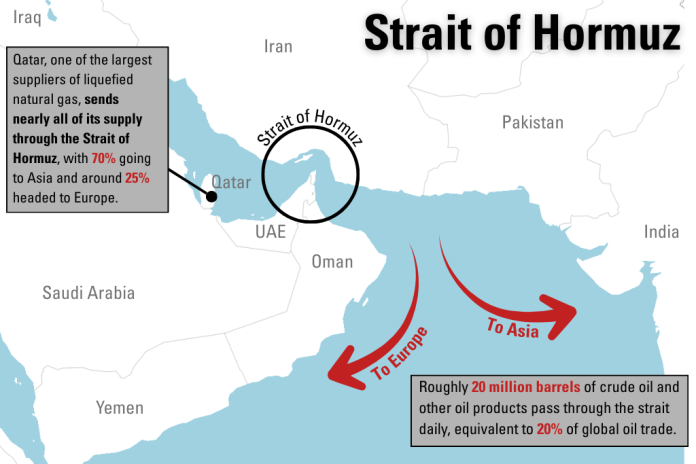
Qatar is one of the largest LNG suppliers worldwide, sending more than 70% of its exports to Asia and 25% to Europe in 2022, according to the Energy Information Administration.
IRAN CONFLICT THREATENS TO RAISE GAS PRICES
Iran’s retaliation spread further across the Gulf States Monday, with state-run Saudi Press Agency reporting that Saudi Arabia’s Ras Tanura oil refinery sustained damage from Iranian drones.
The facility, operated by Aramco, was shut down after a drone strike in the area. The refinery has a capacity of around 550,000 barrels per day and is a crucial supplier of diesel worldwide.
Others at risk
Clayton Seigle, a senior fellow in the Energy Security and Climate Change Program at the Center for Strategic and International Studies, told the Washington Examiner that there are several other major facilities to keep an eye on that are within striking distance of Iran that have not yet been targeted.
This includes Saudi Arabia’s Ju’aymah Terminal, one of the largest LNG export facilities in the world, which handles more than 5 million barrels per day of Saudi oil. Another is Al Basrah Oil Terminal, a major crude oil terminal owned and operated by Iraq, which has a loading capacity of over 3 million barrels per day.
THE US AND ISRAEL ATTACKED IRAN: WHAT WE KNOW
Seigle also pointed to smaller offshore terminals with export capacity of several million barrels per day located off the coasts of the United Arab Emirates and Kuwait.
“When you put that all together, you’re looking at 15 million barrels of crude,” he said.
Additionally, Galimberti highlighted the Leviathan offshore gas field, located in the eastern Mediterranean, as a possible target for Iran.
Leviathan is Israel’s largest gas field, with roughly 22.9 trillion cubic feet in gas reserves, supplying natural gas to Israel, Egypt, and Jordan. It is primarily operated by Chevron.
Hours after Saturday’s strike, sources confirmed to Reuters that the gas field was temporarily shut down as a precautionary measure.
Other foreign-owned entities, including Norwegian DNO and Dubai’s Dana Gas, moved to pause their oil and gas production in the Kurdistan region of Iraq amid the conflict over the weekend.
The region exported roughly 200,000 barrels of crude per day last month.
The Strait of Hormuz
By far the most important piece of the global oil network at risk in the conflict is the Strait of Hormuz, which separates the Persian Gulf from all other marine passageways for energy production.
Roughly 20 million barrels of crude oil and other oil products pass through the strait daily, equivalent to 20% of global oil demand.
Over the weekend, the Islamic Revolutionary Guard Corps said the strait was “effectively closed” to maritime vessels.
While it remains unclear if the closure is being enforced, several large vessels estimated to be transporting more than 10 billion barrels of oil have already turned around before passing through the strait, according to an analysis of shipping data by Sky News.
Seigle explained that some of these ships may be changing their routes due to insurers canceling contracts or GPS systems being jammed.
Galimberti described the transit route as the “aorta” of the energy sector’s circulatory system, warning that if a closure of the strait lasts too long, it could lead to a “heart attack.”
“The Strait of Hormuz is essential to the whole system to work,” Galimberti said.
IRAN CONFLICT THREATENS TO RAISE GAS PRICES
He explained that even if other producers can fill gaps in supply caused by the conflict, market flow won’t be restored if it cannot be transported through the strait.
“This is the highest concentration of foreign gas facilities in the world and the Strait of Hormuz is the big artery of the entire oil market,” he said, adding, “If the war continues, then expect oil prices to continue to climb.”
