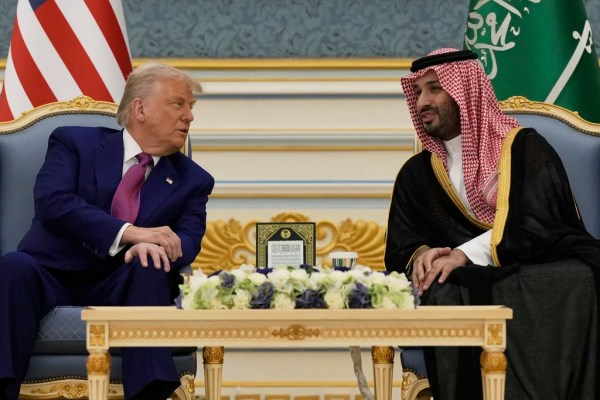
President Donald Trump sent the civil nuclear agreement he inked with Saudi Arabia to Congress this week, seeking legislative approval of the “peaceful nuclear cooperation agreement” that he has made contingent on the Saudis joining the Abraham Accords.
Energy Secretary Chris Wright and Saudi Minister of Energy Abdulaziz bin Salman signed the nuclear agreement on July 22, with Wright hailing it as a deal that would “uphold high standards of nuclear safety, security, and nonproliferation, and strengthen Washington’s competitive edge in civil nuclear technology.” The officials from both countries touted the agreement as one that would strengthen economic ties between Washington and Riyadh, setting them up for a long-term, multibillion-dollar strategic relationship.
Recommended Stories
Trump handed the agreement over to Congress for approval on Monday in line with the Atomic Energy Act, according to multiple reports, including the Wall Street Journal, which first reported the news. When the chambers return to session, the House Foreign Affairs Committee and the Senate Foreign Relations Committee have 90 days to review the deal.
One day after Wright announced the agreement, Trump praised the deal, but hinged it on Saudi Arabia’s willingness to establish relations with Israel by joining the Abraham Accords.
“The Civil Nuclear Deal (There will be no enrichment of material!) being made between the United States Department of Energy and Saudi Arabia, which pertains only to non-military use such as the ones that Iran and UAE (and others) already have, will be approved, but is totally subject to Saudi Arabia joining the very respected and successful Abraham Accords,” Trump wrote on Truth Social on July 23.
The Abraham Accords, which Trump brokered in his first term as president, have regained relevance during the Iran war, as Trump encouraged several Arab Gulf States in May to sign on to the accords as part of a broader peace deal with Iran.
The accords serve as a bridge for diplomatic relations between Arab Middle Eastern countries and Israel. The United Arab Emirates, Morocco, Sudan, Bahrain, and Kazakhstan have each signed on to the agreement with Israel and the U.S.
A Trump administration official told multiple outlets that the civil nuclear deal was submitted to Congress with the requirement that Saudi Arabia join the accords for the deal to take effect.
DOE AWARDS $162 MILLION TO NINE CRITICAL MINERAL EXTRACTION PROJECTS
The nuclear agreement will supply American companies with access to Saudi Arabia’s nuclear energy program, with the aim of expanding U.S. industry exports and creating more American jobs in the industry, per the Department of Energy. Trump has clarified that the agreement does not allow for the enrichment of nuclear material.
The agreement can take effect unless Congress passes a joint resolution to shut it down during the 90-day review period, according to the Associated Press.