
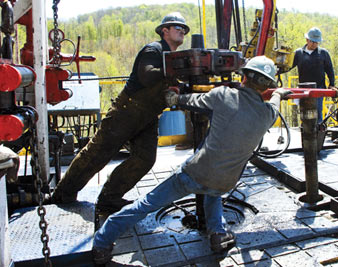
When Andrew Liveris took over as CEO of Dow Chemical at the end of 2004, the company was in the midst of a wrenching reorganization that saw it shed 7,000 jobs—14 percent of its workforce—and close 23 older chemical plants in this country. Looking ahead to a new product cycle in a fast-growing global marketplace, Liveris faced a stark choice: Should Dow invest in new capacity in the United States, or should he locate more facilities in emerging markets? One factor made expanding overseas much more attractive—not labor costs but the price of natural gas.
Dow and several other industrial manufacturing sectors use natural gas as a basic feedstock for much of their product line, not primarily as an energy source. As such there are few substitutes or efficiency strategies the company could use. As Liveris told the Senate Energy and Natural Resources Committee in the fall of 2005, “This [natural gas] price of $14, simply put, renders the entire U.S. chemical industry uncompetitive. . . . We simply cannot compete with the rest of the world at these prices. . . . When faced with a choice of investing in the United States at $14 gas versus $2 to $3 elsewhere, how can I recommend investing here?” Not long after, Dow Chemical announced plans for a major expansion in Kuwait and Oman, both of which were able to guarantee long-term rock-bottom natural gas prices. Other chemical companies followed suit, and a sector that was once among the nation’s strongest export industries became a net importer. Between 1997 and 2005, overall industrial consumption of natural gas in the United States fell 22.4 percent.
Stay informed for what's next
in the midterms.
Get unlimited access to Washington Examiner's midterm coverage, analysis, and political insights.
Already a member? Log in