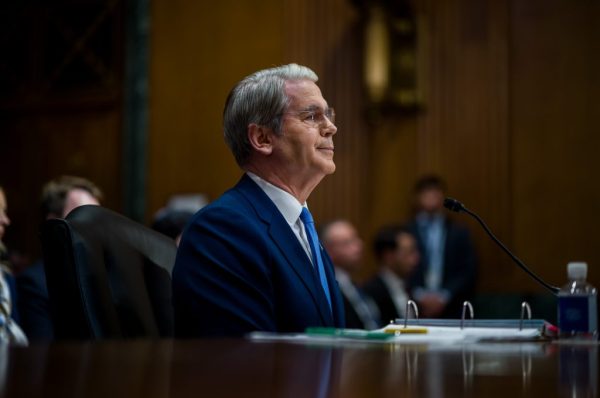
Vice President JD Vance said Treasury Secretary Scott Bessent has a plan to address the nation’s roughly $40 trillion debt, arguing the administration can grow the economy faster than the debt accumulates.
“[Bessent] has had a very discreet plan, of course, supported by the president of the United States, to get the United States to a point where our economy is growing faster than our debt,” Vance said on Newsmax’s Carl Higbie Frontline.
Recommended Stories

“And if you look, we are on track. So, even though the debt is too high, even though we inherited this debt bomb from the Biden administration, we actually do have a plan to get the economy growing faster than the debt, and that’s the most important thing,” Vance added.
Earlier this week, the Treasury Department announced the national debt had surpassed $40 trillion. Its chief, Bessent, said he believes the U.S. can grow its way out of the debt burden.
“There’s nothing magic about the $40 trillion number, and we can grow our way out of that,” Bessent told CNBC’s Squawk on the Street co-host Sara Eisen.
Bessent also attributed part of the recent increase to the temporary impact of tariff refunds mandated by the Supreme Court’s February ruling against President Donald Trump’s emergency tariffs. He said U.S. Trade Representative Jamieson Greer would implement tariffs at “the same level,” adding that he expects 2026 tariff revenue to be roughly comparable to 2025.
Bessent also argued that the $40 trillion figure does not fully capture the nation’s fiscal picture because the government itself holds a significant portion of the debt.
“But what we do want to signal is I think there’s been a lot of misinformation in terms of what’s going on with the deficit, what’s going on with the deficit to GDP,” he said.
The national debt has roughly doubled since the COVID-19 pandemic in 2020. More than $32.2 trillion is held by the public, including state and local governments, businesses and foreign governments, and businesses. The remaining roughly $7.8 trillion is held by the government itself, much of it in federal trust funds such as Social Security.
“Of debt held by the public, about 32% is owned by foreign entities, roughly 55% by private and public domestic entities, and about 14% by the Federal Reserve,” the Committee for a Responsible Federal Budget said.
The $40 trillion milestone has renewed debate over whether economic growth alone can put the nation’s finances on a sustainable path.
“This bleak milestone serves as yet another reminder that it’s past time to confront a fundamental mismatch,” Bipartisan Policy Center President and CEO Margaret Spellings said. “Our federal programs spend much more than the government takes in, and the biggest-ticket items in the federal budget are all running on autopilot.”
Spellings warned that the consequences are already being felt, arguing that rising federal debt is “raising the cost of living and choking out other spending and investment,” threatening the economy and Americans’ long-term prosperity.