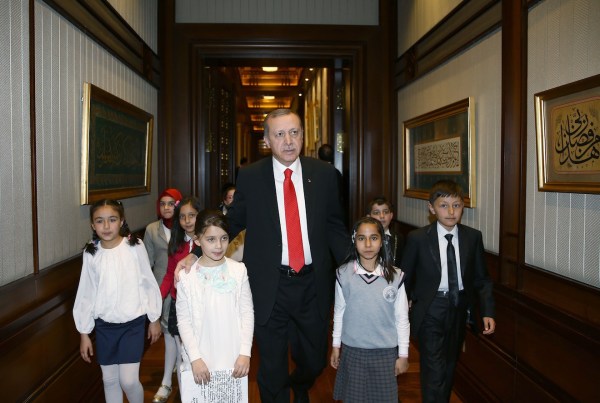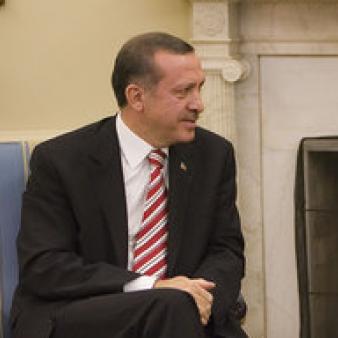
After almost a week of exchanging fire with Syrian troops across its southern border, Turkey finds itself embroiled on another, albeit related, international front. Wednesday the Turkish air force scrambled two jets to intercept a Syrian passenger jet flying from Moscow to Damascus. The plane, said Turkish prime minister Recep Tayyip Erdogan, was carrying “ammunition, and defense equipment,” presumably intended for Bashar al-Assad’s troops in their 20-month-long attempt to crush the uprising against the Syrian regime. Turkey’s foreign ministry explained that the pilot had been warned of Turkey’s intention to ground the plane, but he continued on his course, the F-16s forced the plane to land in Ankara, and now both Damascus and Moscow are demanding answers.
The question is, in the parlance of the White House, does Obama have Erdogan’s back? After all, the Turkish premier is said to be one of the international leaders closest to the president. Moreover, the White House once seems to have perceived this NATO ally as a strategic partner, one it has sometimes sided with against Israel, and to whom it subcontracted much of its Arab Spring policy. And yet over the last two years, Turkey has shown that its ability to project power in the Middle East is extremely limited. Nonetheless, the administration’s blandishments and encouragements, and later its reproaches and betrayals, have pushed Turkey out on a ledge, apparently alone. If some are gloating that a boastful Erdogan is finally getting his comeuppance with his troubles on the Syrian border, the fact is that the administration has let an ally, albeit a troublesome one, expose its weaknesses, a posture dangerous both to itself and American interests.