

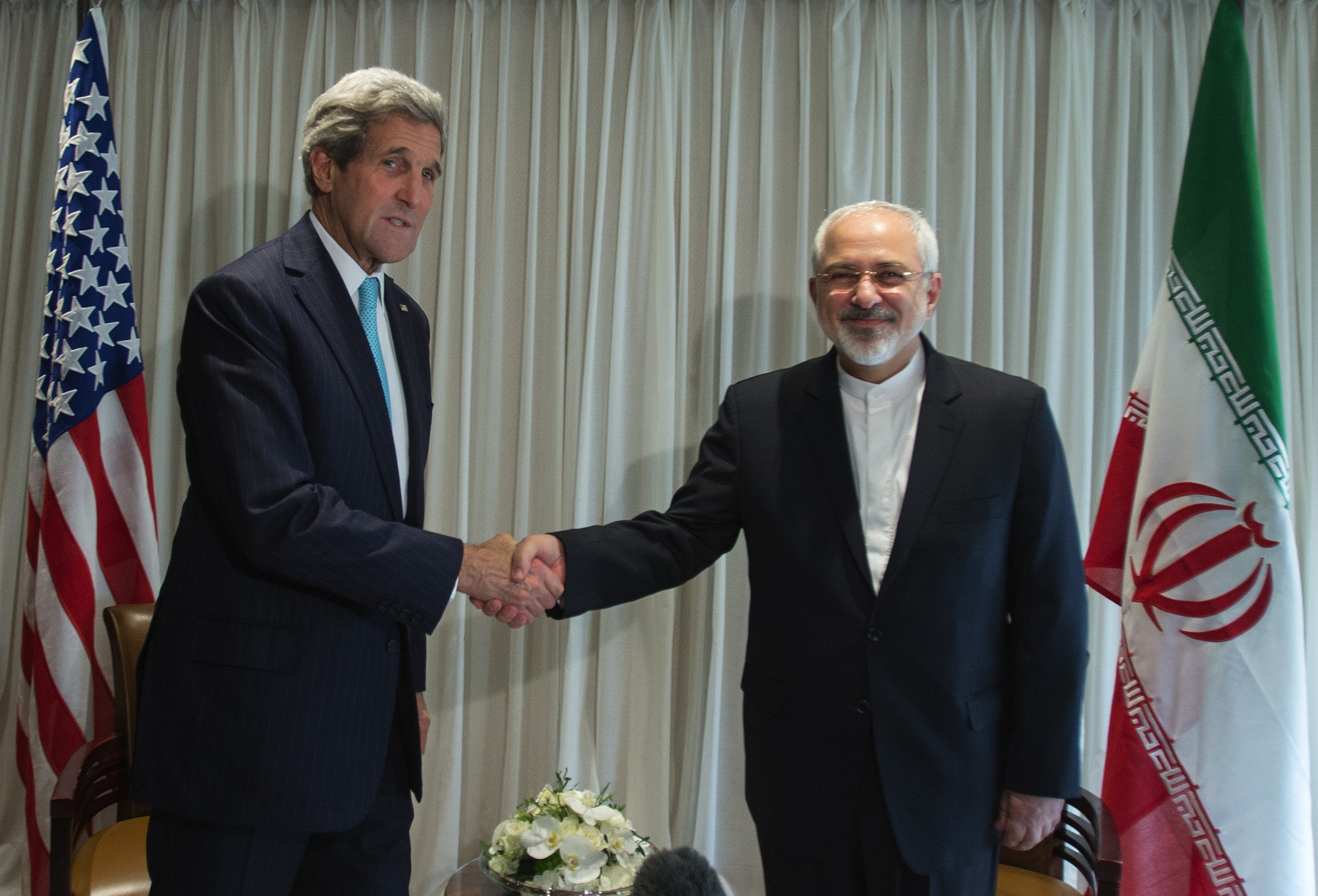
Iran and Russia are right. Or, at least, they are better interpreters of international law than the Harvard Law Review editor currently residing at 1600 Pennsylvania Avenue. After Iran test-fired multiple ballistic missiles last week, the Obama administration has been at pains to find a legal basis on which to condemn the launches and push for more international sanctions. They should have thought of that before negotiating away all meaningful international legal restrictions on Iran’s conventional weapons programs as part of last summer’s nuclear deal.
Iran twice test-fired ballistic missiles last week. First, two Qiam-1 missiles, with a range of roughly 420 miles. The next day, it upped the ante by launching two longer range (about 1,250 miles) Qadr H missiles at targets in the strategically important Gulf of Oman, simulating attacks on U.S. naval assets, and emblazoned with the ominous message: “Israel must be wiped off the face of the earth” in Hebrew. This was not the first such occurrence since the Joint Comprehensive Plan of Action (JCPOA) was negotiated in July 2015—Iran fired its Emad missile in October 2015 and the Ghadr-110 a month later—but it was the first since the so-called “Implementation Day,” on January 16, 2016, changed the legal landscape in which Iran operates.
Recommended Stories


Before the deal, the United States had led the world in constructing a stringent set of sanctions against Iran. Among them, United Nations Security Council resolution (UNSCR) 1929, passed in 2010, dictated that “Iran shall not undertake any activity related to ballistic missiles capable of delivering nuclear weapons, including launches using ballistic missile technology.” Yet, despite this clear-cut “shall not” imperative, White House press secretary Josh Earnest would only hazard that there were “strong indications” Iran violated UNSCR 1929 with the October and November launches.
The administration’s reaction to Iran’s most recent ballistic missile fires was almost identical and just as wrong, but for different reasons. “There are strong indications,” State Department spokesperson Mark Toner said, that these launches are “inconsistent with U.N. Security Council” obligations. Those obligations, however, are no longer defined by UNSCR 1929. Implementation Day not only brought JCPOA into full effect but so too one of the most damning concessions made by U.S. negotiators: the termination of all previous UN Security Council resolutions against Iran. In their place, UNSCR 2231 took effect.
This new resolution, Secretary of State John Kerry told the Senate last summer as Congress was reviewing the JCPOA, has “the same language as [UNSCR 1929]. We transferred it to this and that’s what it is.” Except it is not. Where 1929 expressly stated that “Iran shall not,” 2231 merely says, in an annex on page 99, “Iran is called upon not to undertake any activity related to ballistic missiles.” Thus, a mandatory restriction became a voluntary suggestion.
Russian ambassador to the United Nations Vitaly Churkin offered this helpful tutorial, “A call is different from a ban so legally you cannot violate a call, you can comply with a call or you can ignore the call, but you cannot violate a call.” Churkin, unfortunately, seems right. As is Iran when it asserts that it is now “fully entitled to build a credible conventional capability to deter and defend against any aggression.”
Yet, despite helping create this brave new world, in which aggressive Iranian military rearming is perfectly legal, the administration, and well-meaning members of Congress, is falling back on a well-worn, but outdated, reaction: more sanctions. Unilateral U.S. action, while perhaps satisfying, would have little impact on its own.
Penalties such as assets freezes, visa restrictions, or financial sanctions against a few companies wouldn’t have much effect when Iran is already flush with $100 billion in newly unfrozen assets, and has ample domestic missile capability or access to it. Nor could such U.S. sanctions form the foundation for stronger international action. If Iran cannot be shown to have done anything wrong legally, why would any country risk lucrative business with Tehran to stand with Washington on principle?
Such is the dangerous post-JCPOA world that Obama has recklessly created.
Bereft of legal and economic options, the only viable choice left for curtailing Iranian belligerence is the one that Obama long eschewed and tried to preclude: force.
The United States should warn Iran that it will shoot down any future ballistic missiles that it test fires, employing existing capabilities. Presidential candidates and Congress should issue this threat, as Obama certainly won’t, and the next president should make it policy. Some countries might howl, but our Middle Eastern allies would take heart, and would likely prove effective in hobbling the progress of Iran’s ballistic missile program.
Such a declaration would also send a strong signal of American determination to contain Iranian belligerence and prevent a nuclear Iran, and mark the first pivotal step in restoring American credibility that collapsed with the nuclear deal.
Michael Makovsky is president and CEO of the Jewish Institute for National Security Affairs (JINSA) and a former Pentagon official in the George W. Bush administration.
