
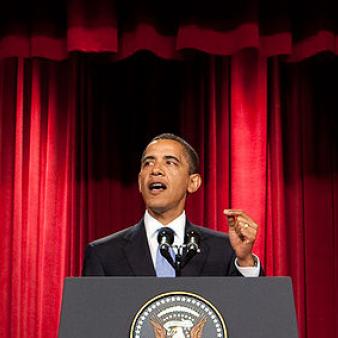
Lost in the debate over responding to Bashar al-Assad’s use of nerve gas is the fact that the United States has other interests in the Syrian civil war, like mitigating the effects of the war on Syria’s neighbors—Jordan, Turkey, Lebanon, Iraq and Israel—and countering the regional ambitions of Assad’s key ally, Iran. Unfortunately, the president has consistently failed to advance these arguments over the last two years. The White House has also been consistent in one other respect: It has repeatedly blamed others for its failures.
When the uprising began in March 2011, administration officials said their “tempered response” was driven by the fears of American allies, like Israel, Turkey and Saudi Arabia, that Assad’s “overthrow could unleash even wider sectarian violence.” This wasn’t true—the Israeli ambassador to the United States Michael Oren corrected the record—but that hardly stopped the administration from seeking to evade responsibility. Knowing that Russia would shoot down any forceful action against Assad, or even relatively strong resolutions at the U.N. Security Council, the White House repeatedly used the Russian veto by proxy. Thus, with the uncertain support on the Hill for military action against Assad, it’s hard not to think that Obama has merely looked to Congress to play the Kremlin’s part. Instead of making the call on his own, the president is looking to others to get him out of this jam—if you think it’s so important to uphold the credibility of the United States, then you do it. And if the strike goes pear-shaped, then your name is on this mess, too.
Real journalism.Trusted by millions.
Unlimited access to in-depth reporting, expert analysis, and the stories that shape our country.
Already a member? Log in