

President Donald Trump said the United States will “run” Venezuela until a “safe, proper, and judicious transition” of power could be arranged, but questions remain about what that could entail and how long that will take.
There are still unknowns about what such governance will include, such as whether Nicolas Maduro’s vice president, Delcy Rodríguez, who has since been sworn in as his successor, can be a willing partner to the Trump administration and enact the change the administration wants to see. She was initially defiant of the daring U.S. mission to capture the now-former dictator and his wife, but has since signaled more willingness to work with the United States.
“Venezuela reaffirms its commitment to peace and peaceful coexistence. Our country aspires to live without external threats, in an environment of respect and international cooperation,” she said on Sunday.
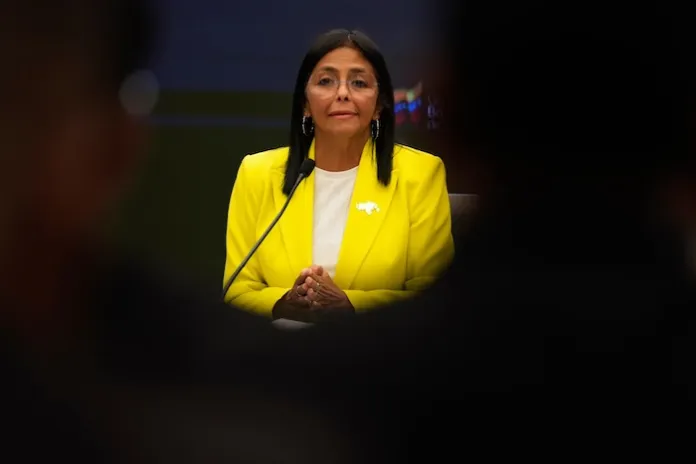
She continued, “We invite the U.S. government to collaborate with us on an agenda of cooperation oriented towards shared development within the framework of international law to strengthen lasting community coexistence.”
Trump plan focuses on top-down control over Venezuela
The question the United States now faces is how to parlay the successful abduction of Maduro into stability for Caracas and the region as a whole.
“What we witnessed was an extraordinary tactical military execution. But then, what we’re not seeing is any of the next-day planning that should have gone into something that significant. It feels very much as if the administration is improvising on what this means,” Heather Conley, a former State Department official now with the American Enterprise Institute, told the Washington Examiner.
“The system” the Venezuelan dictator operated is “continuing on without Maduro physically,” she added, noting that “it’ll be very interesting to watch this interim government — if they negotiate with the administration, or if they resist this and they repeat what Maduro did, [which] was to basically challenge the administration to take action.”
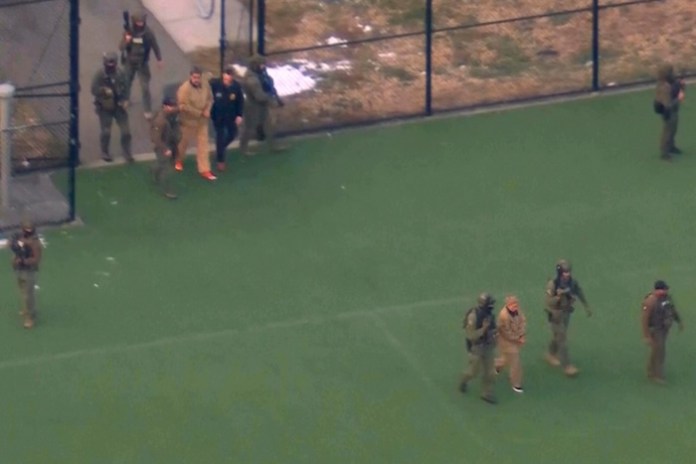
Trump has already warned that if those left in Caracas do not meet the U.S. demands, he could authorize additional operations inside the country and possibly deploy U.S. troops there.
“We are ready to stage a second and much larger attack if we need to do so. So we were prepared to do a second wave if we need to do so,” the president said. “We’re not afraid of boots on the ground.”
Secretary of State Marco Rubio sought to clarify the president’s remarks, saying the administration intends to use the U.S. oil blockade to leverage the Venezuelan government to acquiesce to its demands.
“What’s going to happen here is that we have a quarantine on their oil. That means their economy will not be able to move forward until the conditions that are in the national interest of the United States and the interest of the Venezuelan people are met. And that’s what we intend to do,” he said on ABC News on Sunday. “So, that leverage remains. That leverage is ongoing. And we expect that it’s going to lead to results here.”
Based on the comments from both Trump and Rubio, it appears the way in which the U.S. will “run” Venezuela is on a macro level, leveraging the country’s economy to force change without directly usurping the country’s remaining governing structure — for now.
“This is the same regime, it’s just not headed by Nicolas Maduro. It’s the same criminal regime. It’s the same people that run the military, who backed Maduro and now have formally backed Delcy Rodríguez. So they’re going to work with her, and they’re going to ‘run’ the country. … But I think what it really means is they’re going to direct policy, and they’re going to expect Delcy and her government to follow the US’s lead,” Christopher Hernandez-Roy, the deputy director of the Americas Program at the Center for Strategic and International Studies, said on Monday.
US operation in Venezuela differs from 2003 Iraq regime change
Hernandez-Roy speculated that the administration only captured Maduro and his wife, and not other high-ranking officials, to ensure they did not repeat “chaos” brought by the “decapitation of the power structure in Iraq,” following the U.S.’s 2003 invasion.
Steve Yates, a senior research fellow for National Security Policy at the Heritage Foundation, also noted the differences between this operation and the invasion of Iraq.
He told the Washington Examiner that while “we still have a lot of questions of which way the control over the military and others inside of Venezuela will go,” it will most likely look different from regime changes of the past.
“What we’re not doing is setting up a viceroy and engaging in a de-Ba’athification equivalent in their institutions,” he said. “That’s where I think some of the lessons of the Iraq War have been internalized and this is a different sequence that’s going to play out.”
Yates cautioned against the idea that the Trump administration is playing by ear with the future of Venezuelan governance, telling the Washington Examiner that “we don’t know that there wasn’t a hard and fast strategy for where to go in these contingencies — the administration has been planning for weeks, if not months, about different ways the situation in Venezuela could go.”
“It makes just rational sense if you’re navigating through an uncertain period. You have your preferred outcomes and you’ll put your muscle behind the things that would work best for your equities,” Yates said. “But there probably are a range of scenarios where the Trump administration has devised plans where we can get enough out of this exercise to claim a better trajectory on energy security, a better trajectory on shaping things in the region.”
It doesn’t end with Maduro
Trump appears emboldened after the success of the Maduro capture operation, threatening other Latin American leaders who are not cooperating with the United States, particularly those in Colombia and Cuba.
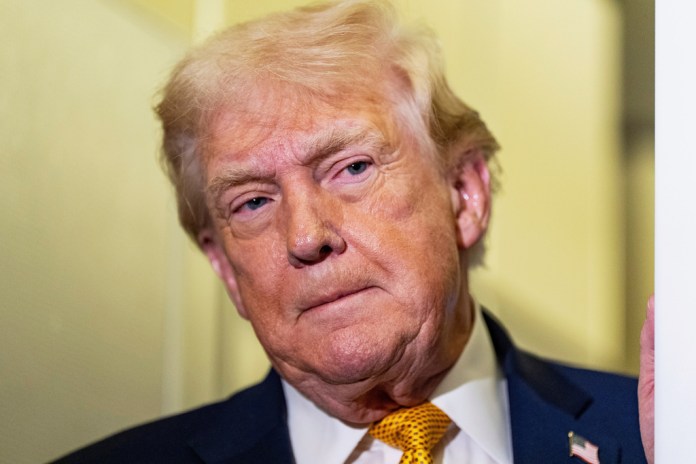
“Colombia is very sick too, run by a sick man who likes making cocaine and selling it to the United States. And he’s not going to be doing it very long, let me tell you,” Trump said Sunday aboard Air Force One about Colombian President Gustavo Petro, while Rubio said on NBC News’s Meet the Press that the Cuban government is “in a lot of trouble.”
TRUMP SIGNALS HE COULD TAKE ACTION ON CUBA, COLOMBIA, AND OTHER COUNTRIES AFTER VENEZUELA
Alternatively, the U.S. has a working relationship with Mexican President Claudia Sheinbaum Pardo, but drug cartels in her country are the primary producers of fentanyl smuggled into the United States, and, as such, remain a significant concern for the administration.
“You have to do something with Mexico,” Trump said. “We’re going to have to do something. We’d love Mexico to do it — they’re capable of doing it — but unfortunately the cartels are very strong in Mexico.”
