

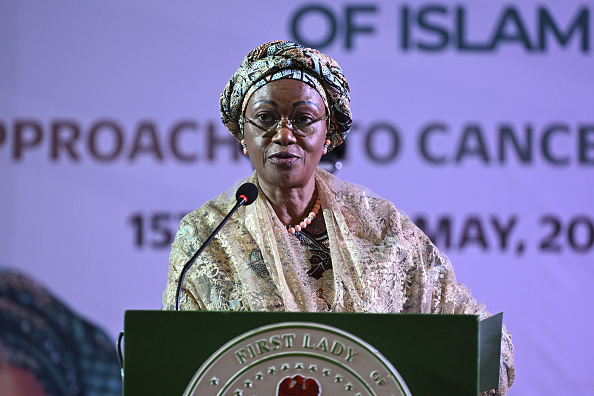
EXCLUSIVE — The security problems facing Nigeria are too complex to be considered an intentional persecution of Christians, the country’s first lady, Oluremi “Remi” Tinubu, believes.
Tinubu, who is both a former senator in the country’s upper chamber as well as an ordained Christian assistant pastor herself, disagreed with the characterization charged by President Donald Trump and several others, and said the allegations are a “form of propaganda to an extent.”
She doesn’t dispute the serious security threat and violence that has beset her nation and believes American support can greatly help them but believes its root causes and victims cannot be boiled down to a persecution of Christians. Both Christians and Muslims have been victims of the terrorist attacks, kidnappings, violence over land and crops, as well as broad sectarian tensions.
“We have a problem. We can’t say we don’t,” she told the Washington Examiner in an interview. “We’re trying to make sure that the country becomes a country, that people feel safe, that every life means something. There’s no life that is worth taking so that everyone is secured. So that is what we’re trying to do as a nation.”
Nigeria, at more than 230 million, is the most populous country in Africa. Roughly 50% of the country is Muslim, and slightly fewer are Christian, about 48% of the population, according to a 2023 State Department report on religious freedom in the country, which cited data from the Pew Research Center.
The United Nations top humanitarian official in the country, Mohamed Malik Fall, said last month, “security remains one of Nigeria’s major challenges,” adding, “attributing this violence to the targeted persecution of a religious group — I would not take that step.”
The divided country is represented by a similarly divided presidential household. While the first lady is Christian and a pastor, her husband, President Bola Tinubu, is a practicing Muslim.
There is no state religion, and like the U.S., there is freedom of religion in Nigeria.
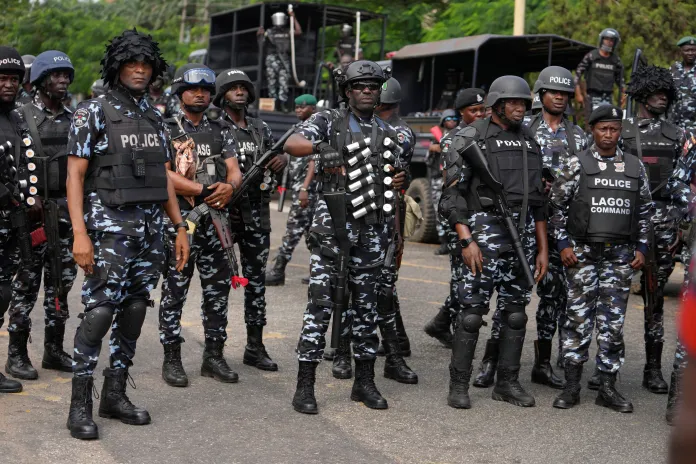
Designated terrorist groups, including Boko Haram and a faction within it that pledged alliegance to ISIS called Islamic State West Africa Province, are prolific in the northern part of the country primarily, whereas there is a different kind of violence in what’s colloquially known as the “Middle Belt,” where Christian farmers do at times come under assault from nomadic Muslims, known as the Fulani.
The country has become a source of attention due to the narrative that Christians are being singled out and targeted. Figures in the U.S., both activists and members of Congress, pushed President Donald Trump to come to their defense.
Rep. Riley Moore (R-WV) introduced a House Resolution condemning the persecution of Christians in Muslim-majority countries after a terrorist attack in Nigeria last year. Moore met with Caleb Mutfwang, the governor of the Plateau state in Nigeria, this week and he said afterward that he “remain[s] committed to working with the Nigerian government in coordination and cooperation to address these security and economic challenges, especially the persecution our Christian brothers and sisters face.”
Since the fall, Trump has spoken out over the issue, declared them to be a Country of Particular Concern under the International Religious Freedom Act on Oct. 31, and then authorized military strikes targeting locations in the northern part of the country on Christmas Day.
When Trump announced the strikes, he said, “I have previously warned these Terrorists that if they did not stop the slaughtering of Christians, there would be hell to pay, and tonight, there was.”
He has since said he was open to additional U.S. strikes if needed.
“The Tinubu government has also realized that it won’t get anywhere arguing publicly with Trump about the supposed Christian genocide, so they’ve adopted a more pragmatic approach we’ve seen many other foreign governments take, which is public praise of Trump coupled with Beltway lobbying,” James Barnett, a research fellow at Hudson Institute who lives in Lagos, Nigeria, told the Washington Examiner.
The U.S. military dispatched a small team of officers to Nigeria, General Dagvin R.M. Anderson, the head of U.S. Africa Command, said this week, but he did not specify how long they had been there or how long they would stay.
The Nigerians themselves have also taken several steps recently to curb such attacks, while the United States Africa Command is supporting their counterterrorism efforts.
In January, President Tinubu announced they would deploy additional military and police forces to reinforce local security, expand patrols and rapid-response coverage, and improve operational coordination and intelligence-led operations to dismantle terrorist and criminal networks. He also ordered enhanced security for houses of worship.
“The Nigerians and U.S. military have found common ground centered on increased U.S. material and intelligence support for Nigerian counterinsurgency efforts,” Barnett said.
Armed extremists killed more than 160 people during attacks on two villages in western Nigeria on Tuesday, Mohammed Omar Bio, a member of parliament who represents the area where the attack took place, told the Associated Press. There was a separate attack that killed more than a dozen people in the village of Doma, while armed extremists killed at least 36 people last week during separate attacks on a construction site and on an army base.
Earlier this week, the Nigerian Federal High Court in Abuja filed 57-related terrorism charges against nine people suspected of being involved in the June 13, 2025, massacre targeting the Yelwata community that left roughly 150 people dead.
Oluremi Tinubu said two of the biggest areas of possible cooperation between her country and the United States are security and trade, but the former must come first to enable the latter.
TRUMP SENDS TROOPS TO NIGERIA AFTER CHRISTMAS DAY OPERATION
“We need a lot of bilateral trade relationships with other countries,” she said. “We want to make sure that the relationship is back, and then the U.S. is a huge economy that will rightly welcome. There are things that we can do together.”
Nigeria is a mineral-rich country containing several critical minerals such as lithium, gold, and uranium, though this has also become a source of violence as people try to secure a share. If the U.S. helps Nigeria stabilize its security situation, the African nation could become a key partner for the U.S. as it tries to reduce its dependence on China for critical minerals.
The U.S. is pushing to form a trading bloc among allied countries to set price floors and coordinate financing on critical minerals to counter China’s grip on the market, Vice President JD Vance said on Wednesday at the State Department’s Critical Mineral Ministerial.
