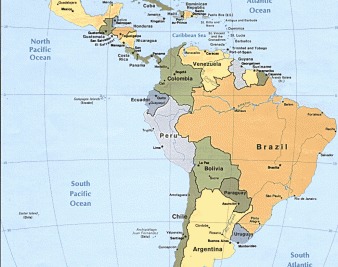
In her remarks to the 41st Washington Conference on the Americas this past May, Secretary of State Hillary Clinton declared the Western Hemisphere “vital” to U.S. interests, adding that Latin America and the United States “will rise or fall together in the 21st century.” Unfortunately, the Obama administration has yet to champion a regional initiative that matches Secretary Clinton’s lofty rhetoric.
Its neglect of Latin America reflects a bipartisan problem: Quite simply, neither Democrats nor Republicans are sufficiently attuned to hemispheric issues. Indeed, 50 years after President Kennedy created the Alliance for Progress, and two decades after the Cold War ended, Latin America is often treated as an afterthought in U.S. foreign policy discussions. While President Obama deserves credit for finally sending the Bush-era Colombia and Panama trade accords to Capitol Hill (where, thanks to the GOP, they received congressional approval last week), he has not promulgated a clear vision for hemispheric trade liberalization, and the broader U.S. trade agenda remains stalled. By way of comparison, Ronald Reagan established the Caribbean Basin Initiative (CBI), which delivered considerable trade benefits to countries in Central America and the Caribbean. George H. W. Bush made some of the CBI trade preferences permanent and launched the negotiations that eventually produced NAFTA. Bill Clinton signed NAFTA into law and enhanced the CBI preferences. George W. Bush signed a multilateral trade pact with Central America and the Dominican Republic (CAFTA), plus bilateral pacts with Chile, Peru, Colombia, and Panama.