

New nutrition guidance from the Trump administration advises that people completely cut out added sugars, prioritize protein, curtail consumption of highly processed products, and embrace whole foods.
On Wednesday, the Agriculture Department and the Department of Health and Human Services released the Dietary Guidelines for Americans, a policy document issued every five years that not only serves as general health recommendations but also governs federal food programs, including food stamps and the school lunch program.
“Today marks a decisive change in federal nutrition policy made possible by President [Donald] Trump’s leadership and the work of MAHA moms and public health advocates who demanded reform,” HHS Secretary Robert F. Kennedy Jr. told reporters on Wednesday.
He called the guidelines “the most significant reset in federal nutrition policy in history” and said that “our government has been lying to us to protect corporate profit-taking, telling us that these food-like substances were beneficial to public health.”
During the announcement, made before a briefing by White House press secretary Karoline Leavitt, Kennedy underscored the implications of the guidelines: HHS’s recommendations inform federal feeding programs, including Head Start, affecting 45 million school lunches every day, in addition to meals for 1.3 million active-duty service members and food served to 9 million veterans in Department of Veterans Affairs hospitals.
Kennedy was accompanied by Agriculture Secretary Brooke Rollins, Centers for Medicare & Medicaid Services Administrator Mehmet Oz, and Food and Drug Administration Commissioner Marty Makary.
Kennedy has said that the DGAs are a vital piece of his Make America Healthy Again agenda, using nutritional health as a foundation for tackling the chronic disease epidemic, including obesity, diabetes, cardiovascular disease, and other metabolic health conditions.
The DGAs of years past have been multihundred-page documents with detailed portion recommendations, but the text provided to the press ahead of the announcement is less than 6 1/2 pages of dietary recommendations.
Kennedy said on multiple occasions in the months leading up to the announcement that the 2026 to 2030 DGAs would be significantly pared down, such that people can interpret the scientific information and make more informed decisions about their own health.
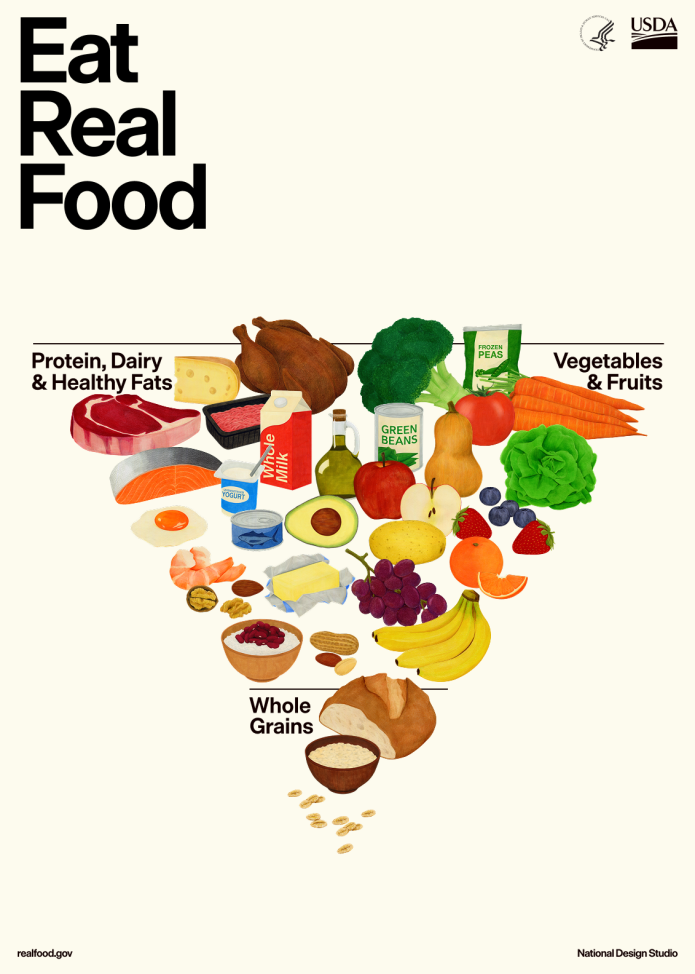
The recommendations themselves are not a strong deviation from the majority of MAHA objectives communicated during the first year of the Trump administration, particularly the emphasis on whole foods instead of what the document calls “highly processed foods.”
The administration did not use the politically charged phrase “ultra-processed foods,” which does not have a formalized definition. Instead, the document describes what ingredients to avoid, including artificial dyes and sweeteners.
“Avoid highly processed packaged, prepared, ready-to-eat, or other foods that are salty or sweet, such as chips, cookies, and candy that have added sugars and sodium (salt),” the document reads. “Instead prioritize nutrient-dense foods and home prepared meals. When dining out, choose nutrient-dense options.”
Protein consumption features prominently in the recommendations, advising 1.2 to 1.6 grams of protein per kilogram of body weight per day, varying by age. This is significantly higher than the previous HHS Recommended Dietary Allowance of 0.8 grams of protein per kilogram of body weight daily.
The document stresses the importance of decreasing carbohydrate consumption, particularly for people with metabolic diseases such as obesity and diabetes, and elevates full-fat dairy as “an excellent source of protein, healthy fats, vitamins, and minerals.”
Although Kennedy has been an evangelist for animal-based fats, such as beef tallow, as opposed to seed oils, the DGAs do not prioritize any single type of nutrient-dense fat over another.
They also recommend that saturated fat consumption should not exceed 10% of total daily calories and that “significantly limiting highly processed foods will help meet this goal.”
The guidelines also say that “no amount of added sugars or non-nutritive sweeteners” is recommended for a healthy diet, recommending that each meal should contain “no more than 10 grams of added sugar.”
Limiting excess sugar is particularly important for children, according to the guidelines, which state that “no amount of added sugars is recommended” for children from infancy to 10 years old.
Administration officials said ahead of the announcement that the new guidelines would be a significant departure from the Biden administration’s focus on so-called “health equity.” The Trump administration instead will focus explicitly on health outcomes in its dismantling of initiatives based on diversity, equity, and inclusion.
“The purpose of our Dietary Guidelines is to make recommendations on optimal nutrition to educate Americans and impact federal procurement programs,” the press release reads. “When DEI impacts nutrition science, it enables special interests to argue the status quo is acceptable because it would violate ‘health equity’ principles to encourage Americans to eat healthier food.”
The American Medical Association, which has been at odds with Kennedy and other administration officials on various other MAHA issues, issued a statement in support of the new dietary guidelines.
AMA President Bobby Mukkamala said in a statement provided to the press via the White House that the new guidelines “affirm that food is medicine and offer clear direction to patients and physicians can use to improve health.”
“The American Medical Association applauds the Administration’s new Dietary Guidelines for spotlighting the highly processed foods, sugar-sweetened beverages, and excess sodium that fuel heart disease, diabetes, obesity, and other chronic illnesses,” Mukkamala said.
HHS CURTAILS CHILDHOOD VACCINATION SCHEDULE
The AMA announced that, in conjunction with the new federal guidelines, the medical organization would be launching a collection of new educational resources for physicians as well as hosting a series of roundtable discussions with physicians, nutrition experts, and public health leaders to provide more specific recommendations for practitioners.
“The AMA is focused on helping physicians translate this science into everyday care and helping patients improve their overall health,” Mukkamala said.
