

The U.S. population is expected to begin shrinking by 2056 due to decreasing birth rates and immigration, according to projections over the next 30 years from the nonpartisan Congressional Budget Office.
The CBO’s thirty-year demographic report, published Wednesday, projects that the population will increase slightly over the next three decades, due largely to immigration, but will level off and begin to shrink in 2056.
Population decline has been a topic of great concern in recent years for political figures, including tech billionaire and Trump insider Elon Musk, and economists, who view it as a threat to stability and growth.
The CBO based its predictions on current federal spending levels and the outlook for the U.S. economy, as well as trends in fertility rates, mortality rates, and immigration. The total U.S. population is expected to increase from 349 million in 2026 to 364 million in 2056, but is predicted to decline from there.
CBO analysts predict that the average population growth rate will slow from 0.3% per year over the next decade to only 0.1% thereafter.
By 2030, CBO estimates that the annual death rate will outpace births due to declining fertility rates, with the overall population continuing to grow only because of immigration.
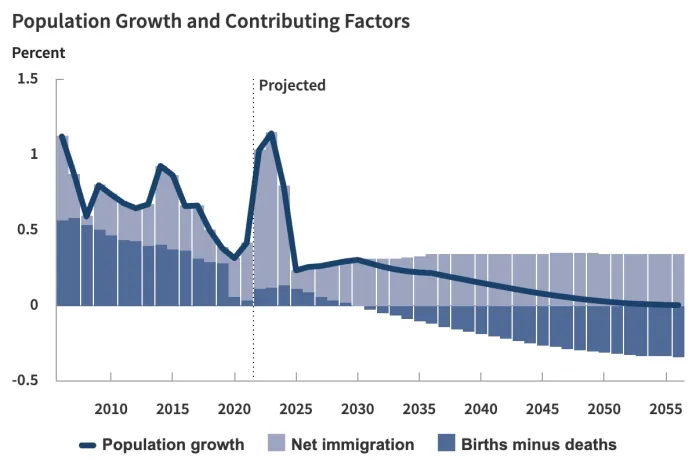
“Over time, the negative net contribution of births and deaths increasingly offsets the positive contribution of net immigration, until population growth slows to zero in 2056. The population is projected to shrink thereafter,” the CBO report reads.
Birthrates in the U.S. and many developing countries have been falling steadily for the past several decades, but the severity of CBO’s projections is new.
The CBO’s September demographic report did note that the U.S. population would begin shrinking without the effects of immigration, but it did not explicitly predict a shrinking total population within the next 30 years.
Part of the reason for the decline in population is that women are delaying having children until later in life. In 2023, the average age of a first-time mother reached 27.5 years old, up from 26.6 in 2016, according to the Centers for Disease Control and Prevention.
One reason for delaying childbearing or having fewer children is the high costs. Financial firm Northwestern Mutual estimated in September 2025 that it could cost roughly $320,000 in 2025 dollars to raise a child from birth to age 18, using inflation-adjusted data from the U.S. Department of Agriculture.
However, if women only begin having children later in life, they will not be able to produce as many offspring during their remaining reproductive years.
CBO’s new report estimates that the total fertility rate, or the number of children born to a woman, is expected to shift in favor of older mothers over the next three decades.
For women under 30, the rate is projected to fall to 0.6 in 2050, compared to 0.74 in 2026. For women over 30, the expected increase ranges from 0.85 to 0.93 births per woman.
CBO predicts that after 2046, immigration is likely to grow at roughly the same rate as total population growth, at roughly 0.02%, but the agency admits that immigration rate predictions could wildly differ in the next 30 years “because of future legislative or administrative actions or changes to enforcement policies.”
Counteracting population decline by increasing American births has been identified as a priority by President Donald Trump.
ALCOHOL GETS MORE LAX TREATMENT IN MAHA DIETARY GUIDELINES FROM RFK JR.
The Trump administration’s pro-family agenda includes tax-advantaged savings accounts for babies born between January 2025 and December 2028 as well as improving access to in vitro fertilization and fertility care.
