

Gov. Gavin Newsom (D-CA) put pressure on local governments Monday, strongly warning that California could withhold funding from counties he says are failing to implement his signature mental health initiative properly, CARE Court.
Frustrated by what his administration views as uneven participation across the state, Newsom singled out Los Angeles, San Francisco, Orange, Santa Clara, San Bernardino, Kern, Riverside, Yolo, Monterey, and Fresno counties, accusing them of lagging in using the court-based program designed to steer people with severe mental illness into treatment.
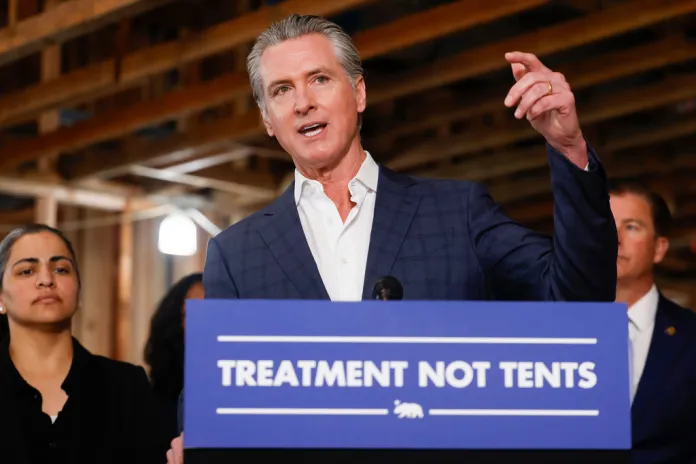
“I’m happy to redirect every damn penny in these programs to the counties that are getting things done, period, full stop,” Newsom said during a news conference. “Unless they stop doing what they’ve done. Don’t make any more excuses.”
Launched in 2023, CARE Court, which stands for Community Assistance, Recovery, and Empowerment Court, allows judges to order treatment plans for people experiencing serious mental health crises, particularly those living on the streets or cycling through emergency systems after traditional services have failed. The program expanded statewide by December 2024 after an initial rollout in eight counties.
Newsom specifically pointed to San Francisco’s program as among the state’s poorest performers, part of a broader push by his administration to accelerate results after months of criticism that the initiative has fallen short of expectations.
“Through CARE Court, we have seen inspirational stories of recovery and resilience, but many counties continue to lag behind their peers,” Newsom said in a statement. “We will not accept failure and excuses when lives are on the line.”
The renewed scrutiny follows a recent San Francisco Chronicle investigation detailing the death of a man shortly after he was denied entry into the city’s CARE Court program, intensifying debate over how effectively the system is working.
Local officials quickly pushed back. Orange County disputed Newsom’s characterization, with the county’s Health Care Agency telling CalMatters in a statement that “Orange County is utilizing the CARE intervention fully.”
The program was designed to reach some of California’s most vulnerable residents — people suffering from psychosis who are unable to care for themselves and often remain unhoused despite repeated contact with public systems. But early results suggest adoption has been slower and more limited than state leaders initially projected.
A CalMatters investigation found the program has served far fewer people than anticipated, leaving some families frustrated after turning to CARE Court as a last resort for relatives struggling with severe mental illness. The report also identified persistent obstacles in moving participants from treatment into stable housing.
State data underscore those challenges. Through January, California had received 3,817 CARE Court petitions filed by family members, first responders, or behavioral health providers seeking help for someone in crisis. Judges approved 893 voluntary treatment agreements, according to California Health and Human Services Secretary Kim Johnson.
NEWSOM BOOK TOUR MISSTEPS EXPOSE NATIONAL CAMPAIGN ‘GROWING PAINS’
Only 32 people have been placed into court-ordered CARE plans — a step judges can take when participants refuse or fail to comply with voluntary treatment arrangements.
The gap between expectations and outcomes now places one of Newsom’s most closely watched policy initiatives at a crossroads, as the governor signals he is willing to use financial leverage to force faster implementation across the state.
