

Officials with the Centers for Disease Control and Prevention are working with the World Health Organization to monitor several cruise ship passengers who have returned to U.S. soil for infection with hantavirus, a rare but fatal respiratory infection.
Five passengers aboard the MV Hondius cruise ship sailing the Atlantic Ocean have died following suspected hantavirus infections, according to an update from the WHO on Thursday morning.
Recommended Stories


The outbreak involves a strain of hantavirus from the Andes region in South America. Hantaviruses are typically spread through contact with infected rodent urine, droppings, or saliva, but scientists suspect that the Andean variant of the virus can also be spread through close human-to-human contact.
If left untreated, hantavirus infections can progress rapidly and result in low blood pressure, low oxygen levels, and eventually death by organ failure.
Oceanwide Expeditions, which operates the MV Hondius, reported on Thursday that at least 29 living passengers from 12 countries disembarked the ship and went home after the death of the first passenger onboard but before officials knew of the hantavirus outbreak.
Those countries are Canada, Denmark, Germany, the Netherlands, New Zealand, Switzerland, Sweden, Singapore, Saint Kitts and Nevis, Turkey, the United Kingdom, and the United States.
Public health officials in several states, including Georgia, Arizona, and California, have confirmed that they are monitoring passengers who disembarked the ship early but are showing no symptoms. MedPageToday reported that other American passengers have returned to Texas and Virginia.
Health officials have said that the threat to the general public remains low and does not pose the risk of a global pandemic such as that of COVID-19 in 2020.
The CDC issued a statement late Wednesday evening saying the Department of State is “leading a coordinated, whole-of-government response” to confirm the safety of all U.S. passengers returning home, including diplomatic coordination.
“As the world’s leader in global health security, the US government is using our premier health experts to guide our response to this evolving situation,” the CDC statement reads. “We are working closely with our international partners to provide technical assistance and guidance to mitigate risk.”
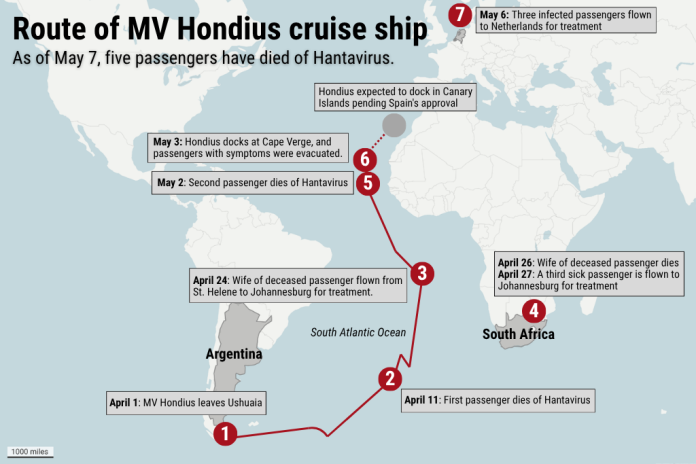
The Health and Human Services Department did not immediately respond to questions from the Washington Examiner as to how many citizens are expected to return to U.S. soil from the roughly 150-passenger cruiseliner.
It is unclear how the U.S. will navigate the global public health incident after having officially withdrawn its membership from the WHO.
President Donald Trump signed an executive order on his first day back in office last year to begin the process of removing the U.S. from the international organization. The final process for doing so was completed earlier this year.
But because the U.S. is still a member of the United Nations and has signed onto global health treaties, the U.S. is still bound by international law to collaborate at least somewhat with the WHO.
WHO Director Dr. Tedros Ghebreyesus told reporters Thursday morning that collaboration with the U.S. has been relatively unchanged.
WHO SUSPECTS HUMAN-TO-HUMAN SPREAD OF HANTAVIRUS ON ATLANTIC CRUISE SHIP
“As we speak, things are going actually as it used to be, freely sharing information from outside and also with getting information from the U.S. side,” Ghebreyesus said.
Ghebreyesus also said the WHO plans to “continue to collaborate from our side and to continue to give information.”
“The WHO mission is to, you know, help the world be safe,” Ghebreyesus said. “And our mission includes the U.S. We want the American people to be safe as well.”
