

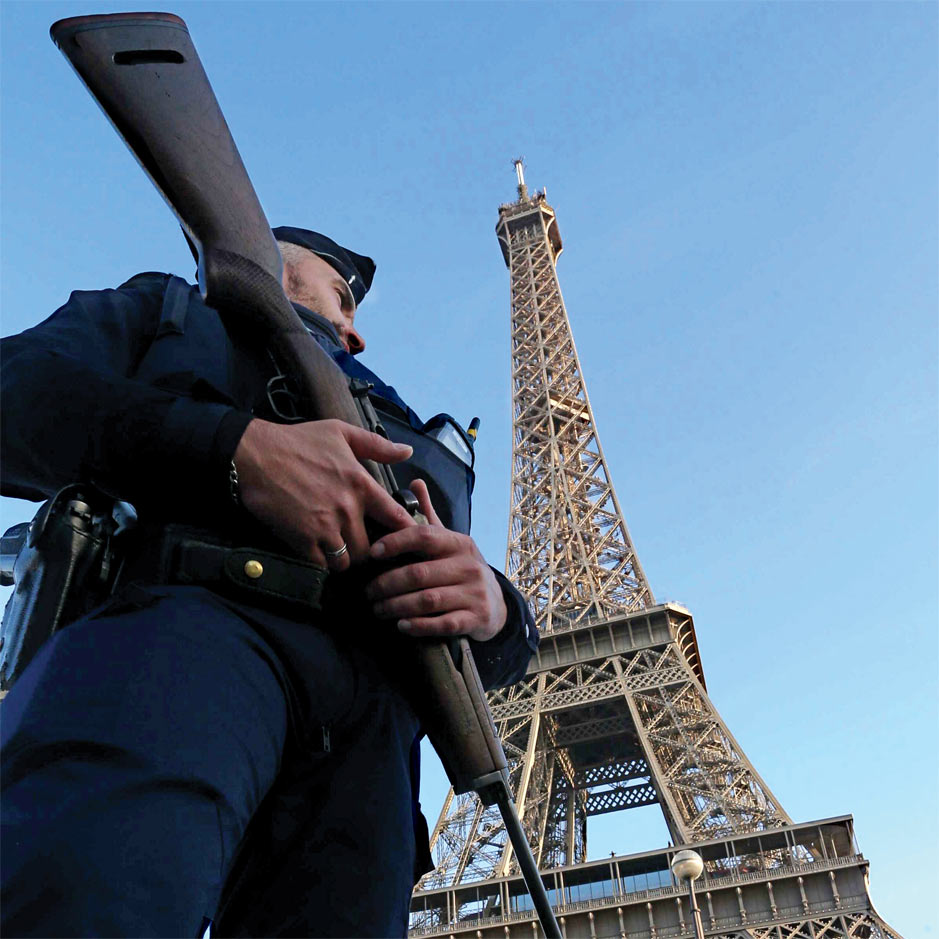
If Europe doesn’t get serious about protecting its borders, it’s going to head back to the days of barbed wire and concrete walls. That’s what President François Hollande warned when he went before a rare joint sitting of France’s National Assembly and Senate to argue for an extended three-month state of emergency. His warning came in the wake of the half-dozen simultaneous bomb and machine-gun attacks in Paris on November 13, claimed by the Islamic State (ISIS), that left at least 130 dead.
Hollande’s standing with his countrymen has had something in common with that of Barack Obama. He came to power to replace a right-winger the broad public had come to loathe, in this case Nicolas Sarkozy. And Hollande soon settled into a pattern of permanent unpopularity that has left the man in the street counting the days till he leaves office, and the politically minded migrating steadily towards the opposite ideological pole. Marine Le Pen’s right-wing National Front has for long stretches of the Hollande era been the most popular party in the country. Conservative former labor minister Xavier Bertrand called for the establishment of special tribunals for jihadists.
Recommended Stories


For now, it is easy to understand why Hollande is asking for emergency powers but hard to tell how he will use them. The new law would allow expanded use of house arrests, warrantless searches of computers, new airline security programs, and surveillance of various social groups. This week, police fired 5,000 rounds of ammunition into an apartment building in the city of Saint-Denis, north of Paris, in a raid that killed the ringleader of the November 13 attacks. It appears that Hollande, who describes France as being in a state of war, has been swept up in the security-consciousness of his countrymen.
But the situation is ambiguous. Europe—or at least the Western European politicians who claim to speak in its name—is managing two emergencies at once: terrorism and a mammoth overland migration of millions of Muslims, mostly young men. Some are refugees from the Syrian war. Others pretend to be such refugees in order to ease their path to political asylum. Almost assuredly these migrant flows will harbor a certain number of people who would be deemed terrorist threats. In a sense, Hollande is pursuing hard measures—like ransacking apartments in the slums—that would protect the French people from terrorists. In a sense he is avoiding hard measures—like repudiating once and for all Europe’s system of porous borders—and thus protecting the French political class from the judgment of the French people. He is also dodging the judgment of financial markets, using the attacks to wriggle out of the austerity budgets that the common European currency, the euro, has imposed on France’s state finances. (“The security pact,” Hollande says, “takes precedence over the stability pact,” as the budgetary targets are called.)
Hollande is not the only Western leader who is trying to insulate himself from accountability to voters as he deals with terrorism on one hand and seeks to avoid dealing with mass migration on the other. President Obama, speaking in Turkey, used his platform in Antalya not to deplore the Paris attacks but to belittle those of his fellow Americans who saw them as a reason to increase the vetting of would-be migrants from the Syrian war. This was the same week Turkish soccer fans booed the moment of silence for the victims of the Paris attacks and shouted Allahu akbar!
Chancellor Angela Merkel in Germany has used the Syrian war as the occasion to launch a demographic revolution. Her estimate that Germany could receive 800,000 migrants in a year (a number that vastly exceeds the number of German births) has sped the onrush of Middle Easterners into Europe since August. This migration has been extremely unpopular in certain sectors of German society. There has been a great deal of violence by migrants in refugee housing—and, by some counts, hundreds of attacks against such facilities, most of them in eastern Germany. At the end of August Merkel gave a press conference that has been remembered for its declaration that thuggery would not be tolerated. Its real significance was that it, too, declared a sort of state of emergency. Merkel warned that the crisis would continue not for days or months but for a much longer period. Under the circumstances, she said, Germany would have to relax its traditional punctiliousness about the rule of law: “It is important that we say German thoroughness is super, but now is the time for German flexibility.”
Thereafter, migrants started pouring into the country without identity checks or proper registration. Most of these people were not, in fact, Syrians, and therefore not entitled to settle. That didn’t stop them from doing so. In mid-November, employees of the federal migration office wrote a letter of complaint to Merkel that authorities were accepting as Syrian anyone who claimed to be Syrian and was vouched for by the translator attached to him. These translators are neither state employees nor under oath. They are usually recently arrived migrant kids themselves.
The press came to refer to the massive welcome to migrants as Merkel’s state of emergency (Ausnahmezustand). In an unfortunately timed cover story, Britain’s Economist published a paean to Merkel on the eve of the Paris attacks, calling her “The Indispensable European.” It unwittingly gave a good indication of the dim view of democracy in the EU. On migration, the magazine editorialized, “she has boldly upheld European values, almost alone in her commitment to welcoming refugees.” One is entitled to wonder how these values can be called “European” if one lady in Germany is “almost alone” in espousing them.
The European value the magazine seemed to value most was fecklessness. The arrival of millions of Muslim migrants into the lands of the European Union was taken almost as an unstoppable natural phenomenon. The EU’s officials in Brussels could do nothing to slow or deflect the flow, having eviscerated the governing institutions of once-capable nation-states like Germany and built nothing to replace them. (That is because the EU lacked the democratic legitimacy, and the budgets that go with it, to build such institutions.) This heartfelt dedication to the EU’s impotence mystifies all foreigners who encounter it. When Die Zeit interviewed Demetrios Papademetriou of the nonpartisan Migration Policy Institute in Washington, the interviewers asked only for confirmation that defending borders was futile. “Are there ‘good’ borders?” they asked. “Borders that protect states without being brutal? Can borders be secured?”
“Of course they can,” Papademetriou replied. “Almost every country on earth does it, and successfully. . . . Every time I talk to officials and politicians in Brussels, I’m shocked by how convinced they are that they can’t do anything to influence people’s migration patterns.”
The interviewers simply couldn’t absorb it. “How do you secure borders?” they pressed on. “The chancellor [Merkel] says, ‘Fences don’t help.’ ”
“That’s wrong,” Papademetriou said. And so the mutual incomprehension continued, across an entire newspaper page.
Naturally, European actions, or nonactions, have a huge influence on migration patterns. Muslims are moving out of Syria in the direction of Germany, first, because Europe is rich and, second, because it is choosing not to give meaning to its borders. Eventually it will have to defend itself, but for now Europeans would rather not think about such things. Consider how little thought went into this assessment of the situation by Alexander Betts of the Refugee Studies Center at Oxford, interviewed in the New York Times: “If Lebanon can host one million Syrians, despite being the size of Maryland,” Betts said, “a region the size of Europe should be able to host millions.” Aside from the obvious cultural differences he chooses to ignore, he is not reckoning with a couple of facts fundamental to his own field. The further from the site of conflict refugees are settled, the more likely they are, over the long term, to become permanent residents rather than temporary sojourners.
In Germany in particular, there is an impatience with the idea that migration might ever be bad, or unmanageable, or even problematic. The Tübingen mayor Boris Palmer, one of the most successful and well-known young Green party politicians, is pro-immigration. But when he expressed his doubts that Germany could absorb all the migrants Merkel had welcomed, many Greens urged that he be thrown out of the party. Simone Peter, the party co-chairman, wouldn’t go that far, but she thought he was hurting morale. “If Boris Palmer says we can’t manage it, then he calls into question the efforts of all of those working in the field,” Peter said. “That Boris Palmer is known well beyond Tübingen gives him a special responsibility. That is why I would hope he would get with the program and spread confidence.”
Even the opposition to migration has tended to be carried out within very politically correct parameters. Merkel’s center-right party rules in a “grand coalition” with the Social Democrats—this would be the equivalent of a Republican-Democrat government in Washington. The Greens and ex-Communists form the tiny opposition, and both support Merkel’s policy. So the only (slight) grumbling has come from the Christian Social Union (CSU), the wing of Merkel’s own party that is based in Bavaria and hence a bit more traditionalist and Catholic than her own Christian Democrats. The CSU leader Horst Seehofer has raised misgivings that the overwhelmingly young and male migrants will be allowed to bring their large families after them, changing a migration of 1 or 2 million people into a colonization of 10 million or more. So Merkel accepted that there would be no family reunification for migrants receiving “subsidiary protection.” This is a category that covers 181 of the refugees who have come so far, but not the other 999,819.
For this Seehofer gets called a rightist. Yet when Bavaria’s CSU finance minister Markus Söder tweeted “#ParisAttacks change everything. We shouldn’t allow uncontrolled illegal immigration,” Seehofer flew into his own censorious rage. “After such attacks as those in Paris,” he said in an interview, “it should be forbidden to stress personal and partisan views.” German government spokesmen have a hard time distinguishing between opposition to mass immigration on one hand and Nazism on the other. Actual protests against the party have been confined to the new, hardline Alternative for Germany party and to the East German anti-Muslim social movement Pegida.
The so-called right-wing press has shown just as little tolerance for unorthodox tweeting. Writer Matthias Matussek of the conservative Die Welt tweeted: “I’ll bet the terror in Paris shifts our own discussion over open borders and the quarter-million undocumented Muslim men in a new, and healthier, direction.” It cost him his job. Editor Jan-Eric Peters “distanced himself in the name of Die Welt” from Matussek and then fired him.
Outside the government and EU ministries, Europeans are rightly very worried about this migration, even in Germany, which is either the most pro-immigration country on the continent or the one that, for historical reasons, is least willing to avow its anti-immigrant sentiments. According to an Infratest-Dimap poll taken in early November, 71 percent want an upper limit to the total number of migrants (something Merkel resolutely refuses to give), 78 percent are worried about the increasing influence of Islam, and 87 percent fear a rise of the far right. By similar margins, they call for the introduction of a law that would require migrants to obey “basic German values.”
Germans seem to believe that all they have to do is insist newcomers respect, for instance, equal treatment of men and women and the right to change or leave one’s religion. These are the two main sticking points Europeans have when they consider Islam. It has pleased certain observers to claim the November 13 attacks in Paris as an attack by Puritans on hedonism or youth or sexual freedom, noting that the venues chosen, like the Bataclan concert hall, were places where young people met to party. The ISIS communiqué, read by Fabien Clain, a French Muslim from Toulouse, called Paris “the capital of abominations and perversions, the place that carries the banner of the cross in Europe.” But this would seem to identify Christianity as ISIS’s primary enemy. And who was Clain? An intimate of Mohammed Merah, the terrorist who murdered several Jewish schoolchildren and a rabbi in Toulouse in 2012. Clain spoke years ago about targeting the Bataclan. What interested him was not the tunes and the scene but its “Zionist” owners.
France was more or less capable of keeping at bay the radical part of its Muslim population until a couple of years ago, when its secret services had to monitor only, say, 800 or 1,200 bad actors. But continued immigration, and jihad, changed the balance of power. Now, according to the ministry of the interior, there are 11,700 with ties to the Syrian war, and the hard core has risen to 2,000. That is just too many to keep an eye on. On October 24 in Marseille, three worshipers on their way to synagogue were wounded in a knife attack. Days after the attacks on Paris, a Jewish school history teacher was stabbed by a group of three men waving a photograph of Mohamed Merah.
What exactly do European politicians think “values” are? Magic words that you just have to say in order to bring others to heel? No, values are another way of saying social power. A value is something that the state is willing to deploy its monopoly on legitimate violence to protect, as the German sociologist Max Weber would have put it. Europe is about to rediscover that it can preserve its values only to the extent it is willing to fight for them.
Christopher Caldwell is a senior editor at The Weekly Standard.
