
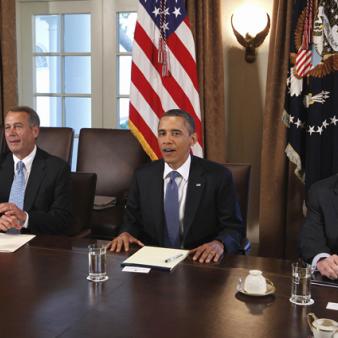
Congressional Republicans’ internal debate over how to respond to President Obama’s impending lawless executive amnesty is being characterized as a battle between “immigration hawks” and those who want “to show Republicans can govern.” But that description is inapt, and it does a disservice to the magnitude of the stakes. While the policy dispute is over immigration, this isn’t about policy. It should make little difference to congressional Republicans whether Obama were to use extralegal authority to grant amnesty to illegal immigrants, on the one hand, or to unilaterally repeal Obamacare on the other. Either way, he would be tearing our constitutional fabric — and no policy is important enough to justify violating our constitutional forms to achieve it.
In the debate over slavery — a policy whose importance would be hard to surpass — the first Republican president, Abraham Lincoln, and Supreme Court Justice Benjamin Curtis, in his wonderful Dred Scott v. Sandford dissent, refused to succumb to the temptation of prioritizing policy desires over our constitutional text and structure. As with the abortion debate in our own day, the Constitution didn’t decide the slavery question, and both men knew it. So while the Taney Court pretended that the Constitution decided that issue in favor of slavery, and while many abolitionists pretended that the Constitution decided the issue in opposition to slavery, both Lincoln and Curtis steadfastly insisted that both sides were in error: Both sides were prioritizing their own policy goals over what Lincoln called “the political religion of the nation.”
Real journalism.Trusted by millions.
Unlimited access to in-depth reporting, expert analysis, and the stories that shape our country.
Already a member? Log in