

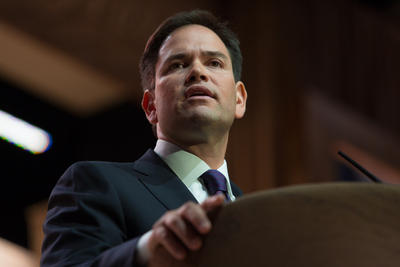
MIAMI — Two years removed from an immigration swoon, Sen. Marco Rubio is poised to enter the presidential sweepstakes a major contender reinvigorated by dogged focus and expertise on international affairs.
The Florida Republican’s 2013 drive to sell comprehensive immigration reform fell flat with many conservatives. Bipartisan “gang of eight” legislation Rubio negotiated cleared the Senate. But the GOP-controlled House rejected the bill, and grassroots activists who championed Rubio during his Tea Party-fueled 2010 Senate victory reconsidered their affection. At issue: the bill’s provision creating a conditional path to legalization and possible citizenship for illegal immigrants.
Recommended Stories


Some on the far right might never forgive Rubio for his “amnesty” heresy, despite a retooled approach that calls for implementing verified border security measures before relief for 11-12 million illegal immigrants is examined. But now, on the eve of his presumed White House launch, Rubio, 43, finds himself among the hottest tickets in a gradually expanding GOP field.
His foreign policy fluency, the product of passion and four years of study on the Senate Foreign Relations Committee, led Rubio back from the political brink. Republicans see the world in crisis and the U.S. flailing under President Obama’s velvet leadership. Rubio perhaps more than any in his party has given voice to that anxiety, and assuaged it by offering a vision that returns the U.S. to its role as the globe’s indispensable superpower.
“Marco has a thoughtful and strategic understanding of the geopolitical landscape,” said Adam Hasner, a Republican who served with Rubio in the Florida legislature. “No one can match him in articulating America’s role in the world, the value of freedom and the importance of standing with our allies — and all without a single note. It’s going to separate him from the pack.”
Over the past year, Americans have watched nervously the rise of the Islamic State; Russia’s invasion and annexation of parts of Ukraine; China claiming international waters for itself in the Pacific; and the Middle East descending into turmoil, driven by apocalyptic mullahs in Iran. Obama appears whipsawed, and for Republicans especially, there is hunger for steady leadership and the reassertion of strong U.S. leadership abroad.
The voters’ intense focus on overseas affairs and desire for U.S. re-engagement following the war-weary post-Iraq war years is a boon for Rubio. He’s a natural Republican hawk in the tradition established by President Ronald Reagan, and his background as the child of Cuban immigrants who disdained the Castro dictatorship of their native island nation informed his view from the earliest age that America is and should be an aggressive force for good in the world.
This image and background could uniquely position Rubio to offer the change of course Republican voters want — and to prosecute a case against presumptive Democratic nominee Hillary Clinton, Obama’s chief foreign policy lieutenant during his first term. Rubio’s foreign affairs aptitude could pay additional dividends, enabling him to overcome charges of inexperience stemming from the fact that, like Obama in 2008, he’s a first-term senator in his mid-forties with no executive experience.
The field of GOP contenders includes former governors Jeb Bush of Florida, Mike Huckabee of Arkansas and Rick Perry of Texas; and sitting governors Bobby Jindal of Louisiana and Scott Walker of Wisconsin. But possibly none of these more seasoned executives can trump Rubio’s detailed understanding of global hotspots, or compete with a travel itinerary that has taken him to Afghanistan, Kuwait, Pakistan, Malta, Libya, Spain, Germany, Haiti, Colombia, Jordan, Israel, London, Japan, the Philippines and South Korea.
“The world is literally falling apart, and it’s not getting better,” said Los Angeles attorney Robert C. O’Brien, a sought-after GOP donor who has yet to endorse a candidate. “This is what makes Rubio a very serious candidate.”
Rubio’s interest in domestic policy was always deep, extending far beyond immigration. Since arriving in the Senate in 2011, he has proposed several reform plans, usually in partnership with other Republicans, touching on kitchen table issues like taxes, economic growth, healthcare, and education. But it was on immigration reform that Rubio assumed his first leading role for the Republican Party on the national stage.
Obama’s 2012 re-election victory over Republican Mitt Romney was attributed to, among other things, the president’s 73-percent-to-27-percent advantage with Hispanics. Soon after, Rubio joined a bipartisan group of eight senators to write a comprehensive immigration overhaul. Rubio was the key player. He alone among the four GOP negotiators had Tea Party credibility; his participation gave the bill a fighting chance to succeed.
Rubio worked it, assuming the risk of selling the “gang of eight” plan to skeptical conservatives who abhor anything that resembles “amnesty.” He appeared everywhere in conservative media, from National Review Online to the airwaves of talkers like Mark Levin. They listened because they believed in the politician who defied his own party to challenge a sitting governor for the Republican Senate nomination.
To the country at large, Rubio was presented, courtesy of a Time magazine cover in February 2013, as “the Republican savior” who would help a party badly in need of reaching out beyond its shrinking base of white voters. The immigration bill ultimately died, largely due to opposition from grassroots conservatives who rejected Rubio’s pitch, and the defeat stunted his political momentum for a while.
But by last spring, Republicans were listening to him again as anxiety built over a world on fire. Rubio’s supporters believe this dynamic has only just begun pay off for the White House hopeful. Political analysts agree.
“Thing about immigration — it’s ceratainly out there and it’s going to be an issue. But I don’t think it’s going to be an issue for a lot of people,” said Amy Walter, national editor of the nonpartisan Cook Political Report. “The focus on foreign policy is good news for him. It puts some of his opponents in a tough position.”
