A group representing more than 3,000 sheriffs around the country told the Senate Wednesday that President Obama’s executive actions on immigration have created confusion among local law enforcement officers, and called on the federal government to rule on the constitutionality of those actions.
National Sheriffs’ Association Executive Director Jonathan Thompson testified at a Senate Judiciary subcommittee hearing and said sheriffs continue to be confused by the Obama administration’s Priority Enforcement Program, also known as PEP.
That program called for the priority removal of aliens who are suspected of terrorism or espionage, those caught crossing the border and those convicted of a felony. But it created two other groups of lesser priority that include aliens convicted of three or more misdemeanors, or one “significant” misdemeanor, such as sexual abuse, drug trafficking or other crimes.
Thompson said the new program doesn’t square with existing law, and said sheriffs shouldn’t be asked to comply with either the Obama administration or existing law.
“In my conversations with sheriffs across the country, it has become clear that the administration’s policies are putting sheriffs in an untenable position and, in the words of Chief Deputy Steve Henry of Pinal County, Ariz., ‘the current policies are institutionalizing systemic national security deficiencies,'” Thompson said in his prepared testimony.
He said sheriffs today face risks regardless of whether they ignore the administration, comply partly with Obama’s actions or comply in full. As a result, he said sheriffs are calling for a more firm legal analysis of Obama’s actions.
“Our request is simple: The president should instruct the attorney general to put forth a legal opinion on the constitutional questions surrounding the Priority Enforcement Program,” he said.
“To continue ignoring the questions simply furthers the view of some that the president does not support state and local law enforcement,” he added. “In the absence of a legal opinion, however, it is imperative that Congress pass meaningful legislation pertaining to criminal aliens.”
Thompson also stressed that the program is failing to protect people from criminal aliens.
“Too few criminal aliens are deported each year and the priorities for deportation are simply too narrow,” he said. “Even worse, some criminal aliens otherwise subject to removal end up released back into our communities for lack of travel documentation or other bureaucratic excuses.”
U.S. Immigration and Customs Enforcement Director Sarah Saldana testified at the same hearing, and in her prepared remarks, she defended PEP, and said it’s letting the government focus on top priority immigrants for removal. She also said it’s making the country safer.
“Over the past few years, ICE has refined its priorities to focus on the most serious public safety and national security threats as well as recent border crossers,” she said. “I believe this strategy makes our communities safer.”
But Jessica Vaughan of the Center for Immigration Studies agreed with the sheriffs’ group that the program is failing, as it’s only focused on the “most egregious convicted criminals and immigration violators.”
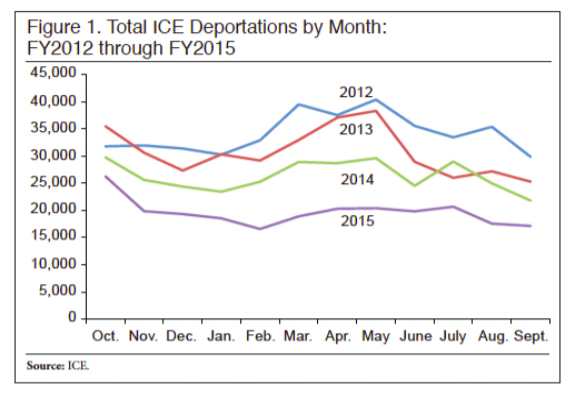
Vaughan also said some evidence that the program is failing can be seen in the number of deportations, which dropped sharply after Obama’s action. She provided a chart cased on government data showing that deportations in 2015 are lower than any of the prior three years.