

Gov. Gavin Newsom (D-CA) has been widely viewed as the natural heir to former President Barack Obama’s brand of Democratic politics as he’s telegenic, comfortable in culture wars, and fluent in progressive policies.
But as speculation of a 2028 White House bid builds, a tension point has emerged between the two that could complicate Newsom’s ascent to the top.
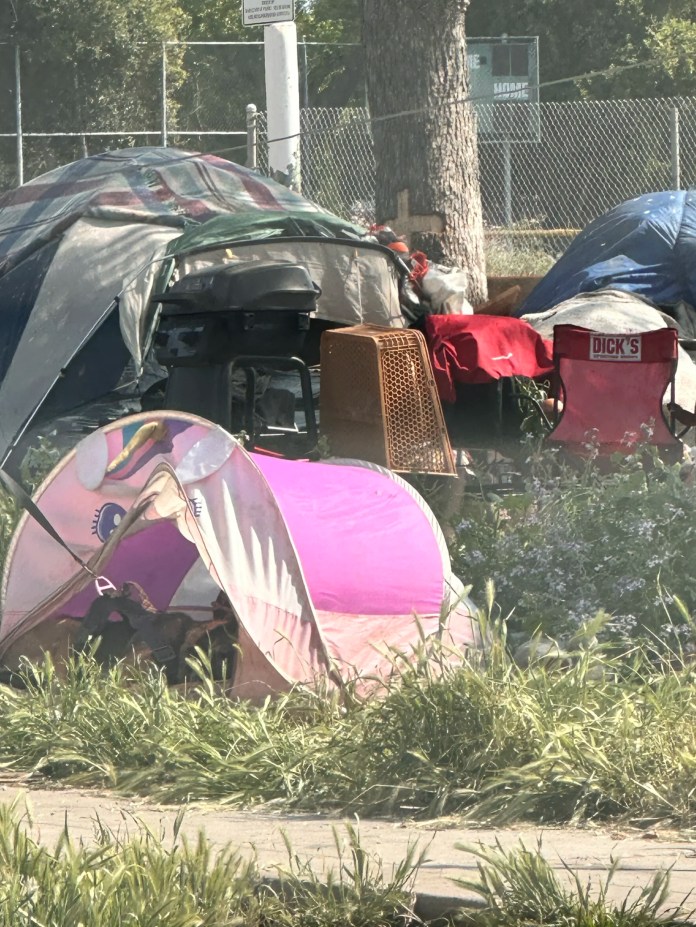
Obama recently slammed homelessness in Los Angeles, calling it an “atrocity” and saying Americans don’t want to “navigate around a tent city” in major urban areas. That put the spotlight directly on Newsom, who has led a state that has spent billions of dollars addressing homelessness with mixed results.
The issue has long been a political albatross for Newsom, haunting him not only during his tenure as governor but also as mayor of San Francisco. It’s also the one issue he has fully blamed on local officials as he prepares to leave the governor’s office and sets his sights on a 2028 presidential run.
“Time to do your job,” he said during a news conference where he publicly scolded mayors. “People are dying on their watch. How do people get reelected? Look at these encampments. They’re a disgrace. They’ve been there years and years and years and years.”
The friction between Obama and Newsom over homelessness isn’t ideological, Los Angeles-based political pundit Jamie E. Wright told the Washington Examiner, adding that it was unfair to characterize the issue as an abstract policy debate.
“It is a daily, tangible failure that is frustrating voters across the political spectrum,” she said. “Obama has always taken a technocratic approach to problems, relying on data, coordination, and long-term solutions. Newsom has had to become more visibly confrontational in addressing homelessness due to the magnitude of the problem, and because he is now the governor of the largest blue state in the country, where people are living in tents along highways. This is beyond philosophical difference. We are watching governing in real-time.”
Michael Fahey, founder of Fahey Communications, also said the friction some people were pointing to struck him as “more about governing style and political tempo than ideological daylight.”
But to political expert James Christopher, Obama’s comments read less like a policy quarrel and more like an electability signal.
“It’s an implicit admission that quality-of-life issues can sink even a broadly popular agenda,” he said. “In that sense, Newsom is not so much an heir as he is a stress test of the Obama legacy. If Democrats believe that the coalition can simply be reassembled, Newsom is a logical standard-bearer. If they conclude the next era requires sharper contrasts, tougher rhetoric, and a willingness to confront governance failures, particularly on homelessness and public safety, then the heir may look very different.”
On the surface, Newsom and Obama largely align on core policy priorities, from climate and healthcare to reproductive rights and economic equity — the two outwardly get along. Obama helped Newsom pass Proposition 50, a redistricting ballot measure expected to give Democrats a boost in the midterm elections. Obama has praised California’s climate leadership and progressive experimentation, while Newsom has often leaned into Obama’s legacy and governing style.
“The real question is not if they agree or disagree,” Wright said. “The real question is whether Newsom is what Democrats mean when they say they want their ‘Next Obama.'”
Wright described the former president as not just a collection of policies but also “a moment; a coalition builder; a cultural shift in a campaign.” Newsom, she said, is “intelligent, savvy with the press, and willing to fight with red-state governors.”
Unlike Obama, Newsom isn’t seen as an outsider, but more as “a manager who carries himself with confidence.”
Wright was quick to point out that her description of the governor wasn’t negative, but rather, different from Obama’s.
“After years of chaotic politics, Democrats may determine that a combination of swagger and executive experience will be enough,” she added. “Newsom has made it clear that he is the next generation of Democrats’ governing philosophy. He speaks in the language of Obama. The only question is whether the American voter is ready to hear him speak in that dialect again, or are they looking for something entirely different?”
Fehey believes if Democrats are looking for a direct heir to Obama, they could be in for disappointment.
“I’m not convinced that person exists in a one-to-one sense,” he said. “Newsom aligns on climate, healthcare expansion, and democratic norms, but alignment on issues isn’t the same as embodying the same political moment. The next standard-bearer will need to hold together suburban moderates, younger voters, and a restless working-class base that is far more skeptical of institutions than it was in 2008. That may require a slightly different tone, more economic populism, and less abstraction.”
Another problem for Newsom is that he symbolizes an affluent coastal liberalism that might not fully translate to the center and southern regions of the country, Maryville University Sociology Professor Kent Bausman told the Washington Examiner.
“In contrast, President Obama’s appeal was not limited to coastal voting coalitions,” he said. “His form of technocratic governance in response to economic crisis resonated across geographical boundaries and other demographics. The question for this present era of inflation shocks, AI disruptions, and growing global tensions is whether Democratic voters will be moved by matters of material security or the restoration of trust in our public institutions.”
VANCE FLEXES ENDORSEMENT MUSCLE AND FUNDRAISING PROWESS AHEAD OF MIDTERM ELECTIONS
For now, Obama remains the party’s de facto leader and arguably its most resonant messenger, a decade after leaving public office.
“The question isn’t whether he’s ready to give up [the mantle],” Fehey said. “It’s whether the next generation can build something durable enough that his blessing becomes symbolic rather than essential.”
