

Bipartisan blowback from elected officials in Texas has stalled the Trump administration’s plans to erect a border wall through Big Bend National Park in West Texas.
Following outcry from Democrats and Republicans in the red state, the Department of Homeland Security agency overseeing border wall planning and construction quietly shifted plans this month to instead use technology to monitor the U.S.-Mexico border in and around the national park instead of a 30-foot steel wall to deter illegal immigration.
An interactive map on a U.S. Customs and Border Protection website that previously showed the wall would run for hundreds of miles through the national park and the surrounding region of the border was updated to show the region would instead be secured with “detection technology.” The park runs along approximately 120 miles of the international border.
Sheriff Thaddeus Cleveland of Terrell County, a former Border Patrol agent, told the Washington Examiner on Monday the change followed pushback from community members and leaders in the region, including five sheriffs who pleaded with the Trump administration not to build a wall through the natural landscape.
“We’re all sheriffs in the Big Bend region where they had planned to build this barrier, and we all stood by each other to say, ‘There are better ways to accomplish this,'” Cleveland said.
An aide to a Texas lawmaker, who asked to speak anonymously, said the border wall, a security measure that has been widely supported by Republicans over the past decade, was now widely opposed by people in the region, even Republicans.
“Republican, Democrat, and everyone on the ground is very united against it,” the aide said in a phone call. “This is something that’s just part of the culture and community down there. [Big Bend] is a very special place. It’s home to a national park. Big Bend is the crown jewel of Texas. It’s a very special place no one wants to see that come through there…there’s multiple ways to address this issue. The sentiment is clear that…a physical barrier isn’t wanted.”
The DHS has touted expanding border wall construction through all four southern border states during President Donald Trump’s second term.
However, in the mid-March letter, the sheriffs stated that border security was “not a one-size-fits-all proposition.”
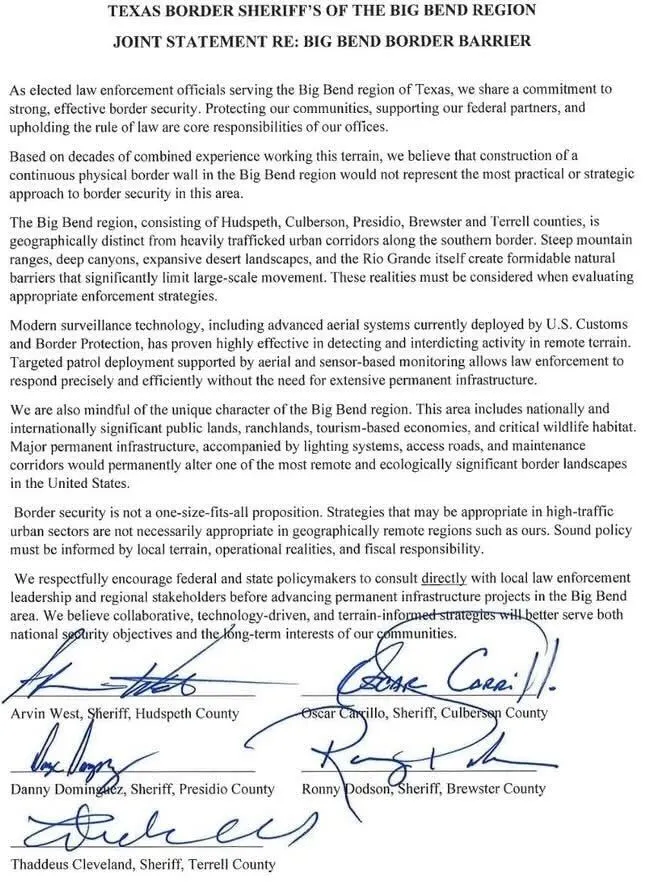
“Strategies that may be appropriate in high-traffic urban sectors are not necessarily appropriate in geographically remote regions such as ours. Sound policy must be informed by local terrain, operational realities and fiscal responsibility,” wrote Hudspeth County Sheriff Arvin West; Culbertson County Sheriff Oscar Carillo; Presidio County Sheriff Danny Dominguez; Brewster County Sheriff Ronny Dodson, and Cleveland.
“We respectfully encourage federal and state policymakers to consult directly with local law enforcement leadership and regional stakeholders before advancing permanent infrastructure projects in the Big Bend area,” the Democratic and Republican sheriffs wrote. “We believe collaborative, technology-driven, and terrain-informed strategies will better serve both national security objectives and the long-term interests of our communities.”
Last week, more than 130 conservation groups, including the Center for Biological Diversity, sent a letter to Congress urging lawmakers to block federal funding for a wall in the upcoming appropriations bill.
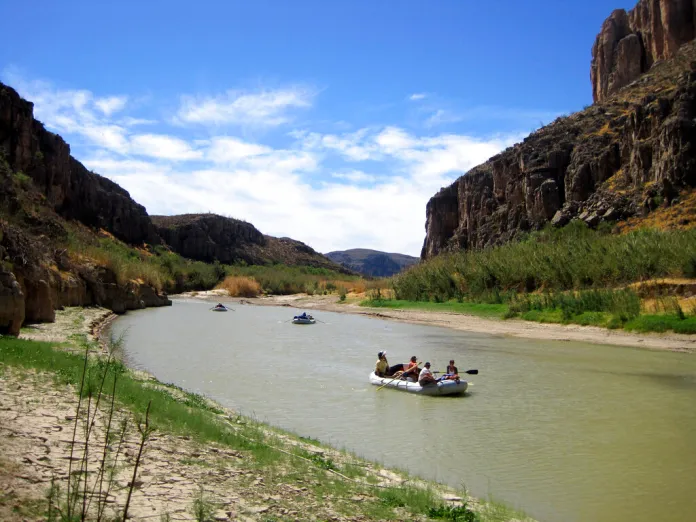
Cleveland added that many local residents and businesses depend on tourism from outfitting services, Jeep rides, canoe and rafting trips, and other activities in the region — an indication of the potential financial effect that would come from the construction of hundreds of miles of wall.
The Big Bend region is one of nine regions along the southern border that is divided into by the Border Patrol, a federal law enforcement component within CBP. Through the years, the Big Bend Sector has historically seen the fewest number of illegal immigrants attempting to cross because it is such a remote part of the shared boundary, according to CBP statistics.
In this part of the 1,950-mile southern border, illegal crossings are far rarer than in populated regions, such as the Rio Grande Valley of southeastern Texas or San Diego, California.
Migrants traveling north through Mexico are more likely to be guided by cartels to parts of the border where criminal rings have housing set up in cities on the border for people they are preparing to push across into the United States.
Cartels also want to ensure that the U.S. side of the border is well-situated so that smugglers can easily pick up people who cross illegally and abscond into the country.
The remoteness of the Big Bend area makes it an unideal place to cross, which serves as its own deterrent. For those who do choose to cross in the area, they must walk several days to reach the nearby major highway.
In that type of remote area, technology offers a more practical method to detect and track illegal immigrants or drug smugglers through the desert rather than depending only on a barrier to stop all crossings or agents in the field to spot every attempt, Cleveland said.
AT LEAST 15 SENIOR CBP OFFICIALS WERE PUSHED OUT UNDER NOEM: SOURCES
Cleveland said CBP drones, cameras, and radar systems are the best tools that law enforcement in the region has for detecting and tracking suspicious activity, and that those items should be boosted, rather than a wall.
The office for Rep. Tony Gonzales (R-TX), the three-term congressman who represents the area including Big Bend National Park, did not respond to a request for comment.
