

The Associated Press surprised and confused people this week when it cut critical details from a story on the Iran nuclear deal, and then reinserted them, and then deleted them again with no formal explanation.
A report dated Aug. 19 originally contained language suggesting the deal would allow Iran to run some of the inspections of its nuclear facilities using its own people, not staff from the International Atomic Energy Agency. The AP article caused an outpouring of anger directed at the Obama administration for supposedly agreeing to or allowing such a weak inspection regime.
The suggestive language was then removed suddenly from the article late Wednesday. This was done to save space, an AP editor said Thursday, assuring her readers that the language had since been reinserted.
But the language was again removed Thursday, leaving many wondering if the details the AP first reported were true. While the AP has commented somewhat on the confusion, it at no point wrote an editor’s note explaining any of its decisions.
The original Aug. 19 report, titled “AP Exclusive: UN to let Iran inspect alleged nuke work site,” contained three now-deleted passages regarding Iranian inspections.
“IAEA experts would normally take environmental samples for evidence of any weapons development work, but the agreement stipulates that Iranian technicians will do the sampling,” reporter George Jahn wrote. “The sampling is also limited to only seven samples inside the building where the experiments allegedly took place. Additional ones will be allowed only outside of the Parchin site, in an area still to be determined.”
“Activities will be carried out using Iran’s authenticated equipment consistent with technical specifications provided by the agency,” it added.
Jahn added in the original report, “While the document says that the IAEA ‘will ensure the technical authenticity’ of Iran’s inspection, it does not say how.”
By Wednesday afternoon, however, these passages disappeared from Jahn’s story.
It’s no conspiracy, one AP editor said. The language was removed, and then reinserted, due to space constraints.
“AP has updated story to restore details of IAEA-Iran deal that were cut last night solely for space,” AP Washington assistant bureau chief Wendy Benjaminson tweeted Thursday morning.
The problem is: The article linked in Benjaminson’s tweet was an entirely separate Aug. 20 report titled, “Report on Iran side deal angers GOP; House Dems claim votes.”
The article she cites included the previously deleted language about environmental inspections. It also included two bylines: Jahn and Erica Werner.
It didn’t end there, though.
Even that article was amended Thursday afternoon, with AP editors once again removing the language about Iranian self-inspection. Additionally, the headline was changed, and Jahn’s byline disappeared.
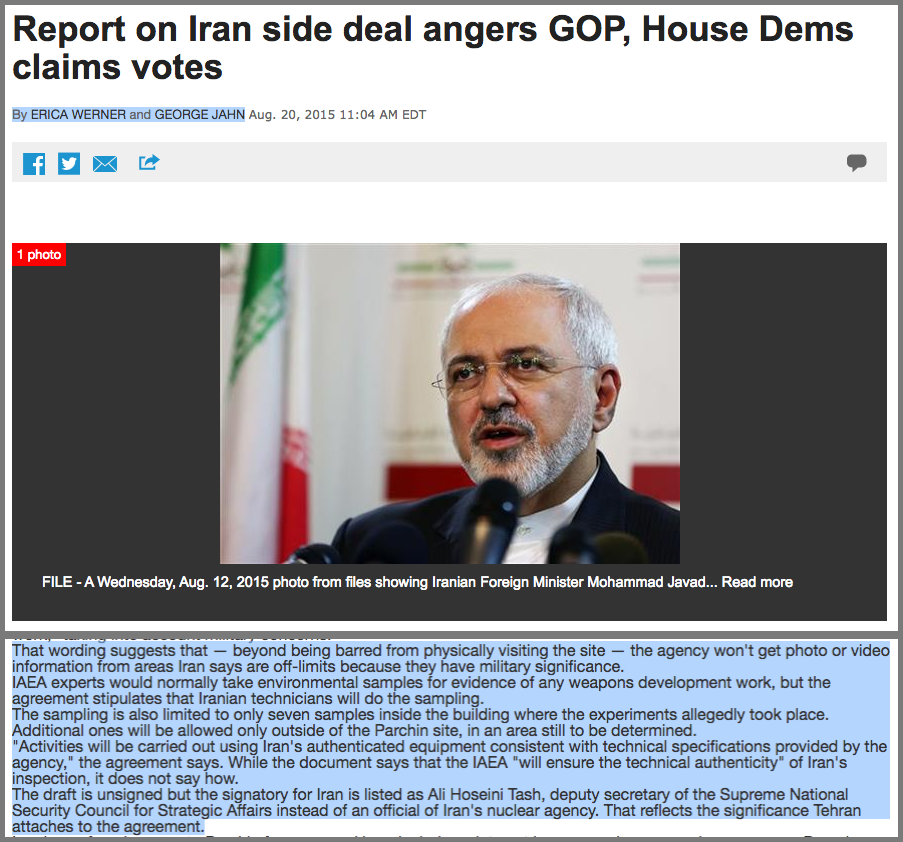
The AP has offered no formal explanation.
AP spokesman Paul Colford maintained Thursday that portions of Jahn’s original report were cut merely to save space.
“As with many AP stories, indeed with wire stories generally, some details are later trimmed to make room for fresh info so that multiple so-called ‘writethrus’ of a story will move on the AP wire as the hours pass,” he said in an email to Vox.
“It was unfortunate that some assumed (incorrectly) that AP was backing off,” he added. “As a former longtime New York newspaperman who’s been AP’s chief spokesman for eight years now, I would say there’s always something to learn from such episodes.”
As of late Thursday, Janh’s original article with the language about inspections could still be viewed in one place, at the hosted2AP.org website.
Asked to explain the decision to remove, then reinsert and then remove the inspection passages, Colford referred the Washington Examiner to a separate AP article outlining the text of draft agreement between the IAEA and Iran. He also referred the Examiner to an AP editor who offered to speak off-the-record about her organization’s filing procedures.
Why did @AP delete the grafs explaining the details of the Parchin sampling plan? Were they incorrect? Inconvenient? pic.twitter.com/yjIryYq4VN
— Jeffrey Lewis (@ArmsControlWonk) August 19, 2015
