

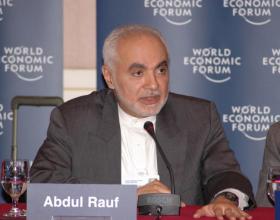
When Hamas official Mahmoud al-Zahhar threw his support behind the Ground Zero mosque, it became clear that what started as a political controversy is also a national security issue. New York Mayor Michael Bloomberg says it is wrong to ask where Imam Feisal Rauf is raising money for his project, which suggests that the city’s chief executive has forgotten that in his town last year federal prosecutors seized four mosques and a skyscraper controlled by the Islamic Republic of Iran’s Alavi Foundation. So let’s put aside for a moment whether Rauf has the right to build a mosque near what the president of the United States has called hallowed ground (he does), or if it is insensitive to do so (it is). What we want to know is what foreign interests are to be served with the money that Rauf is raising to build his Islamic center.
Many have argued that Rauf’s refusal to call Hamas a terrorist organization is evidence that despite the many testimonies on his behalf, the Tribeca imam is not a “moderate” Muslim cleric and perhaps has extremist tendencies. Maybe that’s the case, but let’s put it in perspective: The White House’s counterterrorism czar John Brennan believes there are moderate elements in Hezbollah and actually has the wherewithal to design a policy of rapprochement with a terrorist organization. Rauf is just an imam—and more importantly, in this context, he is an entrepreneur. Among those from whom he seeks funding are Muslim elites throughout the Middle East, a caste that often supports the anti-Israel “resistance” financially as well as morally. While there are some such elites who may detest Hamas for any number of reasons, few are apt to criticize the outfit publicly, especially in front of outsiders like the Americans. Were Rauf to disown Hamas to gain favor with the Americans, the doors now open to him throughout the Muslim world would be shut, forfeiting both his immediate access to money as well as the much more lucrative long-term opportunities afforded him as bridge between the United States and the Muslim world.
Stay informed.Stay ahead.
Join Washington Examiner for unlimited access to the news, analysis, and commentary that matter most.
Already a member? Log in
