

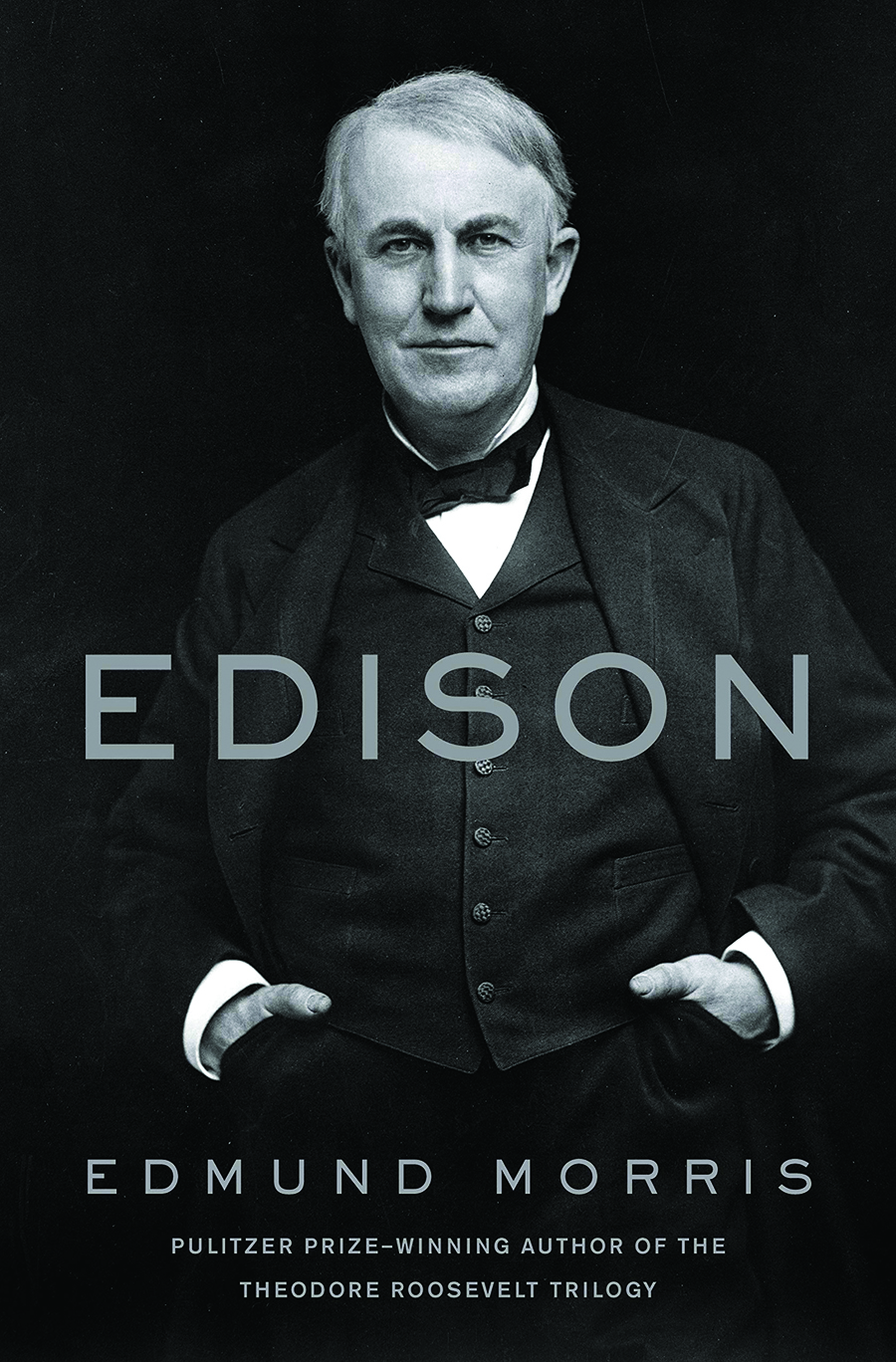
The late Anglo-American writer Edmund Morris published one short book on Ludwig van Beethoven and two ambitious political biographies: a magisterial three-volume life of Theodore Roosevelt, which is likely to remain the preeminent account of Roosevelt’s life and works, and an authorized biography of President Ronald Reagan, which ended up as a curious, semifictional version of Reagan’s career and something of a mess. Edison, which Morris finished shortly before his death last spring at 79, falls somewhere between the two.
The book is a wise, well-informed, and largely compelling account of Thomas Alva Edison’s long life (1847-1931) and enduring influence on the modern world. It also begins with his death and works its way backward, decade by decade, to his birth and upbringing in the small-town Midwest of mid-19th-century America. Morris is very good at explaining, in accessible terms, the complicated mind and technical achievements of a man who was deliberately difficult to know but whose life’s work transformed the world we inhabit.
Yet moving from Edison’s last breath, drawn at 84 in the midst of the Depression, to his childhood and youth before the Civil War is more than a little confusing at times and unnecessary. Still, we are not likely to get a better account anytime soon of the “Wizard of Menlo Park,” whose multitude of innovations and inventions (sound recording and motion pictures, the incandescent light bulb, the mass generation of electrical power, industrial research and development, and on and on) defined as well as transformed the industrialized world.
The scientific and academic establishment of his day tended to deride Edison as an inspired basement tinkerer and greedy entrepreneur. But Morris paints a sympathetic portrait of an astonishing autodidact with a wide, deep, and sophisticated mind. In his later years, when the public held him and his work in a kind of reverence, Edison was embarrassed to be showered with laurels and described as a “genius.” He need not have been.
Among other things, Edison was a mass of contradictions. There is no more American saga than the story of the enterprising small-town boy who, in the decade before the Civil War, left school behind to earn his fortune on the railroad, in telegraphy, and by refining machinery. Having done so at a stunningly precocious age, he invested his money in a pioneering laboratory of invention. But while Edison personified the American dream, he came from a Loyalist family who, after the Revolution, fled America for Canada. His Canadian-born father, an oddball libertarian character, was driven back across the border as a political refugee in 1837.
In his famous laboratories, Edison thrived in the company of like-minded scientists and technicians, but his lifelong near-total deafness, incurred in some mysterious boyhood malady, ensured him of the solitude his restless mind required. Like many famous men, he was a stranger to his family but an amiable, even benevolent, public figure. A critic of pure research and academic inquiry, he craved the approbation of the scientific establishment. He didn’t think bright ideas were worth the trouble without practical application or profit potential; he was also a rich man unimpressed by the trappings of wealth. The first man to record the human voice successfully and the architect of the American movie industry, he had no interest in the creative content of his inventions.
Morris weaves the works and life together with skill. Before Edison, scientific and technical innovation was largely a matter of solitary, even abstract, research. By applying industrial principles to the mysteries of the physical world and commanding small armies in battles of trial and error, Edison gained the breakthroughs that made his reputation while inventing our culture of technical research. We may thank him for the empires of Silicon Valley and the military-industrial complex.
He also personified the genius of obsession. An endless experimenter, tester, and perfectionist, Edison was never happier than when working and sleeping in his laboratories, oblivious to night and day, chasing the answers to burgeoning questions. On the night in 1914, when his giant New Jersey complex was consumed by fire, a business associate lamented, “Mr. Edison, this is an awful catastrophe for you.”
“Yes, Maxwell,” he replied, “a big fortune has gone up in flames tonight. But isn’t it a beautiful sight?”
Philip Terzian, a former writer and editor at the Weekly Standard, is the author of Architects of Power: Roosevelt, Eisenhower, and the American Century.
