

The Supreme Court on Wednesday cast doubt on a provision of the Voting Rights Act of 1965 intended to ensure there’s no racial discrimination at the polls, and President Obama is already suggesting he may seek new federal election rules if the act is struck down.
The justices aggressively questioned whether Section 5 of the act, which requires certain states and localities to get Justice Department approval for any change they make to election rules — from moving a precinct to redrawing election maps — was outdated. The section was devised to prevent certain states, particularly in the South, from blocking minorities’ access to the polls.
Recommended Stories



“Is it the government’s submission that the citizens in the South are more racist than the citizens in the North?” Chief Justice John Roberts asked Solicitor General Donald Verrilli, who argued the case on behalf of the Obama administration.
“It is not,” Verrilli replied.
Four of the five conservative justices pressed the government to justify the need for the act today. One of them, Justice Antonin Scalia, said Section 5 represented “racial entitlement.”
Even Justice Anthony Kennedy, a key swing vote on the court, raised serious questions about the continued need for the act, saying the “law was utterly necessary in 1965,” but “times change.”
Forecasting Supreme Court outcomes is an inexact science at best, but most experts are predicting a 5-4 ruling striking down Section 5. The decision is expected by June.
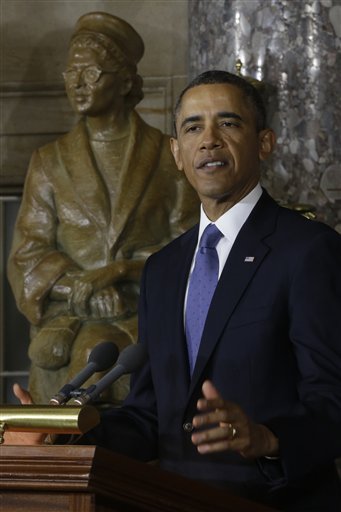
As the arguments were being heard by the nation’s highest court, Obama was on Capitol Hill for the unveiling of a statue honoring civil rights icon Rosa Parks. Were Section 5 overturned, it would have major repercussions for a president who in his inaugural and State of the Union addresses focused on ensuring broader fairness for all people.
Obama in his State of the Union address called for a bipartisan commission to improve the nation’s voting laws. Within the last few days, Obama has gone so far as to suggest that the White House may consider pushing national polling standards that could replace the act if it’s knocked down.
“If we have some national guidelines to make sure people aren’t waiting in line … that there aren’t new tricks that discourage people from voting,” he told SiriusXM Satellite Radio, “it’s not as good as keeping Section 5 of the Voting Rights Act in place … but it’s still possible for us to make sure that everyone is exercising their rights.”
In coming weeks, the Supreme Court will continue to shape Obama’s second-term agenda, particularly on social issues. Next month, justices take up challenges to California’s ban on same-sex marriage and a federal law restricting benefits for gay couples — issues of great importance to Obama’s liberal base.
Democrats descended on the Supreme Court on Wednesday to champion the voting rights law, including Rep. John Lewis, D-Ga., who as a civil rights activist fought for the law.
“There are still forces in this country that want to take us back to another period,” he said from the steps of the court. “We still need Section 5.”
Conservatives counter that the law is a relic of another time, that the South should not be punished for the racial biases of previous generations, and that it should have the right to oversee its own elections.
