

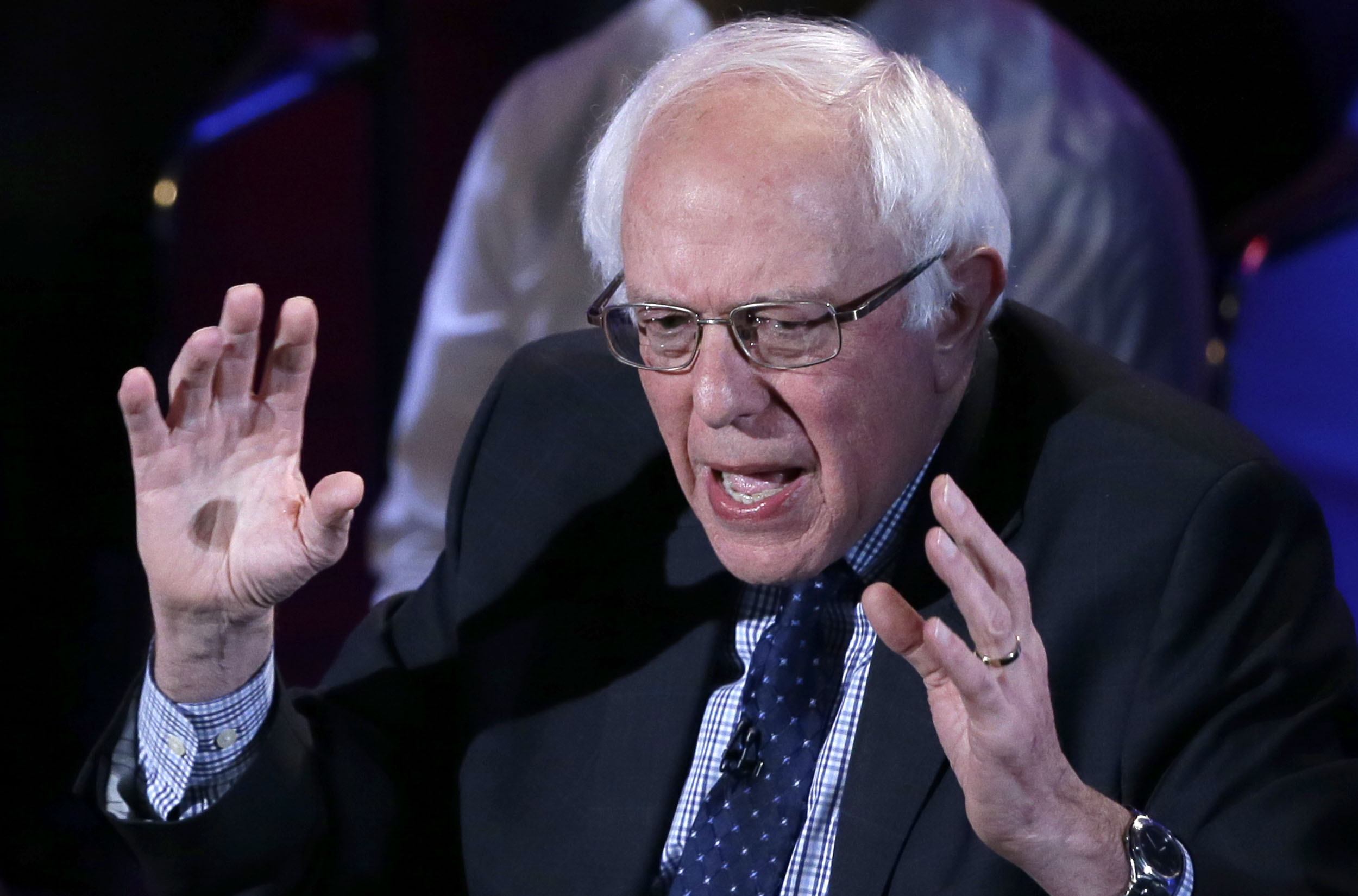
Bernie Sanders’ $14 trillion Medicare-for-all plan appears to have a little chance of becoming law, but several insiders say the symbolism behind it could be more important to his presidential campaign.
Recommended Stories


The Vermont senator on Sunday released his plan that turns Medicare into a federally run, single-payer program that eliminates private health insurance, using a combination of income and payroll tax increases to generate $14 trillion over a decade to fund it. Hillary Clinton countered during the Sunday debate that the plan doesn’t have a chance of getting through a Republican-controlled Congress and instead called for Obamacare to be protected.
But the fight between the two has reignited a longstanding feud in the Democratic Party on the best path for attaining universal healthcare.
“This is much more a symbolic debate than one that’s grounded in political reality,” said Larry Levitt, senior vice president for special initiatives at the nonpartisan Kaiser Family Foundation. “A Congress that just voted to repeal Obamacare is not going to turn around and pass a single-payer plan.
For decades, liberal advocates have clashed over the best way to get to universal healthcare. Some have heralded a single-payer system in which the government picks up the tab instead of private insurers, while others pushed for a more incremental approach, Levitt said.
That incremental approach eventually became the Affordable Care Act, which uses a collection of tax credits and penalties to spur Americans to buy private insurance and expands Medicaid, the federal health insurance program for the poor.
“I think the passage of Obamacare largely settled that debate, at least for the foreseeable future,” Levitt said.
But single-payer advocates beg to differ.
“The Affordable Care Act didn’t address a lot of the problems in the [healthcare] system,” said Adam Gaffney, a physician, writer and single-payer advocate. Gaffney said his views don’t represent any groups he is affiliated with.
Cost-sharing requirements such as co-pays and deductibles have increased, and more than 30 million Americans are underinsured, Gaffney said.
“Regardless of what happens in the coming general election, the Affordable Care Act will not have killed single payer,” he said.
Gaffney said he was disappointed that Clinton seems to be “closing the door on a single-payer program given that so many people support it.”
Clinton has taken the position that an incremental approach is needed. She said during Sunday’s debate that Democrats couldn’t even get a public option, which allows people to buy plans from Medicare, added to the Affordable Care Act when they were in charge.
However, such statements won’t play well in a presidential primary, said Dan Mendelson, president of the research firm Avalere Health.
“She is absolutely right, but it is not a message that is going to be a rallying cry for the liberal part of the Democratic base,” he said.
A leading conservative healthcare scholar added that the single-payer fight doesn’t bode well for the Affordable Care Act.
Clinton is frightened that if Sanders were to revisit the healthcare law, it could “create an opening for getting rid of Obamacare,” said Michael Cannon, director of health policy studies for the libertarian think tank Cato Institute.
Cannon added that the unpopularity of Obamacare has helped spur the debate.
“Had Obamacare proven popular, then a lot of single-payer advocates would say, ‘you know what, let’s just let this work,'” he said. “The fact that Obamacare is so unpopular has them worried and emboldened the single-payer crowd to push harder and sooner because maybe [Obamacare] won’t be around in 10 years.”
