

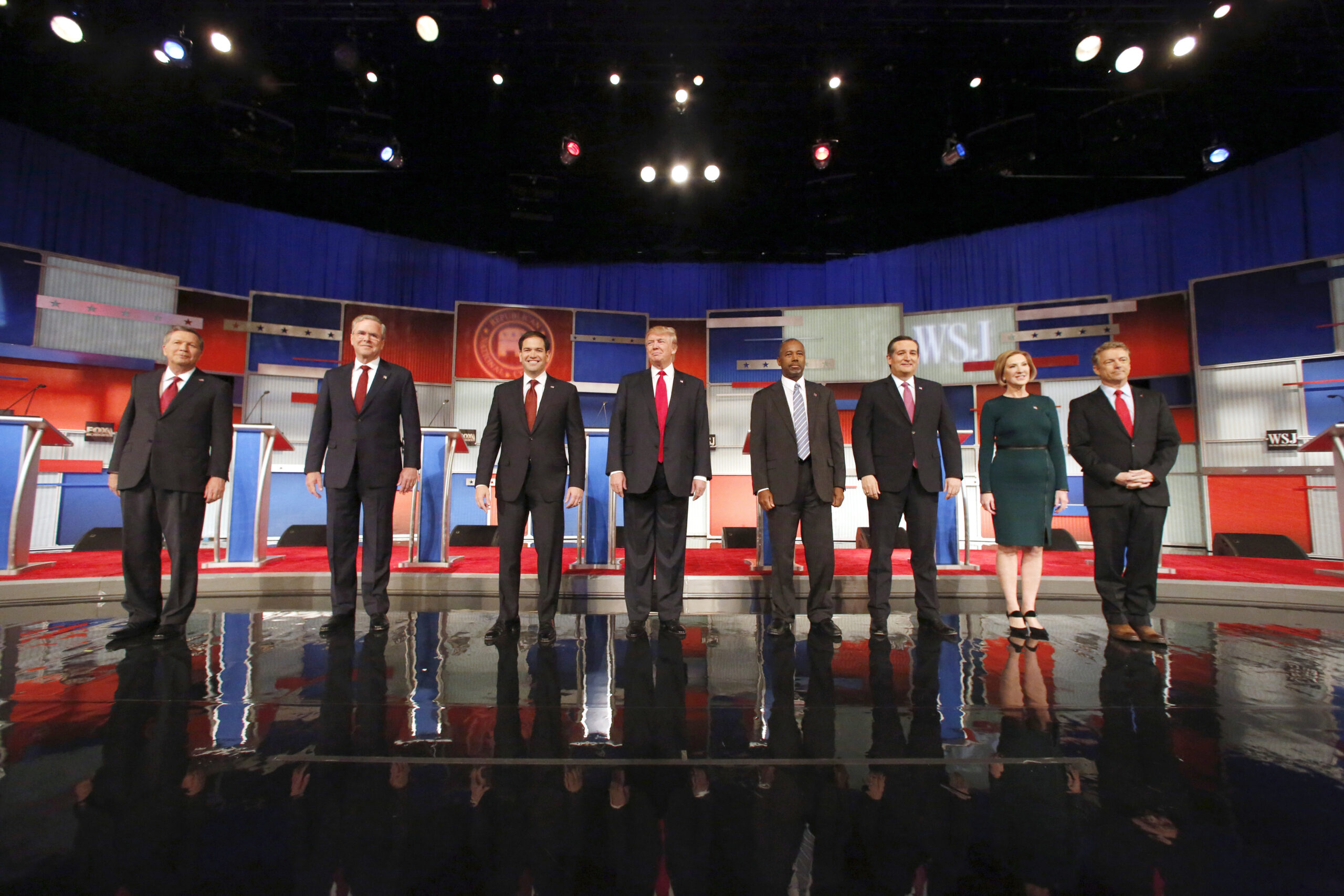
The Islamic State’s deadly terrorist attacks on Paris have sobered a Republican primary campaign dominated by inexperienced outsiders and consumed with cheap personal attacks.
That, at least, is the working theory of veteran Republican political operatives. It makes sense. National security has already playing an outsized role in the GOP nomination fight, and the events of Friday could elevate Republican voters’ existing concerns that the homeland is vulnerable to an attack by Islamic radicals. That should boost experienced candidates with foreign policy expertise and a cogent national security strategy that favors aggressive American leadership abroad.
Recommended Stories


“Thanks to Paris, national security has really become homeland security,” Republican pollster Frank Luntz told the Washington Examiner on Tuesday.
Related Story: http://www.washingtonexaminer.com/article/2575923
The question is whether GOP voters really do become laser-focused on national and homeland security, and if so, is a more serious minded primary electorate bad news for the current front-runners, retired neurosurgeon Ben Carson, and billionaire real estate developer and reality television star Donald Trump. Carson can be shaky and confused when discussing foreign policy; Trump often echoes President Obama in claiming that the U.S. can’t afford to engage overseas and should recede from global leadership.
Broadly, the Republicans who stand to benefit if the answer is yes and the Paris attacks strike a cord are former Florida Gov. Jeb Bush; New Jersey Gov. Chris Christie; Texas Sen. Ted Cruz; businesswoman Carly Fiorina; Ohio Gov. John Kasich; and Florida Sen. Marco Rubio. All six are foreign policy hawks; all are knowledgeable on the issue generally and the Islamic State in particular; and all are in contention for the nomination, some to a greater degree than others.
Fiorina is the only contender of the group who hasn’t previously been elected to public office. But all — including Fiorina — are political insiders whose involvement in Republican Party politics predates the 2016 race. What they also have in common is their push since Friday, in campaign videos, speeches and interviews, to promote their national security bona fides and determination to aggressively to stamp out the Islamic State and other threats as president.
“This hurts the outsiders and helps the establishment guys. This is one area in which the base actually trusts Washington,” said Jim Dornan, a Republican political strategist. “They want a steady hand who they can trust to use our superior military power to keep the country safe.”
The hawks continue to hold sway over Republican foreign policy. But that doesn’t mean the party is in lockstep.
Sen. Rand Paul of Kentucky, an underdog for the GOP nomination, advocates for libertarian-style “non-interventionism.” Paul would reduce the U.S. military’s global footprint and relax America’s traditional, post-World War II role of global leader in combatting international crises, such as the Islamic State’s rise in Iraq and Syria. Trump’s approach to foreign policy, while less consistent, is similar to Paul’s. The New Yorker has said the U.S. needs to re-focus inward and prioritize domestic infrastructure investment.
Even the hawks are engaged in debate, with Cruz and Rubio, top-tier rivals for the nomination, hashing out the wisdom of diminishing the National Security Agency’s domestic spying powers.
Cruz earlier this year joined libertarian-leaning Republicans, Democrats and Obama to support a bill that reformed how the NSA operates in its pursuit of foreign terrorists plotting attacks on U.S. soil. Rubio opposed the legislation, and on Monday he charged Cruz with weakening national security through his support of the legislation. Cruz refuted the charge, and he and his allies are responding by characterizing Rubio’s past support for comprehensive immigration reform as dangerous to national security.
Going full hawk might deliver the biggest political bang for the buck, especially if the Paris attacks and the Islamic States’ threats against the U.S. remain at the forefront. Worries about the Islamic State first became a voting issue in the fall of 2014, and GOP operatives say it helped drive their party’s takeover of the Senate. Indeed, Republican insiders say Colorado and North Carolina might not have been won without it.
“The naive and dangerous isolationist wing of the Republican Party gets put back in the attic every time an international threat arises,” said Brad Todd, the Republican strategist running Believe Again, a super PAC supporting the presidential campaign of Louisiana Gov. Bobby Jindal. “Republicans place a high value on hiring a commander in chief.”
