

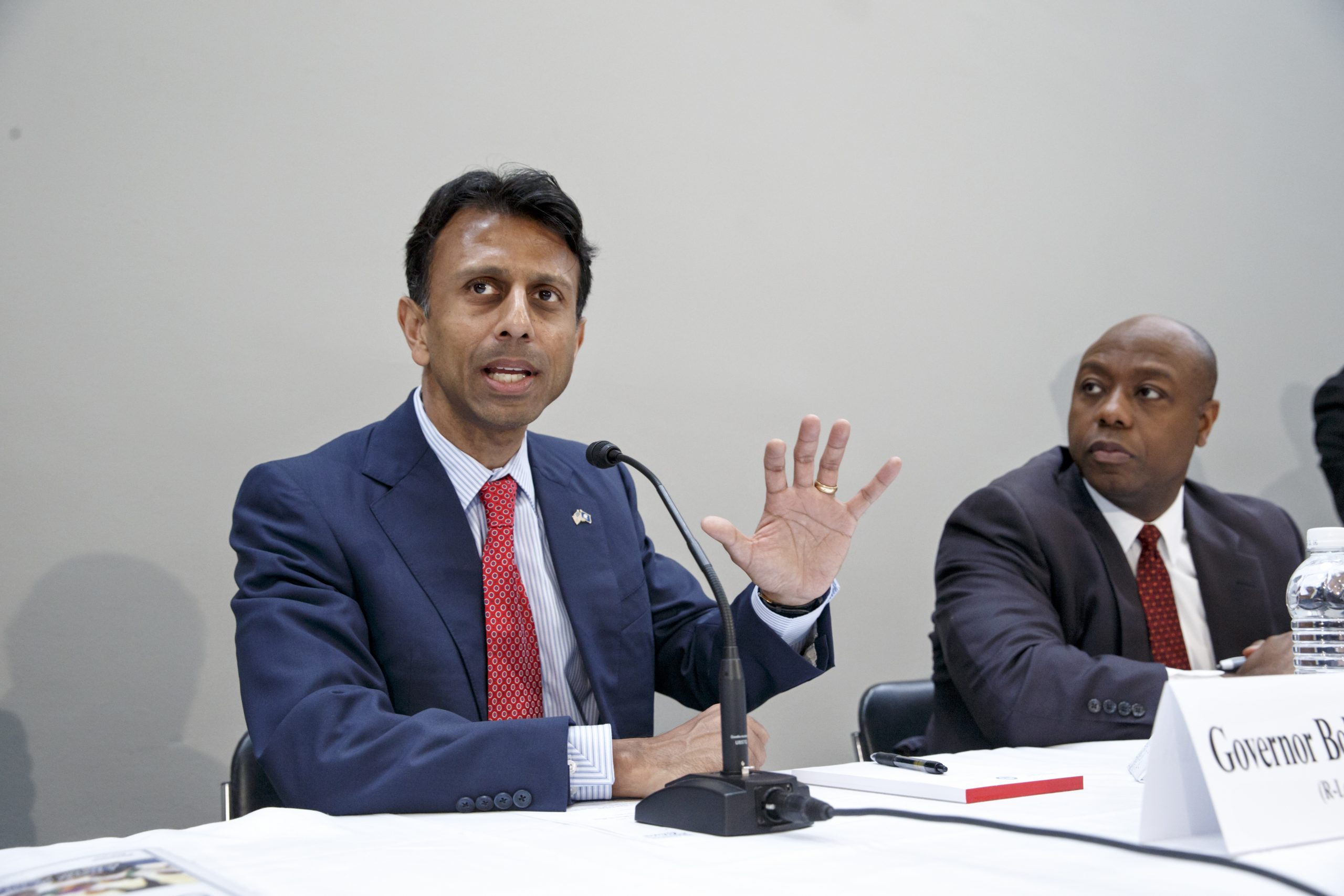
Gov. Bobby Jindal offered the Washington Examiner a peek at his foreign-policy bookshelf this week as the Louisiana Republican moves closer to announcing a run for president.
In D.C. Monday to discuss education reform, the governor steered interviews with reporters toward foreign policy and national security — issues dominating the 2016 race for the GOP nomination at this early stage. Following the Christian Science Monitor roundtable, Jindal’s advisors shared with the Examiner the reading list of books by noted academics and tacticians that have informed Jindal’s approach to foreign policy and national security:
Recommended Stories


• Diplomacy, by Henry Kissinger (1994)
• Presidential Command, by Peter Rodman (2009)
• Special Providence, by Walter Russell Mead (2001)
• Conservative Internationalism, by Henry Nau (2013)
• Advice to War Presidents, by Angelo Codevilla (2009)
• Empire: The Rise and Demise of British World Order, by Niall Ferguson (2004)
• Strategy: A History, by Lawrence Freedman (2013)
Jindal said he has sought counsel on occasion from former Sen. Jim Talent, R-Mo.; Ambassador John Bolton; former Secretary of State Condoleezza Rice and Kissinger, among others.
Proving readiness for the commander in chief role has become a routine test for White House aspirants — and Jindal, even though his political experience has all been domestic, seems to be aiming for an early lead on his rivals in the field of foreign policy.
As the 2016 campaign unfolds, Republican primary voters are especially hungry for a steady hand to take control of unfolding global crises — from the rise of the Islamic State of Iraq and Syria; to the collapse of Yemen; to an aggressive Vladimir Putin in Russia; to an increasingly belligerent China. Like most of the field of potential 2016 Republicans, particularly the sitting and former governors, Jindal is studying up and working to expand his reach beyond domestic policy.
The governor’s homework has included what is becoming for Republicans the obligatory trip to the United Kingdom. He completed working through his reading list late last summer. For Jindal and the collection of sitting and former governors, burnishing foreign policy bona fides is a process. They need to have a sense of America’s place in the world to decide how they want to lead and how to translate that into action as president.
“Governors have a challenge because they haven’t always practiced the language of some of the modern-day crises,” said Richard Grenell, who has advised Republican presidential candidates on foreign policy.
Jindal waded into that challenge in London last month, when he said in a speech and a subsequent TV interview that certain Muslim neighborhoods in Europe were “no-go” zones where civil law was ignored in favor of Islamic religious law. The comments thrust Jindal to the center of an ongoing brouhaha over a claim made by Washington-based terrorism investigator Steven Emerson — and hotly denied by British officials including Prime Minister David Cameron. The governor took some heat from Democrats and was sneered at by some members of the media.
But conservatives loved it, and Jindal’s own political advisors came away pleased, happy with the contrast he has drawn with other potential 2016 candidates who recently traveled to the United Kingdom. New Jersey Gov. Chris Christie caused a media firestorm in Blighty when he expressed nuanced views on whether parents should vaccinate their children. Wisconsin Gov. Scott Walker declined to discuss foreign affairs altogether, citing a desire not to criticize the administration while overseas.
During the breakfast with reporters on Monday, Jindal’s criticism of Obama placed him squarely in the mainstream of likely GOP presidential candidates. The Louisianan, who formerly served in the administration of President George W. Bush and in Congress, rapped Obama as too weak and accommodating to American adversaries. He advocated for a boost in military spending to deal with emerging threats and for a more assertive U.S. role on the world stage.
“I think there has been a bipartisan consensus, in both Democratic and Republican administrations, post Cold War, that a stronger America leads to a safer world, that our enemies need to fear us, our friends need to trust us that we need to have the military might not just to win but to be dominant, to deter any threats to America and to our interests,” Jindal said.
“We are currently projecting, to too many people, unpredictability,” he added. “What worries me the most is what happens with Iran; a nuclear-armed Iran is simply not an acceptable outcome, not only for Israel but for the United States.”
