

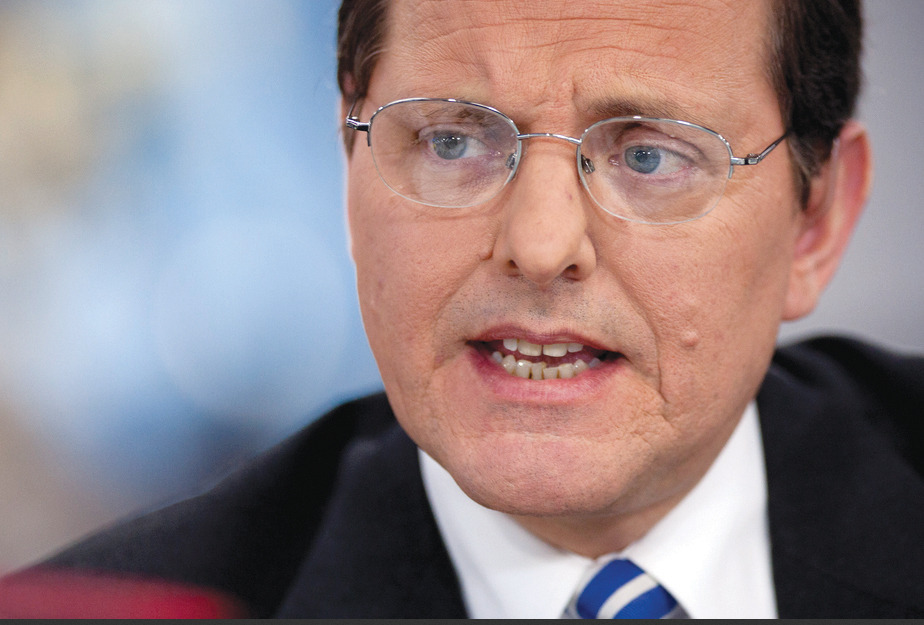
Edward DeMarco is concerned that the U.S. government learned the wrong lessons from the housing crisis.
DeMarco was a first-hand observer. In the depths of the mortgage disaster in 2009, President Obama appointed DeMarco the acting director of the Federal Housing Finance Administration, the new agency responsible for the caretaking of the mortgage buyers Fannie Mae and Freddie Mac after they failed and were bailed out just months earlier.
Recommended Stories



As their government guardian (or conservator, in legal terms), DeMarco sought to put the failed private-government hybrid companies on a path to reform.
Fannie and Freddie boost liquidity in the secondary market for mortgages by buying home loans from lenders and packaging them into securities to sell to investors, with government-backed insurance.
In the wake of the collapse of the private housing finance market, DeMarco took steps to shrink Fannie and Freddie’s influence and prepared them to be shuttered by Congress and replaced by a more sustainable system.
Controversially, the economist and long-time civil servant also decided not to go along with the Obama administration’s plans to offer forgiveness on the principal of home loans owned by Fannie and Freddie. Doing so could have helped underwater homeowners recover and boosted the economic recovery, but would have exposed taxpayers to risk. For nixing Obama’s proposals, DeMarco drew heated denunciations and calls for his resignation from economist and columnist Paul Krugman, nine Democratic attorneys general and countless liberal activists.
Obama replaced DeMarco in January 2014 with Mel Watt, a former North Carolina Democratic congressman.
With no congressional action on Fannie and Freddie in sight six years into the conservatorship, Watt reversed course, pursuing a number of changes meant to increase the availability of credit to would-be homeowners rather than lessening the influence of the mortgage buyers. His moves, along with other housing finance decisions made elsewhere in the Obama administration, have drawn criticism from Republicans, who warn that he is risking a repeat of the degradation of lending standards that led to the crisis.
DeMarco is now a scholar at the Milken Institute. He spoke to the Washington Examiner about his tenure and the future of the housing finance. An edited transcript of the conversation follows:
Washington Examiner: Sorry to revisit what might have been a painful moment, but how did it feel to have Paul Krugman call for you to be fired at one point?
DeMarco: [Laughs.] It did not bother me. It was a controversial set of issues. There was a lot of heated rhetoric around it, and I just stuck to trying to do sound, analytical-based decision-making that was good for the short term and the long term.
Examiner: Looking around at what’s happening now, are you among those who believe that credit is just way too tight, in terms of home loans?
DeMarco: I don’t subscribe to the “credit is way too tight” storyline.
I believe that there are several things going on here. Depending upon the characteristics of the borrower, credit is certainly available.
The rules have changed so much that, for some folks who don’t have a long history of regular wage income, getting a mortgage has become more challenging, both for the borrower and the lender.
And I think that a lot of people have stepped back from this crisis and drawn several conclusions. One is to be a lot more careful with the level and type of debt they take on as a family or a household. I think that younger adults are taking a good bit more caution in thinking about the financial commitment and risks associated with mortgage lending.
And we’ve also seen some other changes among younger adults relative to their parents with regard to household formation; how they’re going about starting a career. A lot of them are not thinking about a single career but trying several things. And that alters some of their near-term desires and expectations with regard to homeownership.
That does not mean that over the course of their adult life they don’t plan on being homeowners. I think the desire to become a homeowner is as strong now as it’s ever been, but I think that there are really going to be some changes with regard to timing and approach that are taken by younger adults.
Examiner: Thinking about policy at the federal level, some critics have said that, even if not now, this is putting us back on the path toward loosened standards that we saw before 2006-2007. Do you share that concern?
DeMarco: I have a concern that we’ve not necessarily learned all the right lessons from the housing crisis. Yeah, I do.
I think there are some who are very much focused on creating a lending environment focused on encouraging potential homeowners to take on debt — and to take on long-term debt — and on how to bend the pricing of that or the eligibility standards for it in order to enhance homeownership.
If house prices are rising and the labor market is strong, then the risks from that are lessened. But if we have a regional or national recession, if labor markets turn tough again, if house prices decline maybe because of a rise in interest rates or something that happens in the larger economy, then the risks of that start to manifest themselves again.
Our focus ought to be more on helping families create sustainability in homeownership, and that sustainability in part has got to be creating a stronger environment and expectation for homeowners to actually build equity in buying a house. Whether that’s through a down payment up front or through the approach that’s taken to financing mortgage debt.
But when you put very little money down in purchasing a house and then you take out a 30-year fixed-rate mortgage, those first seven to 10 years you’re paying down very little on your principal. So you could have a great credit score and so forth, but, you know, we’re all subject to risks in life. That risk could be a health risk, it could be an unexpected job loss, a family situation, a divorce. If you’ve got little money down and you’re in a long-term mortgage like that, your equity position cannot as easily sustain these kinds of shocks.
It concerns me that we seem to be leaning back into that kind of situation.
Examiner: About Fannie and Freddie specifically: As far as I can tell, it looks like there’s not going to be any legislation action, there’s really no momentum there, for the rest of President Obama’s tenure. So we’re looking at two years at least. Is that too long? Can we have a sustainable housing finance system with those two [government-sponsored enterprises] in place?
DeMarco: I’ve been saying almost since I became acting director of FHFA back in 2009 that these conservatorships were not intended to be a long-term situation, and that there are risks associated with not dealing with this issue. And my view on that hasn’t changed.
I really believe that Congress and the administration need to act. This is the responsibility of Congress. They’ve chartered these two companies, gave them a certain set of privileges, and they did not give FHFA the authority to decrease the number of charters, increase them, or change them. Only Congress can do that. So we really need to have legislation to deal with these conservatorships.
I think that the risks that develop that by this tremendous time lag are many, but they include that more and more of this market is becoming dependent on taxpayer support, between the Federal Housing Administration, Fannie, and Freddie. As a result, we’re seeing that what would be normal private mechanisms operating to allocate the capital, to price the risk of lending, is being replaced instead by these kind of decisions being made by policymakers and industry lobbying and so forth rather than through normal market processes.
The other thing I would say is that I’ve not given up myself that Congress and the administration can act over these next two years. I know many people believe it’s highly unlikely but I think there’s a common foundation to build on.
Examiner: Reading through your writings for the Milken Institute, it seems like you feel like people pay too much attention to housing finance relative to rental housing or affordable housing for elderly people or low-income people. Is that fair to say?
DeMarco: It is. We expend a tremendous amount of energy and public policy discussion revolving around homeownership. Yet the homeownership rate in this country for 50-60 years has operated in a pretty narrow band. It’s approximately two-thirds of households.
We exceeded that only in this past decade. And we saw the result of that and the damage it did to families, when we tried to undertake a bunch of policy initiatives to pump up the homeownership rate, and as a consequence trillions of dollars of household wealth was lost, the damage individual families and neighborhoods was horrific, and we’re back down now to a homeownership rate of around 64 percent.
All that, and yet we expend tremendous subsidies, directly and indirectly, to promote homeownership, where most of the recipients of these subsidies would become homeowners in any event. The subsidies tend to drive up house prices, and the subsidies tend to go to the better-off families. One of the biggest ones, of course, being the mortgage interest deduction going to the benefit principally of higher-income families. Usually when you want to provide subsidies, there’s an issue here with regard to people who are truly in need. Are we giving proper attention in consideration to the role of public policy in ensuring that we have safe and viable housing options for the elderly and for the truly needy, for the poor families in our country?
And we’re going to see a lot of growth in the need for elderly housing as the Baby Boom not just reaches retirement age but truly starts to age.
Examiner: Lastly, what’s next for you?
DeMarco: I’m continuing to focus on housing finance issues and speaking out about the need for the country really to develop a national housing policy and to help create a new infrastructure for housing finance in the future.
This semester I’m the visiting professor at the Owen School of Management at Vanderbilt. I’m very much enjoying the opportunity to interact with the students in the business school there in the class that I’m working with.
