

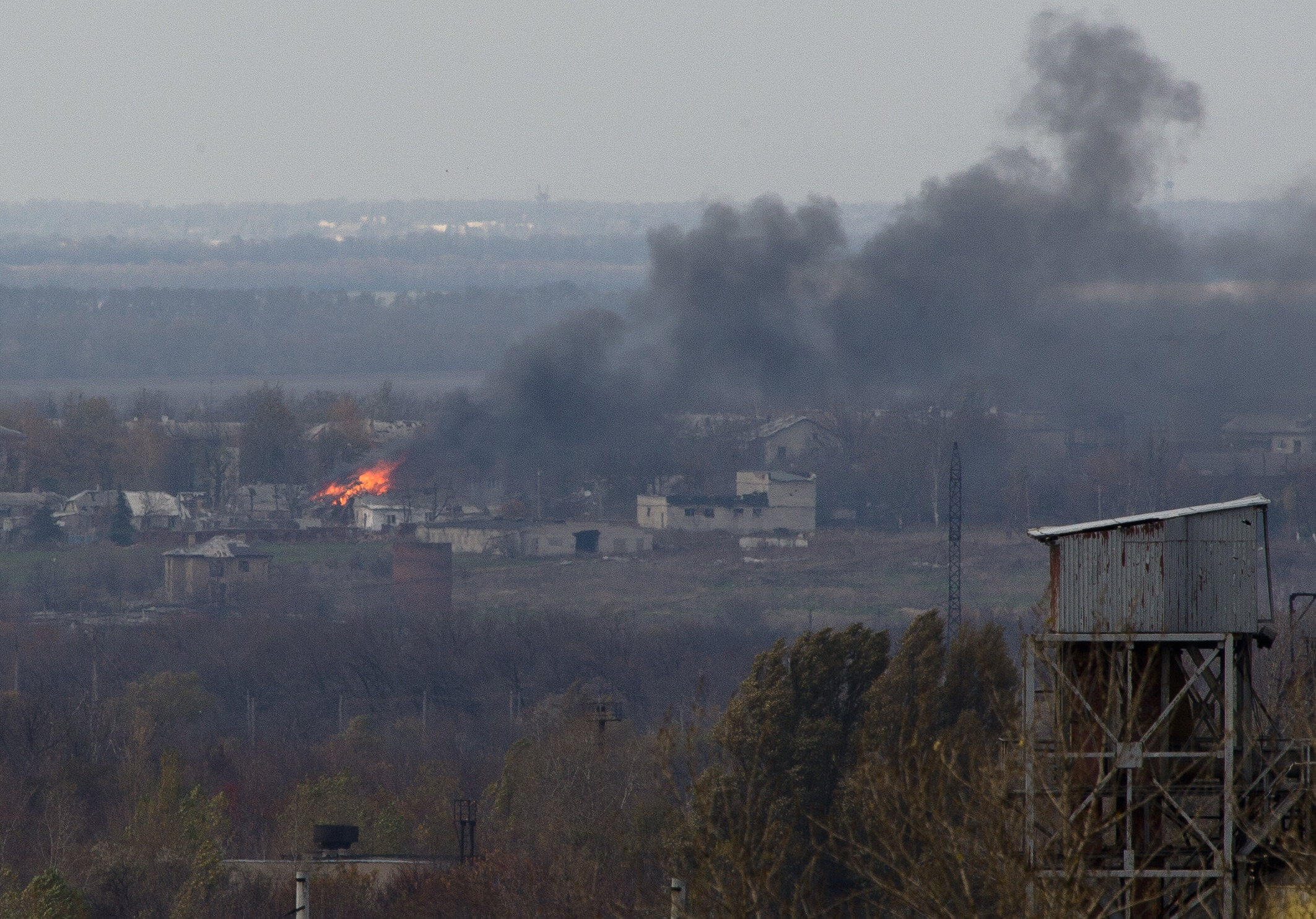
The fragile ceasefire between Ukraine’s government and Russian-backed forces who have declared independence in the eastern part of the country is quickly disintegrating, raising fears that the conflict will intensify.
Ukrainian military officials said Friday that a column of 32 tanks, 16 artillery pieces and trucks carrying ammunition and fighters crossed the border from Russia — the latest sign that Moscow is taking an active role in keeping the rebels in the fight despite a Sept. 5 ceasefire deal in which it pledged not to do so.
Recommended Stories


“The deployment continues of military equipment and Russian mercenaries to the front lines,” spokesman Andriy Lysenko told reporters, noting that five Ukrainian soldiers had been killed and 16 wounded in the past 24 hours.
Fighting has flared up since separatists in the Donetsk and Luhansk regions of eastern Ukraine declared independent “people’s republics” after holding referendums in defiance of the international community.
So far, Moscow has been careful with its reaction to the vote, with presidential aide Yury Ushakov on Friday telling the official RIA-Novosti news agency that Russia “respects” but does not necessarily recognize the results.
“These are different words,” he said. “The word ‘respect’ was chosen on purpose.”
Moscow is also calling for a new round of talks to revive the ceasefire, but Kiev is skeptical of their usefulness, citing recent Russian moves. Air Force Gen. Philip Breedlove, commander of NATO forces in Europe, said Monday that the rebels, backed by Moscow, had used the ceasefire to consolidate their control of the regions and virtually erase the international border between Ukraine and Russia in those areas.
The renewed crisis puts the Obama administration in a difficult position, caught between its determination for a peaceful solution to the conflict and growing fears among NATO allies in eastern Europe that Russian President Vladimir Putin is willing to risk war to get what he wants. Those fears are shared by many in the new Republican majority in Congress, who are likely to press Obama to take a tougher line against the Kremlin and perhaps also arm Ukraine’s military — an idea Sen. John McCain, R-Ariz., the likely incoming Armed Services Committee chairman, has been pushing.
But even though Russia’s seizure of Crimea in February shocked the administration as well as NATO into reassessing its relations with Moscow, Washington still sees its long-term role in Europe more as a supportive one.
The administration’s global strategy, released in January 2012, noted that increasingly wealthy European nations would take on a greater share of the continent’s defense within NATO as U.S. forces were reduced by Pentagon budget cuts or redeployed elsewhere.
“Most European countries are now producers of security rather than consumers of it,” the strategy document notes.
Though U.S. military officials acknowledge that the trend of pulling forces out of Europe will have to be reversed, the administration continues to press European allies to do more for their own defense.
In a speech in Tallinn, Estonia, on the eve of September’s NATO summit, Obama pressed European nations to meet alliance goals of spending at least 2 percent of gross domestic product on defense, saying, “this week’s summit is the moment for every NATO nation to step up and commit to meeting its responsibilities to our alliance.”
Only four countries — Estonia, Greece, Britain and the United States — have met or exceeded that target, according to alliance data from 2013, the most recent available. Cumulative defense spending for all European countries in NATO is 1.6 percent of GDP.
And though officials in eastern Europe, especially Poland, have taken steps to boost their countries’ defenses, some allies, such as Germany, remain skeptical of the need for dramatic increases in spending.
“I’m worried about Europe,” Joint Chiefs of Staff Chairman Martin Dempsey said Wednesday during a visit to New York. “For 20 years … the Europeans have been pretty complacent about their security. I don’t think they can afford to be complacent any longer.”
