

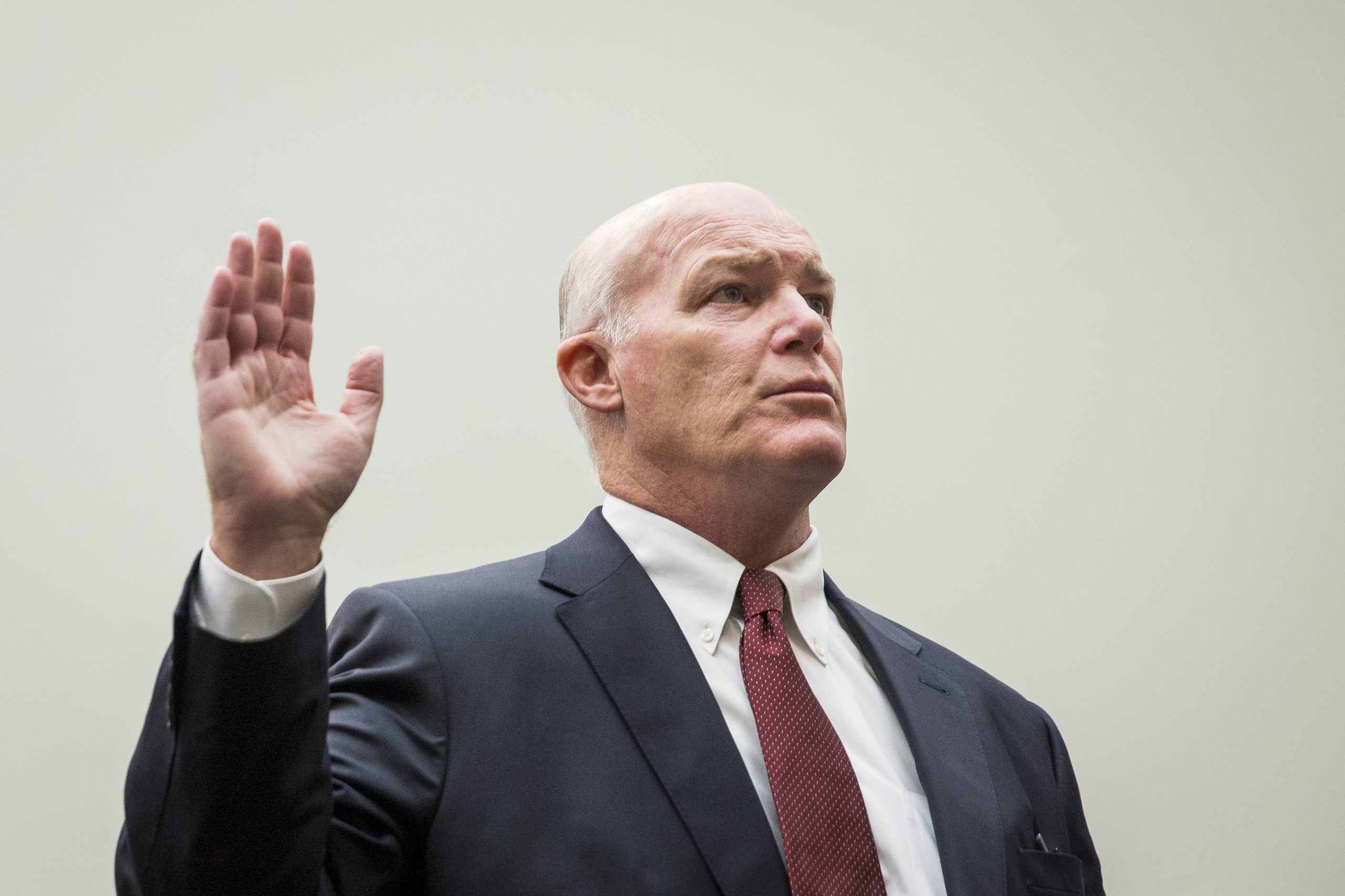
Revelations of continuing disarray at the U.S. Secret Service, a fight over the agency pitting President Obama against Republicans, and a growing sense that the organization tasked with protecting the president is out of control have raised some serious questions. Here are the five biggest:
1. Will President Obama stick by Director Joseph Clancy?
Even though the White House has repeatedly declared its full confidence in Clancy for weeks, another embarrassing incident at the White House could quickly change the dynamic and erode the backing.
Recommended Stories


Obama supported the leadership of Julia Pierson for months until an embarrassing string of security lapses occurred, and the Washington Examiner reported that the Secret Service allowed an unauthorized man with a gun to travel with Obama in an elevator during a visit last fall to the Centers for Disease Control and Prevention in Atlanta.
That was the final straw for Pierson. Shortly after, both Obama and Department of Homeland Security Secretary Jeh Johnson changed their tune and said she had lost their confidence. Pierson delivered her resignation and was out.
Despite Obama’s repeated professions of trust and confidence in Clancy, the first family’s security is at stake, and he’s undoubtedly on a very short leash and could face a similar fate if one more embarrassing incident occurs under his new watch.
Sen. Ron Johnson, R-Wis., who chairs the Homeland Security Committee, was unsatisfied with Clancy’s responses during House testimony earlier this week and said he may be “in denial” about the extent of the agency’s cultural problems.
New York Times best-selling author Ron Kessler, who recently penned “The First Family Detail,” pins the blame on Obama for not following an independent panel’s recommendations to tap someone from outside the agency to shake things up and restore discipline and order.
“It’s Obama who is in denial about how serious these problems are,” Kessler told the Examiner. “He ignored the panel’s recommendations and that just shows a colossal lack of judgment, especially since his own life and the life of his family is at stake.”
“Nothing is going to change,” he added.
2. Why does the FBI have higher disciplinary standards than the agency and what, if anything, is the agency doing about it?
Examiner reporting shows that the FBI has higher disciplinary standards than the Secret Service on a number of fronts — and agents pay higher penalties for misdeeds.
For instance, Larry Berger, an attorney who has served as a general counsel for the Federal Law Enforcement Officers Association, says the FBI has much higher standards than the Secret Service for alcohol-related incidents.
He says the Bureau requires at least a 30-day suspension without pay for an off-duty drunk-driving charge, even in a personal vehicle.
“And it goes up from there, depending on the circumstance,” he told the Washington Examiner.
In contrast, the Secret Service’s penalty for a drunk-driving conviction — not a charge — in a personal vehicle is a 14-day suspension without pay. A conviction in a government-owned vehicle results in a “standard” penalty of 45 days suspension without pay, according to a Secret Service spokesman.
In addition, Secret Service agents and officers continue to receive Law Enforcement Availability Pay when they are under investigation for wrongdoing. The pay is a 25 percent bonus on top of their base salary and is meant as a way to compensate workers for the unpredictable nature of the job — that they can be called in at any time if a security crisis warrants it.
But often times, the agents under investigation are either on administrative leave or reassigned to non-operational desk jobs, raising questions about whether the pay is warranted.
A source familiar with the practice told the Examiner that the policy doesn’t make sense, especially because the FBI has a tendency to revoke the pay if agents are accused of serious wrongdoing and are under investigation.
The FBI did not return a request for comment.
The Secret Service, however, can tighten its protocols and penalties for alcohol-related offenses any time it chooses, according to Cheri Cannon, a partner at the law firm Tully Rinckey who specializes in federal labor and employment law.
“Each agency, within certain guidelines, is free to set its own rules in its Table of Penalties and they can set it within any limits they want as long as there are no statutory penalties required by law,” Cannon said.
So far, however, Clancy has given no indication that he’s ready to raise disciplinary standards and penalties in line with the FBI.
3. Does the agency have the money it needs to hire and train more officers and agents?
In its final report, an outside review panel stressed the need for strong new outside leadership, but it also said additional resources and staff should be provided as soon as possible. The report recommended that the agency add at least 200 positions in the Uniformed Division, which is charged with security at the White House complex, and 85 in the Presidential Protective Division, who safeguard the president and the first family when they travel.
“The Secret Service is stretched too thin and, in many cases, beyond its limits,” the report concluded.
The Presidential Protection Division, for instance, in years past trained for two weeks out of eight. But in fiscal year 2013, the average agent received only forty-two hours of training, apart from firearms re-qualifications and basic career development technical requirements. Training for the Uniformed Division also has fallen to unacceptable levels, the report found.
Clancy at a Thursday hearing of the Senate Appropriations Committee thanked senators for passing the Department of Homeland Security spending bill, noting that for a second year in a row, Congress worked to give the agency the money it asked for and provide additional resources to support “staffing, training and operational needs.”
Originally, the Secret Service had a goal of pushing through six classes of uniformed division officers through the hiring process this year, but have since upped the goal to nine.
Clancy this week said the agency has hired more administrative support personnel to speed up the hiring process, which is time-consuming involving background checks, polygraphs and medical record checks.
On the agent side of the equation, Clancy says the Service has hired 81 agents this year for Obama’s detail and has a goal hiring an additional 27 next year.
Still, he said, the agency faces serious staffing challenges for Pope Francis’s visit to New York City, Washington, D.C. and Philadelphia in September and the United Nations 70th anniversary, in which 170 heads of state are expected to attend in late October.
“It’s going to be a very challenging time for the Secret Service,” Clancy said Thursday.
4. What is the agency doing to fix the White House fence-jumping problem?
For now, the Secret Service is relying on a bike rack on the sidewalk of Pennsylvania Ave. along the North White House fence line to help prevent would-be fence-jumpers from being able to gain a running start to scale and hurdle the fence. They’ve also posted additional officers in the buffer area.
“It keeps anyone who may want to jump the fence, gives them a little more distance from that fence, and also gives our officers a better view of who might be trying to get to the fence, so they’ve got to get over two fences. Admittedly, the first one is very easy to get over, but it gives us a chance to respond,” Clancy told the Senate Appropriations Committee Thursday.
The agency will install a higher interim fence more difficult to climb this summer with a final product in place the following summer.
5. Can the agency ever get its reputation back?
The bottom line: no more embarrassing incidents or security lapses — at least for a period of several months to a year.
The string of security lapses and agents misbehavior over the last few years have forever stained the agency’s once-revered image captured in the 1993 American action thriller “In the Line of Fire” starring Clint Eastwood.
On Friday the agency created the position of chief operating officer and named a new Number Two in an attempt to improve performance.
Still, DHS Secretary Jeh Johnson, in making the announcement, said fixing the problems at the Secret Service would take time.
If Congress’ harsh reaction to Clancy’s similar comments at this week’s House hearing are any indication, Clancy stills needs to do far more to improve agency standards and instill discipline.
“Dude, you don’t have to earn their trust. You’re their boss. They’re supposed to earn your trust,” Rep. Christ Stewart, R-Utah, told Clancy Tuesday.
“This will not stand,” stated Rep. Hal Rogers, R-Ky. during the same hearing.
“We’ve got to have some changes and I don’t sense at the moment that you have the determination to make it happen … We will be watching and waiting,” he added.
