

Marco Rubio was riding high after a debate performance five days ahead of Super Tuesday. He had laid into Donald Trump to a degree that had so far seemed unimaginable from a field of Republican presidential candidates that was usually apprehensive about challenging the prickly billionaire.
Rubio, after mocking and interrupting Trump throughout the debate, spent the next morning laying into Trump at a rally, mocking his typo-ridden tweets. It looked as though someone finally managed to one-up the seemingly unstoppable front-runner.
But then Trump did what he does best.
With one news conference, featuring an unexpected endorsement from his formal rival Gov. Chris Christie, Trump grabbed hold of the national news cameras and swung them back toward himself for 30 minutes — and then for the rest of the day.
Fox News, MSNBC and CNN all carried the announcement in full and news websites blared “Christie endorses Trump” headlines on their front pages. And all that news about Rubio getting the upper hand? Gone.
One of the most remarkable things about Trump is his relentless ability to court, confront and control the media at every turn. Throughout the campaign, he has aggressively dominated every news cycle. No story is too small and no TV anchor too big for Trump to command, face down or even belittle over and over again until he gets his way or has had his fill.
Paradoxically, despite the almost constant barrage of verbal and written assaults that reporters, columnists and cable news talking-heads receive from Trump, they can only cover him more.
Hostage situation
Psychologists might identify it as a political media Stockholm Syndrome.
Depending on which reporter, producer or anchor you ask, the attention Trump earns is justified or it’s not. It’s overblown or it’s only fair.
“We cover him because he’s the front-runner,” one cable news producer said, somewhat defensively. “Replace his name with someone with his poll numbers and victories and you wouldn’t have the critics saying what they are saying. Where were the critics when the media drowned out Hillary and gave Obama all the attention when he was winning primary after primary?”
Wall-to-wall coverage of the former network reality TV star, however, began well before the first official primary contest, the Iowa caucuses in February.
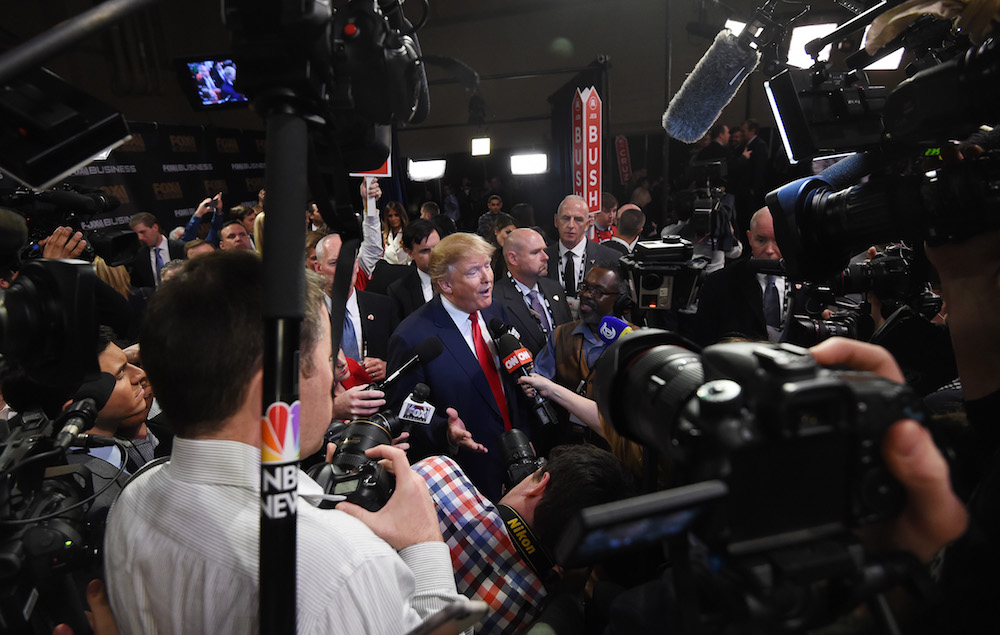
Trump did an unusual thing for a politician: He welcomed the controversy. He showed up on almost every news program that invited him and answered every reporter who called. (AP Photo/Shizuo Kambayashi)
Trump’s ’round-the-clock presence on cable news, in newspapers and online started in June, after Trump launched his campaign with a slow escalator ride down to the microphone, then an hour-long speech, most of which is forgotten.
But what caught the attention of reporters and is still cited in their reports eight months later is what Trump said about illegal immigrants.
“When Mexico sends its people, they’re not sending their best, they’re not sending you. They’re not sending you,” said Trump, pointing out to people in the audience at Trump Tower in New York City. “They’re sending people that have lots of problems and they’re bringing those problems with us. They’re bringing drugs. They’re bringing crime. They’re rapists. And some, I assume, are good people.”
The sweeping declaration struck at the very heart of all things politically correct and decent, as the East Coast media see it.
And it also sent Trump in the opposite direction of the Republican National Committee, which in 2012 made clear it wanted to adopt a softer tone on immigration policy, to appeal more broadly to Latinos.
The media swarmed Trump, called him a bigot and demanded he explain what he meant.
But Trump did an unusual thing for a politician: He welcomed the controversy. He showed up on almost every news program that invited him and answered every reporter who called.
He fought back, insisting that there are rapists and other criminals flooding into the U.S. from across the Southern border.
At campaign rallies, Trump thrilled thousands of supporters in arenas across the country by promising to “build a wall” along the border. He peppered his script-free speeches with jokes at the expense of his rivals, his favorite target being Jeb Bush, who he relentlessly mocked as “low-energy,” an insult that struck many as an attempt to emasculate the former Florida governor.
His supporters loved it and Trump was catapulted to the top of national and state polls, where he has mostly stayed ever since.
Trump, live
“Trump understands that politics is entertainment,” said Roger Stone, a longtime Republican operative and former Trump adviser. “The way you win votes is by entertaining voters. When he speaks, he always says something controversial. When he says them, he earns free media coverage. The problem his opponents have is they measure every word. Nothing they say is controversial. It’s all poll-tested and boring. Trump is never boring, above all.”
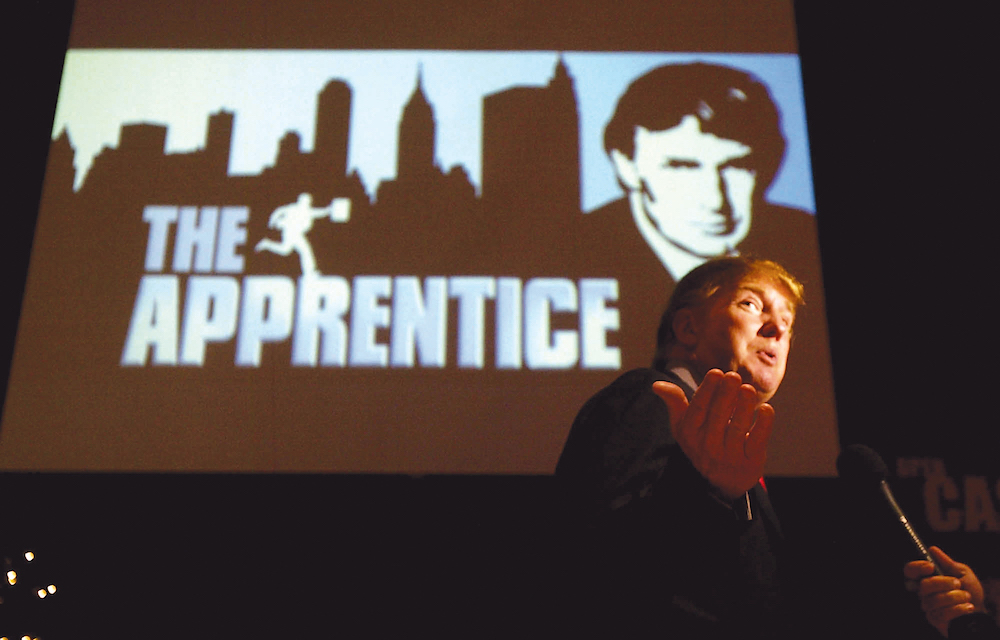
Trump seems to have fully realized himself as the straight-shooting, often crass billionaire boss he fashioned himself as on NBC’s wildly popular “The Apprentice.” (AP Photo)
It’s true that Trump has utilized his years of experience, more than a decade, as a reality TV star. At his rallies, press conferences and media interviews, he seems to have fully realized himself as the straight-shooting, often crass billionaire boss he fashioned himself as on NBC’s wildly popular “The Apprentice.”
The show launched in 2004 and transformed him from New York tabloid character to national celebrity, known for his catchphrase, “You’re fired.”
It’s a persona he thrust into his quixotic bid for the White House. He amused supporters with his showmanship, and at the same time lured in the media with his unfiltered delivery, regardless of who it might offend.
“He transformed politics into reality politics using skill sets he acquired in 11 years of reality TV,” said Hugh Hewitt, a conservative radio show host who has interviewed Trump several times during the campaign. “He is quite an artist of rhetoric and modern media communications and has more practice than any other Republican. I give him props for being able to carry this and sustain it. He’s the best interview in America.”
As one New York-based campaign reporter put it: “Being a reality-television star is the perfect experience to prepare a candidate for the modern news-media cycle.”
Just a phone call away
But most reporters who cover the campaign will tell you that it’s not just Trump’s readiness for TV that keeps him in the spotlight. Despite his undoubted status as a mega-celebrity, he makes himself available to media to an extent rarely seen from politicians.
Even long-shot candidates with much lower name recognition like Lindsey Graham, Carly Fiorina and Bobby Jindal were far less likely to accept interview requests from reporters and TV news producers.
Ahead of his official campaign announcement, a reporter for the Washington Examiner secured two phone interviews with Trump on matters that would hardly be considered front-page material.
One of the interviews centered on the Huffington Post, which had said it would not take a Trump White House run seriously (Trump called the left-leaning website “a very dishonest organization”). The other was about whether he thought he would make the cut to participate in the GOP primary debates, which at the time was struggling to accommodate the unusually large field of candidates.
“He’s been easier to book than many, many people. I won’t name names,” Hewitt said. “He is very disciplined in making the rounds and so that has been to his benefit. It’s all media all the time. That’s great. You’ve got to flood the zone in America. In a media cycle where there’s a breaking story every day, every candidate ought to be available every day, to every major media platform.”
Many in the media have said that the intense focus on Trump, even if he is a compelling subject, has been excessive and even irresponsible.
Trump’s campaign rallies, particularly in the earlier days of his campaign, were often carried for massive chunks of uninterrupted airtime on cable news channels.
The candidate seemed to make that happen himself by tossing a bombshell statement into the public square and then hosting a rally or press conference just hours later.
And he frequently did this on or heading into Mondays, assuring that the week’s news cycle would be set by him and about him.
It was a Monday that Trump released a statement to the press calling for “a total and complete shutdown of Muslims entering the United States until our country’s representatives can figure out what is going on.”
It was almost entirely forgotten from that point that a new poll had Ted Cruz overtaking Trump in Iowa.
The wrath of Don
One producer at a cable news outlet said the process of covering Trump is like being held captive against your will.
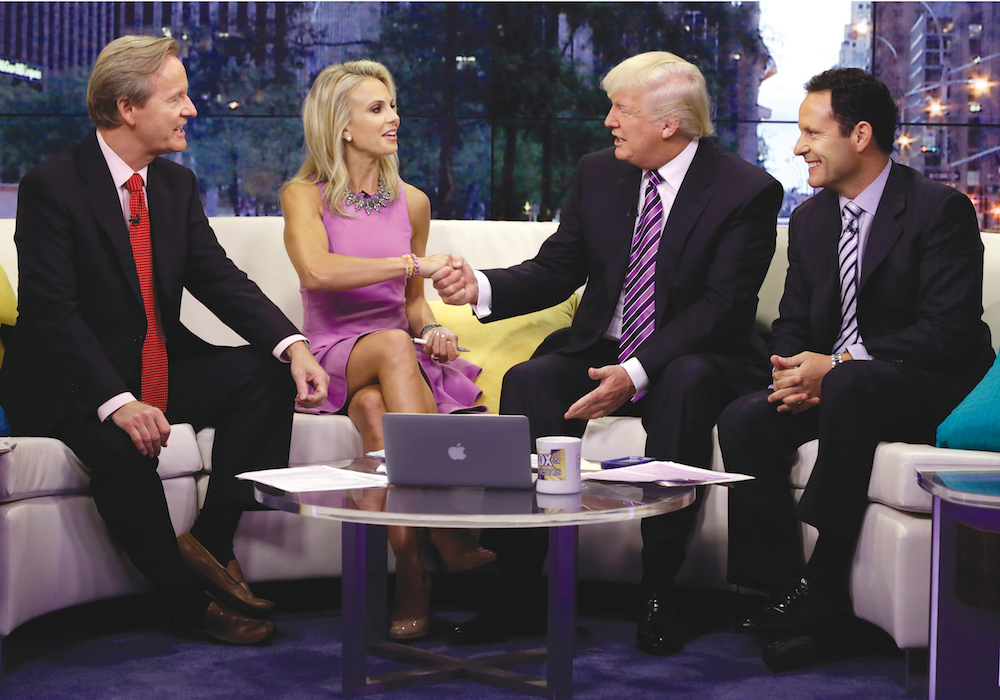
“Cable news is obviously geared towards the sensational, and Trump willingly provides that,” one network TV journalist said. (AP Photo)
“He’s absolutely exploited the media environment to his advantage,” the producer said. “He understands every single tendency that producers of this business have and he tailored his strategy to hold us hostage.”
The producer, like many media professionals interviewed for this article, spoke on condition of anonymity because the campaign still needs to be covered. But also because there’s evidence that speaking even remotely critically of Trump will incite the candidate and may spur him to retaliate by either blocking access to him or by publicly ridiculing the source of the criticism.
Neither makes for good business if you’re a political journalist pressured to get clicks or if you’re a TV news executive in a fight for ratings.
“It’s a problem. We need to make revenue,” said the producer. “In terms of ratings, Trump is good for the company.”
It’s not just cable news. On the three 30-minute network nightly newscasts, Trump got about a third of all coverage dedicated to the campaign over the course of 2015, according to the Tyndall Report, which monitors those programs.
But it’s cable news that Trump seized by the throat.
Former House Speaker Newt Gingrich said in a February interview on Fox News that the channel was largely, if not totally, responsible for Trump’s rise in politics.
“Donald Trump gets up in the morning, tweets to the entire planet at no cost, picks up the phone, calls you, has a great conversation for about eight minutes, which would have cost him a ton in commercial money, and meanwhile his opponents are all out there trying to raise the money to run an ad,” he said on “Fox & Friends.”
From 2011-15, Trump had a weekly segment on that same show where he would call in and talk about any topic thrown at him. It kept his name in the news and built his reputation among the largely Republican audience.
Filling the vacuum
Trump’s seemingly endless capacity to capture the media’s attention has been devastating in the race for the GOP nomination.
Pre-Trump, Republicans were said to have a “deep bench” of talented governors and senators ready to take on Hillary Clinton in a general election. But then a brash billionaire kicked open the door, and by keeping the cameras and audio recorders pointed at him, he began to suffocate them one by one.
With each deliberate controversy, such as releasing Lindsey Graham’s cell phone number, calling Clinton “disgusting” for taking a restroom break or even announcing that he’s boycotting Fox News, Trump creates a vacuum that kept most of the other candidates from being heard.
“What that outrage-a-day rollout does is suck all the oxygen away from his competitors, allow Trump to change the subject if he steps in it and make observers forget what the last outrage has been,” said one network TV journalist.
One cable news insider pointed a finger at the industry that allows it to happen.
“Cable news is obviously geared towards the sensational, and Trump willingly provides that,” he said. “I’d actually go as far as to say that since he’s such a seasoned media vet, he knows exactly what he’s doing when he says something outrageous right before a major event or just as someone else is stealing the spotlight.”
If Trump is the politician who figured out today’s media environment, to its most fundamental level, he doesn’t let on that he knows it, other than asserting that he can drive ratings.
As available as Trump makes himself to the media, the average observer would be forgiven for assuming he hates the press.
At every campaign rally, Trump is sure to tell the audience how “dishonest” and “terrible” the media is. He points to the cameramen present and insists they won’t show how big the crowd is, suggesting that the media are deliberately concealing his popularity.
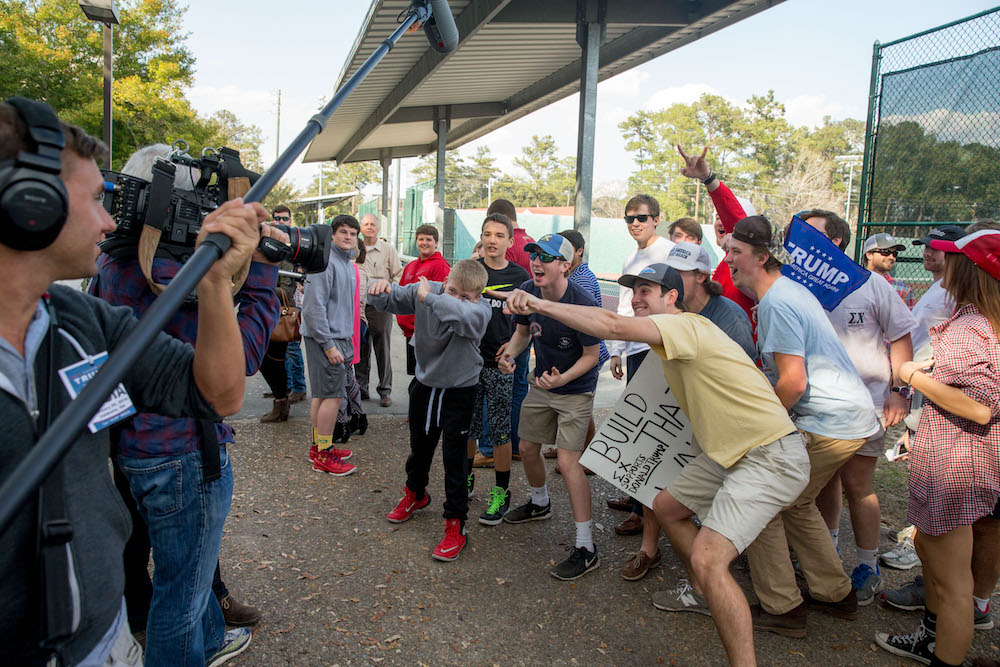
Trump has fought the media and it delights his supporters, the core of which are working-class, white, centrist Republicans. (AP Photo)
The bite always results in wild applause.
“Donald has tapped into this vein of things because he feels it himself,” said Jeffrey Lord, a conservative journalist and Trump supporter, in an interview with the Examiner. He said he once asked Trump what he would do about the news media if he were ever to run for president. “He told me if he ran for president he was not going to put up with it.”
Trump has fought the media and it delights his supporters, the core of which are working-class, white, centrist Republicans. It’s a demographic that’s deeply skeptical of the national news media at large, believing it too liberal and having too much influence in politics.
This, even as the media has struggled to adapt to the Internet age. Newspapers are shrinking and TV news crews are being forced to produce more with less.
Trump gives them what they need: a colorful character and a good soundbite.
“He is controlling the media,” conservative radio host Rush Limbaugh said on his show in January. “He controls the media when he’s not on it. He controls the media when he is on it. He controls the media when he’s asleep.”
In August, Left-leaning MSNBC personality Mika Brzezinski dubbed Trump “the most powerful person in media.”
But for some of Trump’s supporters, the media is an afterthought. Trump does take a blowtorch to the press, but his backers think his path to the nomination is about more than that.
“Instead of blaming themselves for being clueless, the media say, ‘Trump pulled a trick on us!'” said conservative author and Trump supporter Ann Coulter in an email to the Examiner. “About half-way through Trump’s second term, the media will figure out that Trump became president because he pushed popular policies the public has been dying to vote for, but that no politician or political party has offered the country in four decades.”
