

House and Senate lawmakers Monday sat down to work on a compromise budget blueprint that could pave the way to repeal of the Affordable Care Act.
“Repealing the president’s health care law would pave the way to starting over on patient-centered health care reform where patients and families and doctors are making medical decisions, not Washington, D.C.,” House Budget Committee Chairman Tom Price, R-Ga., said.
Recommended Stories


The Senate-House Budget Conference Committee held its first meeting aimed at reconciling the differences between the two budgets, authored by Republican majorities in both chambers.
A key element of both plans is a provision that would allow the Senate to repeal Obamacare with just 51 votes, rather than the usual 60 votes.
“After weeks of hard work, the House and the Senate approved our respective budgets last month, both of which were balanced-budget proposals,” Price said. “And now, we’re here to continue that work and find an agreement on a unified budget resolution.”
The House and Senate plans are similar. Both cut more than $5 trillion from federal spending in about a decade and both provide nearly $40 billion in additional funding for the Pentagon that is not offset by other cuts and will add to the deficit.
But there are also important differences between the House and Senate budgets.
The House budget turns Medicaid into a block grant program in order to reduce costs, and Medicare would be converted to a voucher system with cuts amounting to $148 billion. The Senate plan matches President Obama’s budget, which reduces Medicare spending over a decade by $431 billion. The Senate plan does not make changes to those programs.
Both budgets provide language allowing a 51-vote Obamacare repeal in the Senate. The Senate version also provides reconciliation instructions to the Senate Finance Committee to pass a tax reform bill.
The House expands reconciliation authority to all 13 committees.
Overall, both budgets aim to reduce the nation’s debt and deficit and cut wasteful government spending.
The non-binding measure would provide direction to House and Senate committees in passing spending legislation later this year.
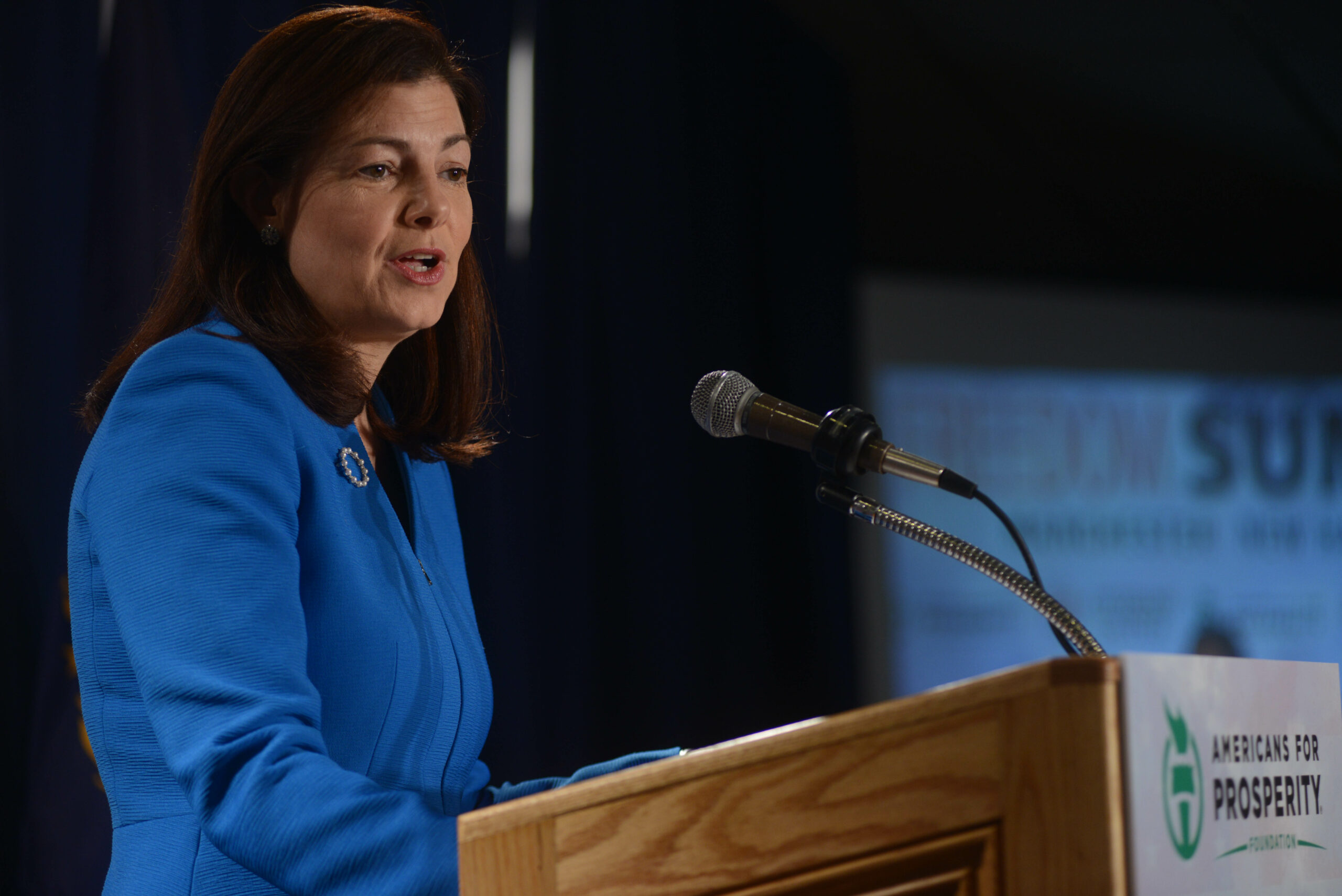
“While there are important differences in both budgets,” Sen. Kelly Ayotte, R-N.H., said, “Both budgets make tough choices to create a fiscally responsible blueprint for the nation.”
Senate Budget Committee Chairman Mike Enzi, R-Wy., said lawmakers are aiming for a joint measure that will boost the nation’s economy and put it on the path to fiscal health.
“Today we take the next step and start to work on a joint balanced-budget resolution to expand America’s economy and increase opportunities for hard-working families,” Enzi said. “Restoring the trust of the American people can be done by passing a balanced budget, and it’s about restoring that trust of the American people, because the federal government’s chronic overspending and exploding debt threatens each and every American.”
Democrats on the conference panel rejected both the House and Senate proposals, arguing the cuts to entitlement programs would harm families while preserving tax cuts for the rich.
Democrats noted Republicans took no steps to close tax loopholes commonly targeted by progressive lawmakers that benefit the wealthy.
“The budget resolutions that we are debating today are nothing less than a disaster for the working families of this country,” Sen. Bernie Sanders, I-Vt., the top Democrat on the Senate Budget panel said.
“On every important issue that we face, both of the Republican budgets — the House budget and the Senate budget — do exactly the opposite of what needs to be done and in fact what the American people want us to do.”
Democrats contested the GOP claim that their blueprints would balance the budget.
Rep. Chris Van Hollen, D-Md., the top Democrat on the House Budget Committee, said Republicans are promising to balance the budget with savings achieved through the health care law they aim to repeal. And the budget does not account for hundreds of billions of dollars in additional revenue loss from House-passed legislation that would raise the threshold on the death tax to $10 million per couple.
“It doesn’t balance,” Van Hollen said.
Republican lawmakers on the panel celebrated the budget conference, noting that it’s seldom that lawmakers work together on a common spending blueprint.
“I was tempted to take a selfie,” Rep. Mario-Diaz Balart, R-Fla., said. “It’s a really rare occasion.
