

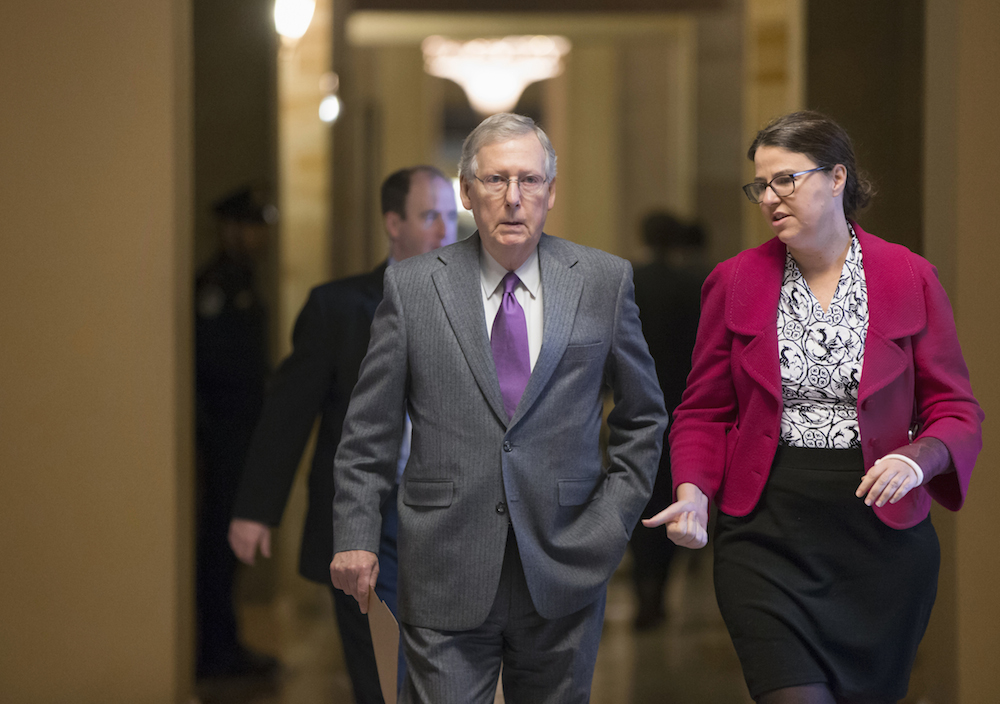
Three months later, Republican senators are still catching flak from constituents about the $1.1 trillion omnibus spending package that passed in December.
“Republican voters are just wondering when we’re going to get serious about debt and spending,” Sen. Jeff Flake, R.-Ariz., who voted against the bill, told the Washington Examiner on Thursday. “If we can’t do it when we have majorities in the House and the Senate, it’s tough to see a time when we will. I think that’s the frustration and I hear it all the time.”
Recommended Stories


Some senators, especially newly-elected lawmakers, learned a grating lesson in the 2015 spending fight on how the most important legislation gets drafted and passed in crisis situations. While Texas Sen. Ted Cruz’s complaints about Senate Majority Mitch McConnell were somewhat predictable, the frustration with McConnell’s decision-making last year has spread to other corners of the GOP conference.
For freshman Sen. David Perdue, the omnibus vote was particularly painful. The Georgia Republican is a budget hawk — “we are past the tipping point” on the debt, he said on the Senate floor last week — but he maintains he was put in a corner last year by Alabama Sen. Richard Shelby.
Georgia and Alabama have been fighting over water rights for decades, so Shelby, a powerful member of the appropriations committee, added language to the omnibus that would “tip the scales” in favor of his home state. Perdue and the rest of the Georgia delegation convinced congressional leaders to strip out the provision, but, in exchange, they had to vote for the bill.
“Hell yeah, it hurt,” Perdue said. “It is not the right way to do this, but we stood up and fought for the water rights of the people of Georgia.”
This kind of year-end horse trading would never have happened if Congress had funded the government earlier by passing a series of individual appropriations bills over the summer. McConnell tried to do that in June, but Senate Democrats used the filibuster to prevent a debate on a defense spending bill as part of their plan to force Republicans to increase spending.
At that point, the Kentucky Republican gave up on passing the funding bills and moved on to other legislative priorities, even through several Republicans wanted him to hold the Democrats’ feet to the fire.
“We should have coordinated our efforts and our messaging and put pressure on Democrats to take up the defense appropriations bill,” one GOP senator close to leadership told the Examiner. “They should have paid a much higher price for blocking the defense authorization bill and for President Obama vetoing it.”
McConnell implicitly responded to that complaint in December. “It takes 60 votes to do most things that we do, and so I was always looking for the kinds of bills that were worth doing, that [also] enjoyed bipartisan support,” he explained in Washington.
There are plenty of Republicans who agree that McConnell’s hands were tied. “The Democrats had made clear that they were going to filibuster the appropriations bills, so I don’t think there was a sense that, had we brought them up, that we could force the Democrats to vote otherwise,” Flake said.
That defense is leading some grassroots activists and conservative lawmakers to clamor for Senate leadership to eliminate the filibuster. The topic came up repeatedly during the Heritage Action Conservative Policy Summit on Wednesday.
“The filibuster rule … is not constitutional,” said Rep. Mick Mulvaney, R-S.C. House Freedom Caucus chairman Jim Jordan, R., Ohio, who led the revolt against former Speaker John Boehner last year, backed the more radical idea of holding the first constitutional convention since 1787. “I think it makes a lot of sense,” Jordan said.
McConnell opposes the idea of ending the filibuster, but those sorts of comments shows pressure is growing on him to back radical tactics to push through a Republican agenda. But McConnell defends his strategy, and explained that he was trying to help vulnerable Republican senators running for reelection in 2016.
“I think for people like Kelly Ayotte, and Pat Toomey, and Ron Johnson, and Rob Portman, and Mark Kirk — they want to make the argument that they’ve made a difference,” he said. “Not that they’ve sat around all the time making points, but that they’ve made a difference. And I think we have an agenda that we’ve accomplished here in the first year that will help them do that.”
That agenda might appeal to blue-state voters in a general election, but it comes at a price: Conservative voters are as angry as they have been in years, and most of that passion is directed at Republicans.
“You talk to almost any member, House or Senate, and if the person you’re talking to is a Republican you are most likely going to hear about how many angry phone calls they’ve gotten in the days and weeks after the omnibus, and it hasn’t stopped,” said another Republican senator who didn’t want to criticize McConnell openly. “And I didn’t even vote for it!”
