

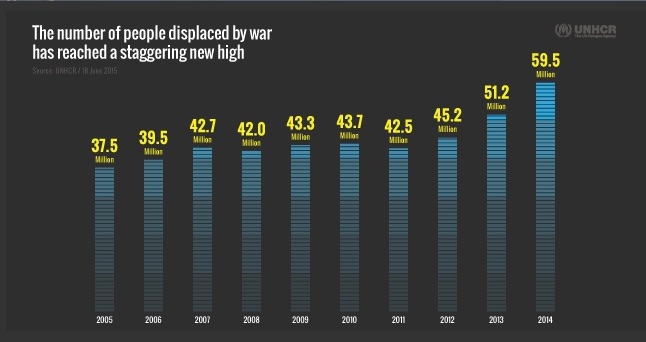
In 2014, the numbers of people fleeing war and persecution totaled roughly the population of the United Kingdom or the world’s 24th largest population, reaching the highest levels ever recorded, according to a comprehensive United Nations report released Thursday.
One in every 122 people in the world is now either a refugee, internally displaced, or seeking asylum, the UN Refugee Agency reported. “In 2014 alone 13.9 million people became newly displaced — four times the number of the previous year,” the report said.
Recommended Stories



The number of the world’s forcibly displaced people now totals a staggering 59.5 million compared to 37.5 million a decade ago, according to the report¸ and was the biggest leap ever seen in a single year. Every day last year on average 42,500 people became refugees or internally displaced.
Alarmingly, more than half of the world’s refugees are children.
Refugee aid agencies, tasked with caring for and managing the migration of the displaced, are stretched to their limits and do not have the resources to handle the mass migration of people.
The war in Syria, now in its fifth year, has been the single-largest driver of world displacement since early 2011. Turkey took in 1.59 million Syrian refugees in 2014, making it the world’s top refugee-hosting nation.
In the past five years, at least 15 conflicts have either begun or reignited, spurring the mass exodus: eight in Africa, three in the Middle East, one in Europe and three in Asia, the UN reports.
These wars are sending a staggering 6.7 million refugees into Europe, up 51 percent from last year. In 2013, that number was to 4.4 million. Within the European Union, Germany and Sweden handled the largest number of asylum applications, and a record 219,000 people have taken the treacherous trip across the Mediterranean.
Another major contributing factor to the rising totals of refugees is that so few refugees are able to return home — only 126,800 did so in 2014, the lowest number in 31 years.
It is increasingly common for refugees to be “stranded for years on the edge of society as long-term internally displaced or refugees,” the UN reports.
The number of refugees first topped 50 million last year, the first time it had done so since World War II, and now appears set to surpass 60 million.
“We are witnessing a paradigm change, an unchecked slide into an era in which the scale of global forced displacement as well as the response required is now clearly dwarfing anything seen before,” U.N. High Commissioner for Refugees António Guterres said in a statement.
“It is terrifying that on the one hand there is more and more impunity for those starting conflicts, and on the other there is seeming utter inability of the international community to work together to stop wars and build and preserve peace,” he added.
