

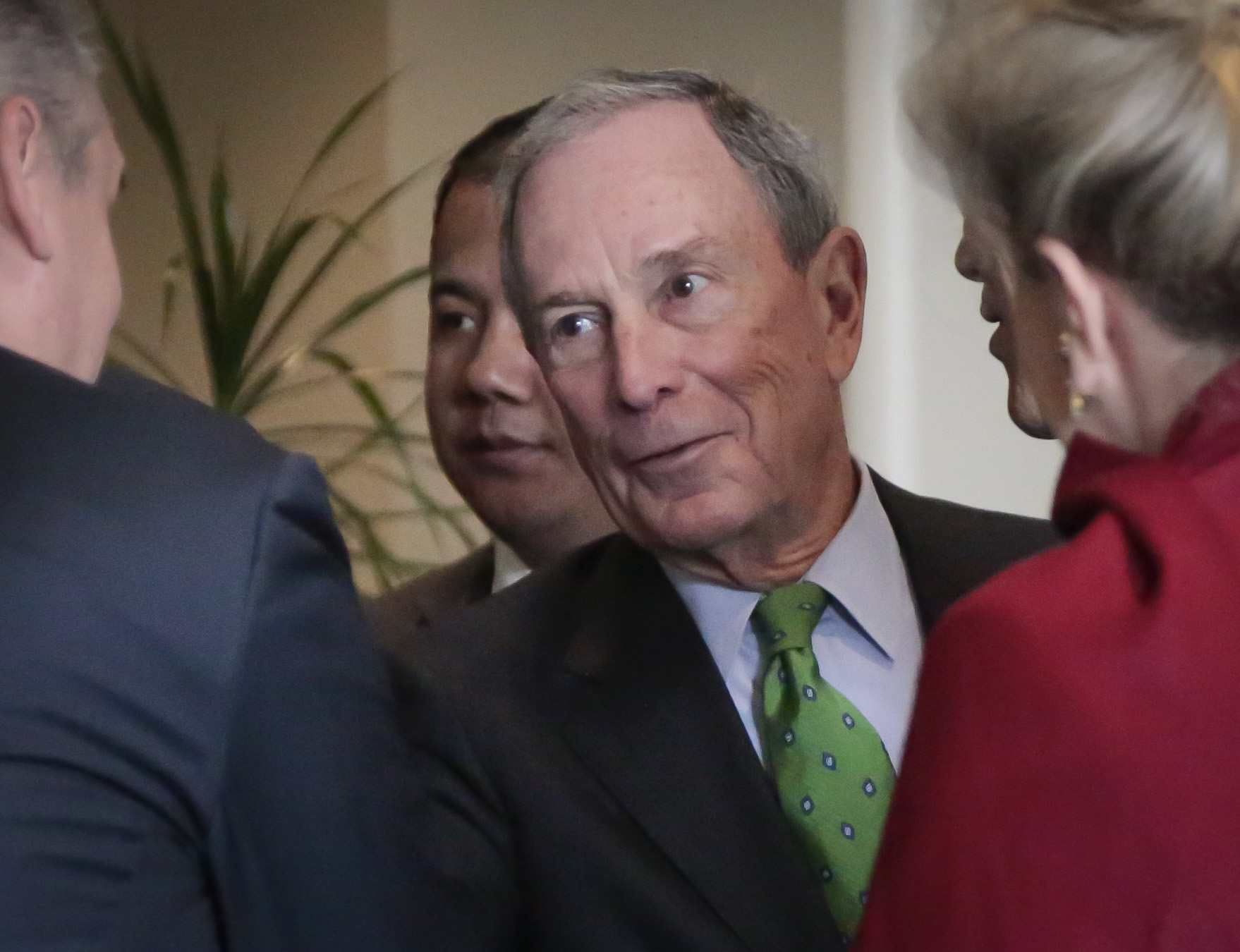
Former New York Mayor Michael Bloomberg indicated to the Financial Times Monday that he may be considering a White House run, and said he is “looking at all the options” when asked if he’d run.
“I find the level of discourse and discussion distressingly banal and an outrage and an insult to the voters,” Bloomberg said in an interview, before adding that the U.S. public deserved “a lot better.”
Recommended Stories


From these and a few other comments, the Financial Times speculated that Bloomberg is indeed “eyeing” a 2016 presidential bid, and suggested that his potential candidacy would “dramatically reshape the 2016 race for the White House.
Bloomberg, who co-founded a media empire in 1990 that that now bears his name, asked advisors in January to come up with a plan that could see him launching a campaign as an independent, the New York Times reported.
The Times also reported that a potential presidential run by the billionaire could see him spending up to $1 billion of his estimated personal worth of $39 billion.
Bloomberg told the Financial Times in an interview that he’d move to get his name on U.S. ballots by the beginning of March, and said that he’s “listening to what candidates are saying and what the primary voters appear to be doing.”
The report theorizes that Bloomberg’s more liberal tendencies would be beneficial to the Republican Party, whose primary has been dominated since June by billionaire businessman Donald Trump, because it could attract Democrat voters away from Hillary Clinton and Sen. Bernie Sanders, I-Vt.
Along with his success in media, Bloomberg has made a name for himself by being a proponent of anti-gun legislation and government-led efforts to restrict consumer access to certain commercial products, including cigarettes and large sodas. His position on these issues, especially his many attempts to curb gun sales, as well as his support for efforts to fight climate change, would likely appeal to Democratic primary voters, the Financial Times suggested.
But Bloomberg has some work to do if he’s serious about running.
Seventeen percent of likely Democratic voters in Iowa said they had a favorable view of the former mayor, while only nine percent of Republicans in the Hawkeye State said the same, according to a Bloomberg News/Des Moines Register survey conducted just before the first caucuses.
Clinton has dismissed the idea of a Bloomberg campaign, and Sanders has criticized it, saying another billionaire in the 2016 race would confirm that the country is, “moving away from democracy to oligarchy.”
Though many suspect an independent would have no shot at success in a presidential race, the Financial Times notes that the 2016 primary has been anything but predictable.
“While experts believe that an independent candidate would struggle in a system that is heavily skewed to favour candidates from the two main parties, the 2016 race has already proved the danger of accepting conventional wisdom,” it noted.
“A year ago, most experts predicated that the race would see Mrs Clinton face Jeb Bush, the former Republican governor of Florida, or Scott Walker, the Wisconsin governor. But Mr Walker dropped out of the race early, and Mr Bush is struggling to save his campaign as he languishes in fifth place in the New Hampshire polls after doing badly in Iowa,” the report added.
