

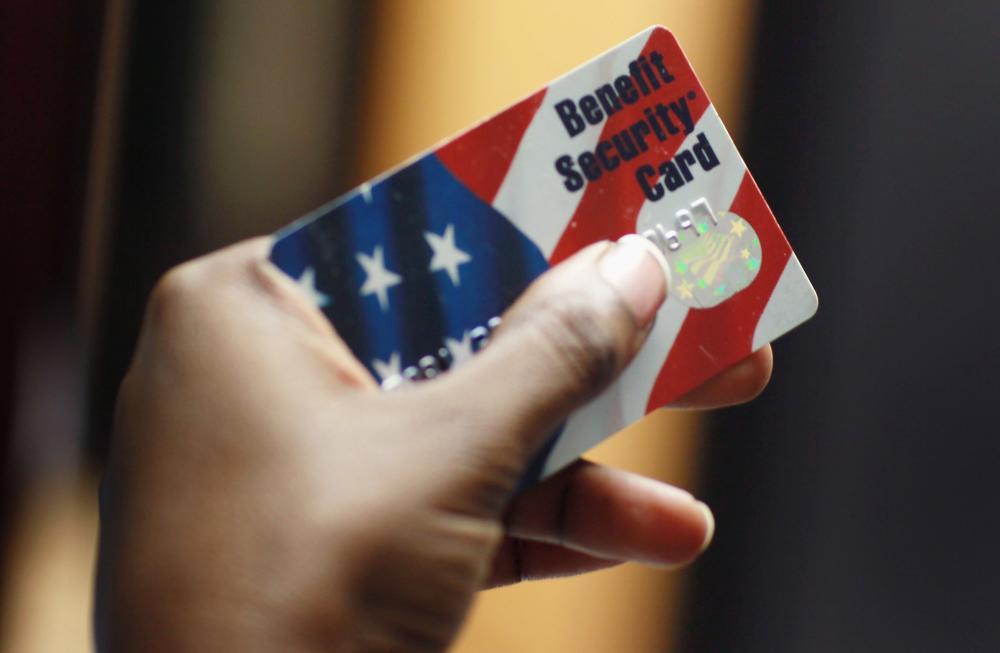
The federal government on Thursday proposed new rules to crack down on people who sell their food stamp cards for cash, seeking to curtail a form of entitlement fraud that is rampant in the Washington area.
Citing the growing number of food stamp recipients selling their cards over the Internet, the new Department of Agriculture guidelines would allow states to investigate people who request replacement cards more than three times a year. States could cut off aid to those who couldn’t adequately explain their repeated losses.
Recommended Stories



The District ranks third nationwide in the number of households that request four or more cards annually, federal data show, behind only South Dakota and Oklahoma.
But the type of fraud federal officials are targeting represents only a small fraction of the waste and abuse reported within the food stamp program, federal data show. And that single measurement greatly underestimates food stamp abuses in the Washington region.
Far more common abuses involve food stamp recipients who trade their cards to retailers for cash — typically at less than the card’s true value — and those who lie about their circumstances to qualify for the benefit. Both of those schemes are far more prevalent locally than recipients who sell their cards and then request replacements.
Maryland ranks second nationally in overall food stamp fraud, federal data show, even though it ranks 39th in the number of households that replace four or more cards each year.
For every $100 in benefits, Maryland gave out $6.11 to people who weren’t eligible — amounting to a misappropriation of about $60 million, according to an Agriculture Department analysis of 2010 data, the latest available. Virginia gave out $5.04 to ineligible recipients for every $100 spent on food stamps, which also was well above the national average of $3.05 for every $100 spent on food stamps.
In contrast, the District, which ranks high in the number of people requesting replacement cards each year, ranks 21st among the states in overall food stamp fraud, with $3.76 in overpayments for every $100 spent on food stamps.
Analysts welcomed the federal tightening of the food stamp rules, though some questioned whether the new efforts would do much to stop people from gaming the system.
“This is not a very big part of the fraud, but it strikes me as basic common sense,” said Michael Tanner, a senior fellow with the Cato Institute, who focuses on social welfare policy. “The biggest fraud on food stamps is primarily at the store level, not individuals giving away their cards. Still, it’s a welcome development.”
Federal officials note that requests for replacement cards, which work like debit cards, are not reliable indications of fraud. Some people just lose their cards, they said. But the new guidelines are a logical step to help curb food stamp fraud that costs taxpayers roughly $750 million a year, they said.
“Selling those food benefits for cash is an intentional program violation that can result in disqualification — and it won’t be tolerated,” said Kevin Concannon, USDA undersecretary for food, nutrition and consumer services. “However, we have also made clear in the rule that states must protect vulnerable populations, and that the rule is meant to stop fraud, not negatively impact access to benefits for those who for legitimate reasons are requesting multiple replacements.”
