

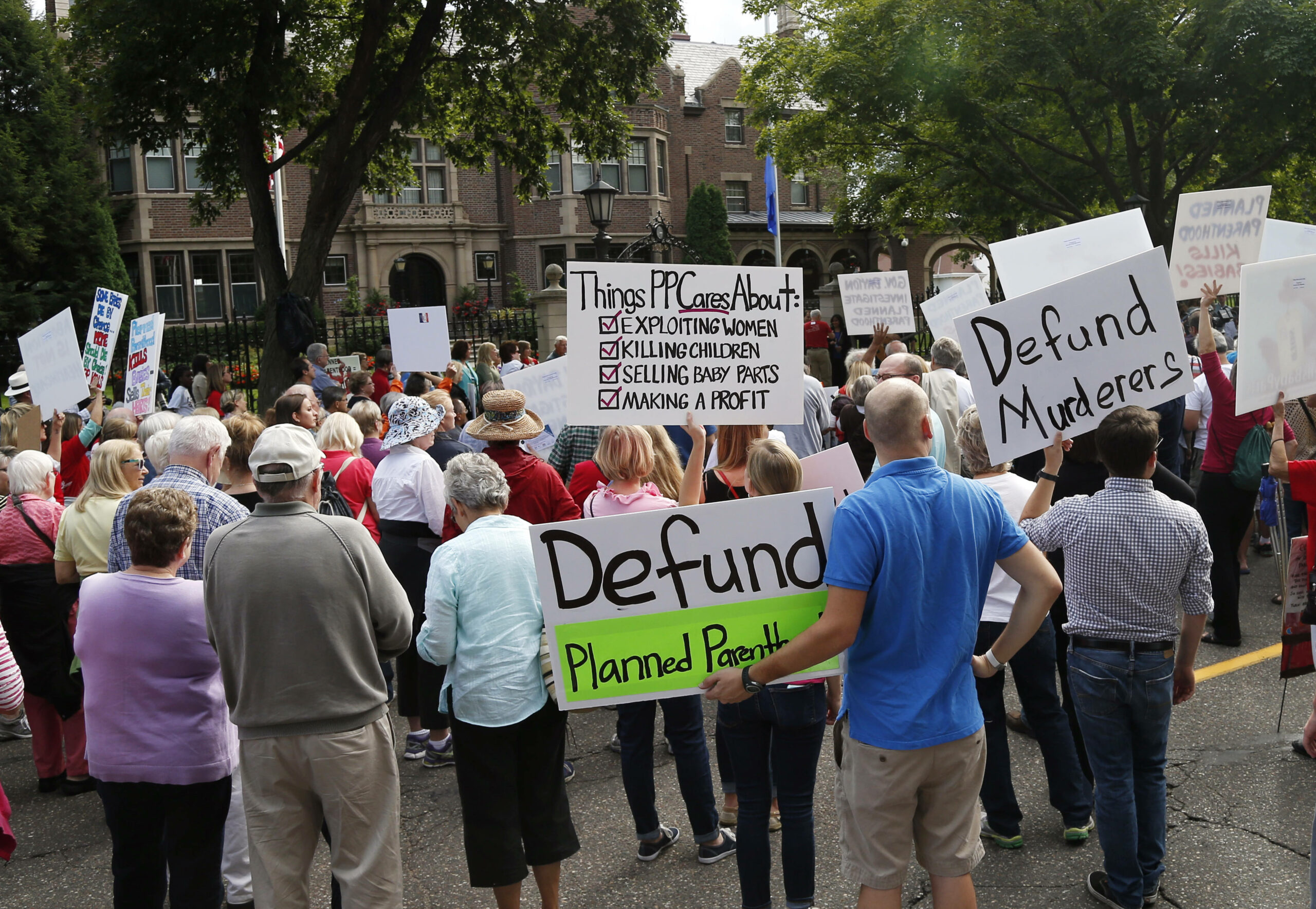
The man whose Planned Parenthood videos have led to a major backlash against the country’s largest abortion provider chose one of the toughest states to do his undercover investigation.
David Daleiden, a 26-year-old abortion opponent, is facing two major court battles as the National Abortion Federation and a company called StemExpress sue him for taping their employees without obtaining their consent and try to prevent him from releasing the full footage.
Recommended Stories


Following a two-and-a-half-year investigation, Daleiden released a string of videos showing discussions with Planned Parenthood officials and others involved in supplying and selling the body parts of aborted fetuses. The videos gained widespread attention, prompting Planned Parenthood to ban its centers from receiving any further compensation for fetal tissue and spurring an effort by congressional Republicans to stop all federal funding to the group.
But to get the footage, Daleiden posed as a buyer for a fake human tissue company and secretly recorded multiple meetings with leaders from Planned Parenthood, the National Abortion Federation and tissue companies.
And he did most of that in California, one of 11 states with so-called “two-party” or “all-party” laws, which are stricter confidentiality standards requiring consent from everyone involved before taping a conversation. That could trip him up as he defends his undercover video project.
As part of their defense, the nonprofit law firms representing Daleiden are arguing that because some of the conversations took place in public places, California’s confidentiality law doesn’t apply. And even if they lose on that count, they say Daleiden is exempted entirely from the law because he was trying to prevent a crime.
To record StemExpress Chief Executive Cate Dyer, head of the company that formerly contracted with some Planned Parenthood centers for tissue, Daleiden met her for a lunch meeting while secretly outfitted with recording devices. The public nature of the meeting means Dyer couldn’t have expected privacy in such a public place, Daleiden attorney Charles LiMandri, of the Freedom of Conscience Defense Fund, told the Washington Examiner.
“We don’t think it’s confidential,” said LiMandri, who argues that some case law has upheld the ability of investigative journalists to take undercover videos at lunch meetings.
Some experts in privacy law say the fact that Daleiden conducted the conversation in a restaurant could protect him against charges that he invaded Dyer’s privacy.
“You put a camera in a bedroom, that’s invasive,” said George Freeman, executive director of the Media Law Resource Center. “I don’t think that would pertain to a restaurant … I think it would be really hard to show that’s an intrusion.”
But Daleiden’s attorneys could find it difficult to convince a court that the conversation wasn’t confidential at all, since the two-party law is typically viewed as applying regardless of where the discussion took place.
“It would be presumably illegal because obviously the second party didn’t consent,” Freeman said.
That was the opinion of Los Angeles Superior Court Judge Joanne O’Donnell, who said in August that Dyer could have had expectations of privacy sitting in a restaurant booth.
Most recently, the superior court has ordered Daleiden’s group, the Center for Medical Progress, to turn over documents, communications and some unedited footage to the biomedical company. The ruling also means StemExpress can subpoena Holly O’Donnell, a former employer who plays a prominent role as a whistleblower in the dozen or so videos Daleiden has edited and released.
Similarly, the U.S. Court of Appeals for the Ninth Circuit has allowed a lower court decision to go forward requiring the Center for Medical Progress to turn over documents to the abortion federation. The group is petitioning for a stay to that decision so that it doesn’t have to provide the names of its donors.
The full footage has been obtained by the House Oversight Committee, after Chairman Jason Chaffetz, R-Utah, issued Daleiden with a subpoena for it. He has set up a room where congressional staffers can view it but hasn’t released it to the public.
“With nearly 800 GB of data to review, it will take significant time to evaluate all of the footage,” Chaffetz said last month. “Out of an abundance of caution to ensure the safety and security of all individuals recorded, the footage will not be released to the public at this time.”
Neither case challenging Daleiden’s group is likely to get a court hearing until next year, as the Center for Medical Progress fights to get the charges dismissed. And if the courts find that Daleiden did illegally record confidential conversations, his attorneys are ready with a counter-argument: that he is exempted from the confidentiality law because he was trying to prevent a crime.
“Even if there was a reasonable expectation of confidentiality, the exception would be if you are trying to prevent a violent crime to a person,” LiMandri said.
The crimes, according to Daleiden and his legal team, is that Planned Parenthood illegally profited from the tissue beyond just getting compensated for the overhead costs of providing it — and that abortion providers illegally performed partial birth abortions or neglected to care for babies who remained alive after abortion attempts.
The videos released by Daleiden don’t prove any of those claims. And it could be hard for his lawyers to convince a judge that he is exempted from the law because he was trying to prevent a crime in theory. But LiMandri said he has “pieces of compelling evidence” that some of the fetuses were born alive.
“If any of these babies are born alive, then by taping it he’s trying to prevent the crime of violence to a person,” LiMandri said.
