

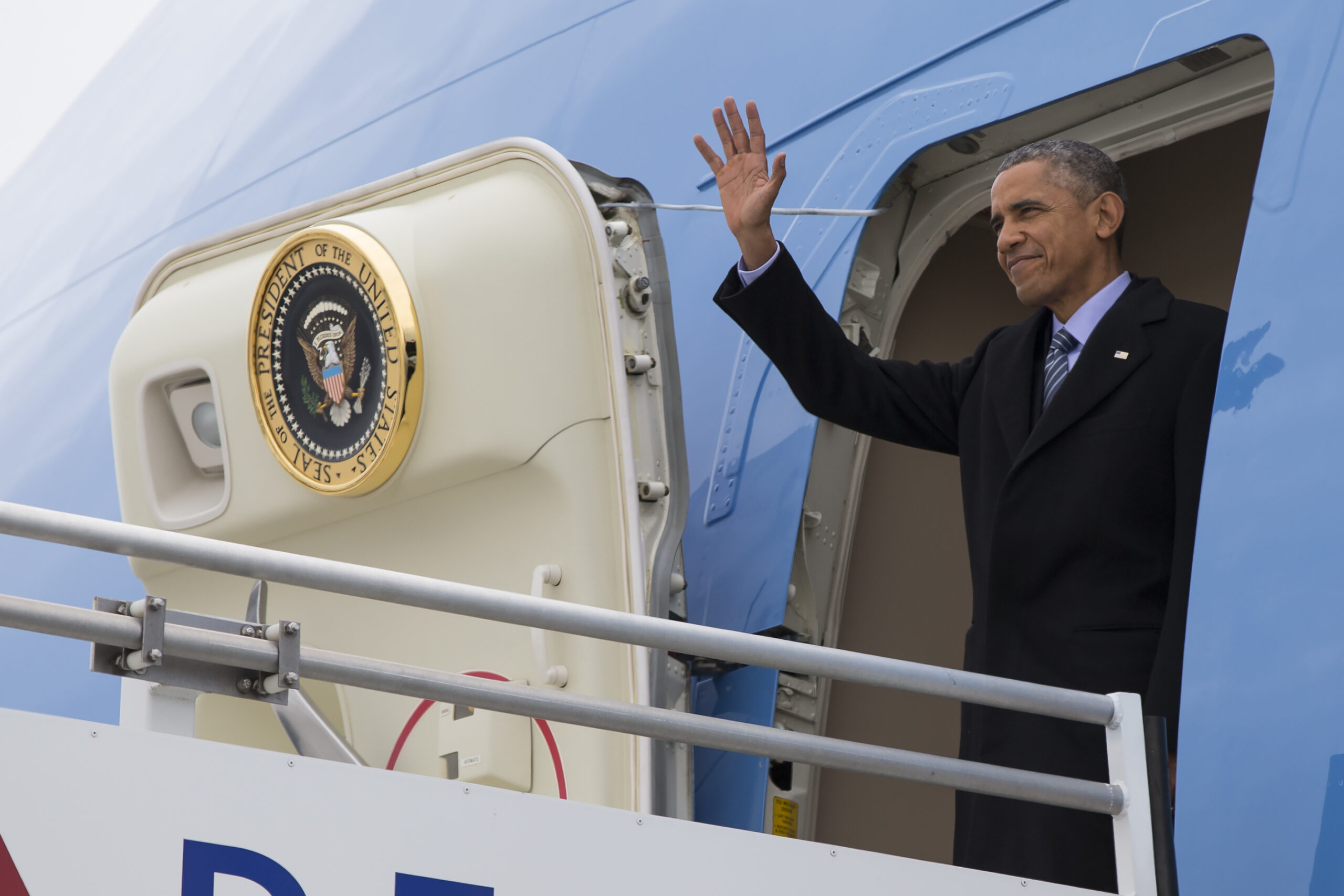
President Obama’s national security strategy, unveiled Friday, outlined no change in strategy for dealing with the Islamic State of Iraq and Syria.
Instead, the commander in chief proposes to stay the course and argues that his current actions are working and have helped stop the terrorists’ territorial conquests.
Recommended Stories


While mentions of the Islamic State are sprinkled throughout the 29-page document, there is just one paragraph devoted entirely to the the matter of defeating the jihadi group.
Under a section titled “combat the persistent threat of terrorism,” Obama’s blueprint says the U.S. has undertaken a “comprehensive effort to degrade and ultimately defeat” the Islamic State yet the successes so far that it cites are limited to halting the group’s momentum.
“Joined by our allies and partners, including multiple countries in the region, we employed our unique military capabilities to arrest [the Islamic State’s] advance and degrade their capabilities in both Iraq and Syria,” the document states.
The document mentions the Islamic State 11 times compared to 15 mentions of Russia.
Its language is vague in describing the goal of the administration’s work with coalition partners to train and equip a moderate opposition forces in Syria. It states that the training is aimed at providing “a counterweight” to the brutality of the regime of Syrian President Bashar al-Assad.
National Security Adviser Susan Rice offered more details about recent successes in the fight against the Islamic State. During a question-and-answer session at the Brookings Institution Friday, she said American-led airstrikes had destroyed nearly 200 the Islamic State oil-and-gas facilities and pushed the terrorists out of key areas of Iraq.
“Just last week, [the Islamic State] conceded defeat in a months-long siege of Kobani,” a Syrian town near the Turkish border, Rice said.
On the jihadis dissemination via social media of videos of its murder of hostages, Rice said: “[The Islamic State] should know that their barbarism only fortifies the world’s resolve.”
Critics and even supporters of the administration’s foreign policy had low expectations for the long-awaited National Security Strategy, and those low expectations appear to have been fulfilled. Obama hasn’t offered a new foreign policy blueprint since 2010, even though it’s required by law to be updated annually, giving critics more fodder to accuse him of rudderless crisis-to-crisis approach.
(President George W. Bush was almost as delinquent, providing only two such strategy documents in his eight years in office — one in 2002 that laid out his case for preemptive strikes, which became known as the Bush Doctrine, and another in spring 2006 in the middle of his second term.)
But in recent weeks, the Islamic State raised the stakes on Obama’s strategy doctrine with its gruesome slayings of foreign hostages, most recently the burning alive of a caged Jordanian pilot this week.
Those looking for a new, more robust approach to the administration’s Islamic State strategy were disappointed.
“This new ‘strategy’ is a regurgitation of the same failed policies that have engendered an international environment of weakness and made the United States and our allies around the world less safe,” said Rep. Mike Turner, a senior member of the House Armed Services Committee.
“The reality is we live in a world where the threats to our security have grown exponentially over the last six years,” said Sen. Jim Inhofe, R-Okla., a senior member of the Senate Armed Services panel. “During this period of time, our U.S. military has been systematically dismantled and the lack of the U.S. leadership and presence has created a vacuum around the world.”
Several national security experts praised many aspects of the strategy document although they too said it recycled many of the policies already in place.
Michael O’Hanlon, a national security analyst at Brookings, said Obama and Rice in her remarks Friday were on point in asserting that the U.S. leadership remains strong in many areas, that the world is in reasonably good shape compared with periods in the past, that strategic restraint – especially in the use of military force – has it virtues and the Asia pivot remains important.
“That said, there was little new ground broken on policies where improvement is needed, including Syria, Afghanistan, and Russia/Ukraine,” he said. “But it would be slightly unfair to expect all of that out of a broad strategy document.”
Others said Obama’s coalition airstrikes against the Islamic State is the right approach, but the president and his administration need to do a better communications job to be convincing.
“It’s definitely a stay-the-course approach because a long-term strategy with sustained military and economic tools is what’s required,” Johan Bergenas, a national security expert at the Stimson Center, told the Washington Examiner. “The problem the president has is to sell that to the public.”
Obama will have a chance to make his case in a matter of days when he sends Congress a new request for authorization of a use of force against the Islamic State.
Speaker John Boehner, R-Ohio, said this week that passage of the first such authorization since 2001 would not be an “easy lift” and that it was up to Obama to “go out there and make the case … for why we have to fight this fight.”
This story was published at 5:00 am and has been updated to add comments from O’Hanlon.
