

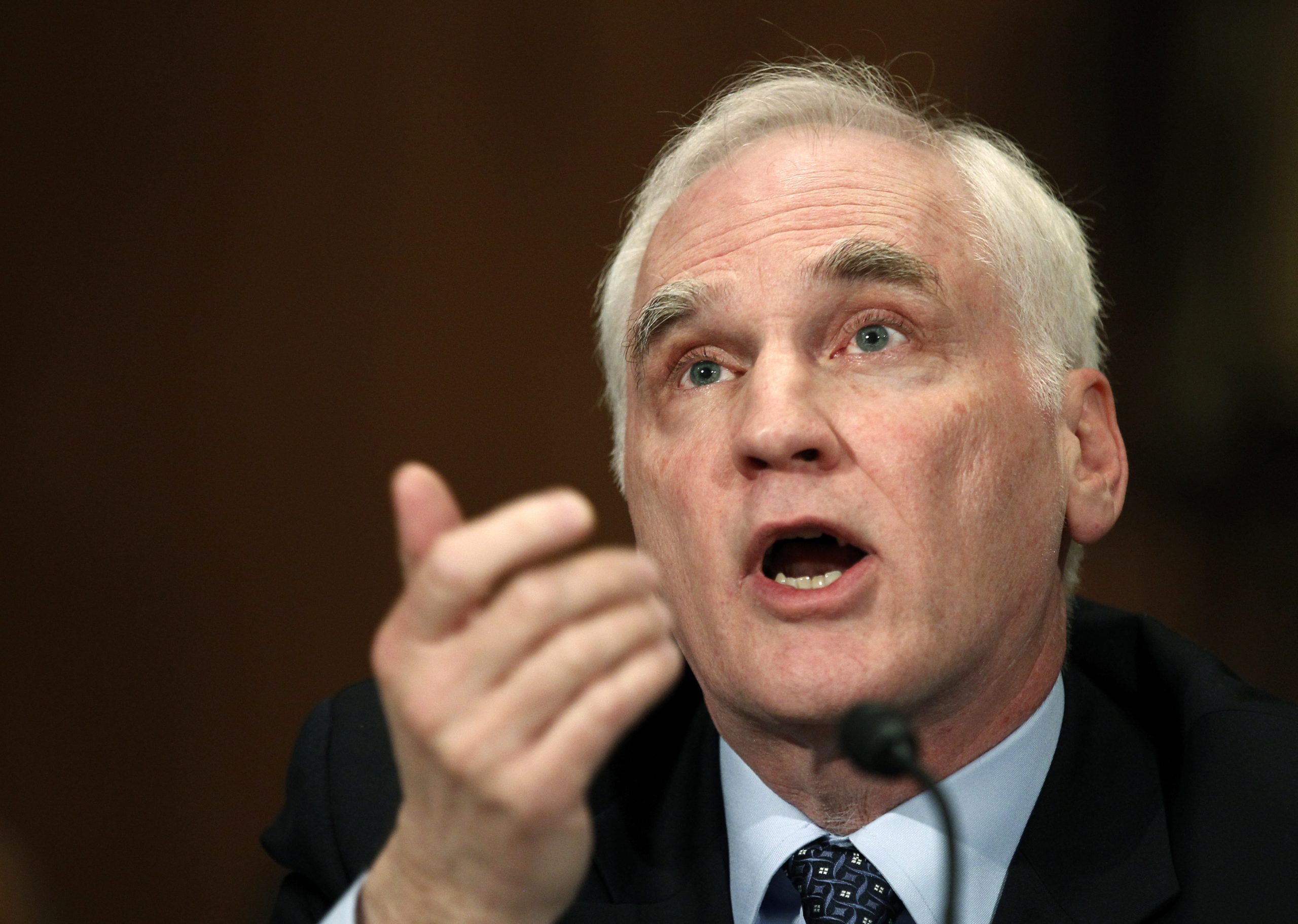
Federal Reserve governor Daniel Tarullo will introduce the results of the central bank’s stress tests for banks Wednesday amid a new recognition of his role as the lead financial regulator in the U.S.
Recommended Stories



He may be below the organizational chart to chairwoman Janet Yellen at the Fed, but the 62 year-old bureaucrat is the top-level government official most immersed in oversight of the financial sector, and it is he who will issue a statement alongside the public announcement Wednesday regarding whether the stress tests found that banks like Goldman Sachs and Citigroup are financially strong enough to survive a market panic.
In the wake of the 2008 financial crisis, the Fed, tasked with carrying out the nation’s monetary policy, was given new regulatory powers and responsibilities by Congress in the 2010 Dodd-Frank law.
Those powers have been effectively consolidated under the authority of Tarullo, who took office in the first days of President Obama’s tenure in 2009.
Tarullo, a law professor and former Clinton White House official, is the head of the Fed’s internal Committee on Bank Supervision. He is also the Fed’s representative at the Financial Stability Board, the body of international regulators set up to coordinate between countries. In his speeches and public appearances, he delves into the details of the Fed’s latest deliberations on regulating the financial system.
He is also the acknowledged de facto vice chair for financial supervision, a position that was created by the Dodd-Frank law but has never been filled.
The vice chairman for supervision position had been vacant for 1,692 days as of Monday, according to the Bipartisan Policy Center’s nominations tracker, without President Obama nominating a candidate to fill it.
Barney Frank, the former Democratic chairman of the House Financial Services committee and Dodd-Frank namesake, said last week at an event in Washington that “I think de facto it’s in place” with Tarullo.
“My guess is that what you have is people in the administration decided a couple of years ago that one of the worst things in the world was to try to get somebody confirmed and therefore weren’t going to do any confirmation that wasn’t necessary,” Frank said. He then commented that he didn’t “think there is any practical consequence” to the fact that the post had not been filled.
In the past, Yellen has also acknowledged that Tarullo plays the role of vice chair for supervision.
“As a result of Dodd-Frank, the Board of Governors was granted tremendous new regulatory authority. That authority falls on the governor who is in charge of the regulatory group,” said Aaron Klein, the director of the Financial Regulatory Reform Initiative at the Bipartisan Policy Center and a former Treasury Department official.
“Tarullo’s responsibilities, power, and authorities are greater than his predecessor because the law changed,” Klein said, referring to Dodd-Frank’s enactment.
Not only did Dodd-Frank grant the Fed more authority to conduct regulation, but the Fed also consolidated its own system-wide authority, at the Board of Governors in Washington, rather than at the 12 regional banks that conduct examinations of banks in their districts.
The shift in power away from the regional banks and to the Board of Governors was highlighted in a Wall Street Journal article last week that noted that oversight of big Wall Street banks is now led by a little-known committee, the Large Institution Supervision Coordinating Committee, headed by Tarullo. Previously, that responsibility had been carried out by the Federal Reserve Bank of New York, which has most big banks within its region. The New York Fed has recently been criticized by progressive senators, such as Sherrod Brown, D-Ohio, for being too close to the big banks it oversees.
Yellen also mentioned the Large Institution Supervision Coordinating Committee in a speech in New York last week, saying that it was created to “improve our supervision of the largest systemically important firms.”
By centralizing oversight of big firms, Yellen said, the committee is better able to identify trends across banks, allow staff from different regions to share perspectives with each other, and better take into account threats from the broader economy or financial system.
The committee oversees big New York-headquartered banks like Goldman Sachs and Morgan Stanley. But it also monitors banks headquartered elsewhere, such as Charlotte-based Bank of America, foreign-owned U.S. bank subsidiaries, and large non-banks that are considered systemically important, such as the insurance company American International Group and the life insurer MetLife.
