

U.S. jobs grew by 215,000 in March, the Labor Department reported Friday morning, and the unemployment rate ticked up to 5 percent.
March’s job growth beat the expectations of economists, which were for 210,000 new payroll jobs, according to a survey conducted by Bloomberg.
With revisions to the reports from the past two months, job growth over the past three months has averaged 209,000. That pace of job creation is more than enough to keep the recovery on track and the unemployment rate headed further down. Only about 75,000 to 100,000 new jobs each month are needed, economists at the Federal Reserve and Wall Street believe.
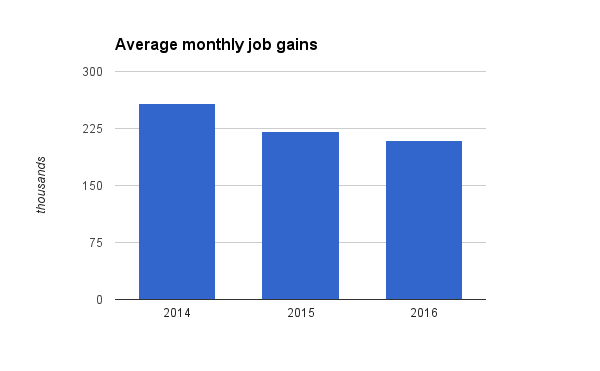
Job growth has slowed in 2016, just as it slowed in 2015, but it is still strong enough to keep the jobs recovery stretching into a sixth year without interruption.
Although the unemployment rate edged up by 0.1 percent and hasn’t declined this year, it has been overshadowed by growing labor force participation, which has propped up the unemployment rate.
In other words, the unemployment rate rose for the “right” reason, not because of job losses. Through March, labor force participation was up 1.45 million in 2016, and the participation rate has inched up by four-tenths of a percentage point to 63 percent.
Having more people enter the labor force then leave it is a new phenomenon during the current recovery. Since the start of the recession in late 2007, the labor force participation rate tumbled from 66 percent to the lowest levels since the late 1970s, back when women were still entering the job hunt in large numbers.
Falling labor force participation has been driven both by ongoing demographic changes, predominantly the retirement of the Baby Boom generation, and by the weak jobs market. Economists have debated how much the weak recovery is to blame for the participation drop.
Now, however, unemployment appears to have fallen low enough to bring some of those people back into the workforce.
Goldman Sachs economist David Mericle, in a note sent out Thursday, suggested that the economy could reach full employment by the end of the year, and that “some groups of non-participators could be drawn into a very hot labor market,” slowing the projected decline in labor force participation due to retirements.
Nevertheless, stronger hiring has yet to make a dent this year in the huge number of people who have been forced into part-time work because they had their hours cut or couldn’t find a full-time situation. At 6.1 million in March, that statistic hasn’t shown signs of falling since November.
In fact, a broader measure of underemployment taken from the household survey, the “U-6” rate of unemployment, rose in March, from 9.7 percent to 9.8 percent. That rate takes into account both involuntary part-time employment and workers who are only intermittently looking for jobs.
Also disappointing in Friday’s report was the lack of stronger wage growth, one of the signs of a tightening labor market that has been missing even as the unemployment rate has closed in on 5 percent. Average hourly earnings, at $25.43, have grown only 2.3 percent in the past year, in line with the relatively slow pace of the past few years.
The survey of businesses included in the jobs report showed that stronger employment growth was held back by the headwinds from overseas that in the past year have hit U.S. oil producers and manufacturers hard.
About 12,000 mining jobs were lost in March, largely reflecting job cuts among oil drillers. Since September of 2014, the U.S. has seen 185,000 mining jobs evaporate as the price of oil has cratered from over $100 to under $40 a barrel. Meanwhile, manufacturing employment dropped by 29,000 in March alone. Manufacturers have been strained as weakness overseas has driven up the dollar, making U.S. products more expensive to foreign buyers.
The flip side of those losses is that the U.S. gained jobs in sectors less exposed to international trends. The retail sector, the health care industry, and restaurants all saw job growth, while the ranks of construction workers grew by 37,000. Over 300,000 construction workers, on net, have been hired in the past year.
The payroll jobs numbers reported by the Labor Department are adjusted to smooth out seasonal variations, and are liable to revision in future months.
