

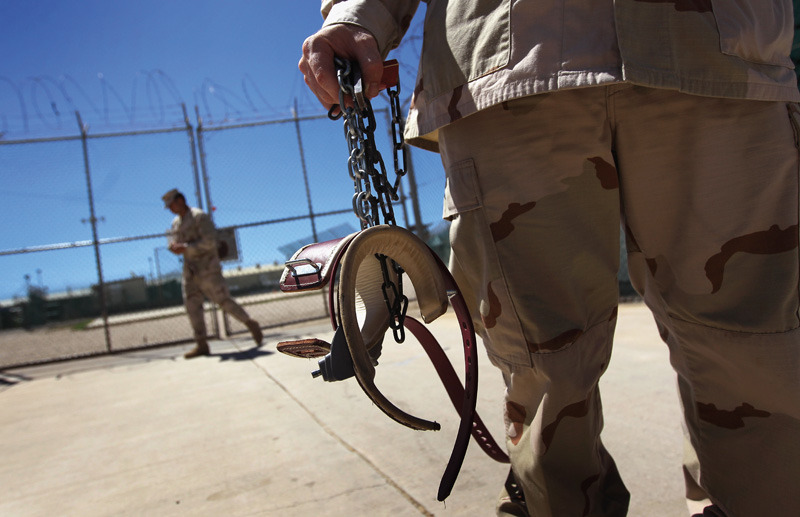
Blocked by Congress from closing the terrorist prison at Guantanamo Bay, Cuba, as he had promised, President Obama is trying instead to empty it by executive order.
The administration has released or transferred 39 suspected terrorists from the facility over the past 18 months, and officials have promised more to come. The recent flow from the prison comes after a period of more than a year in which no one left.
Recommended Stories



Only 127 remain of the 779 people sent to Guantanamo since the prison opened on Jan. 11, 2002 — the smallest population ever. Other than nine who died in custody, the rest have been repatriated, transferred to other countries or freed.
“The path to closing Guantanamo during the Obama administration is clear, but it will take intense and sustained action to finish the job,” Cliff Sloan, who resigned in December as the State Department’s special envoy for closing the prison, wrote in the New York Times.
Among the roadblocks are what to do with the prisoners being tried before military commissions on charges stemming from the Sept. 11, 2001, terrorist attacks and other incidents, along with those judged too dangerous to release but who will not be prosecuted. Congress has barred the administration from transferring those detainees, who number about 50, to the United States.
The releases have raised a debate over whether the administration is risking national security in its haste to shed U.S. responsibility for the remaining detainees, as well as the security of other countries. Though some detainees who recently left Guantanamo have been transferred into rehabilitation programs in Saudi Arabia and elsewhere, others have been released to third countries or by their home countries after being repatriated, raising concerns that they will return to the fight.
Administration officials downplay those concerns, saying each detainee’s case has been reviewed carefully by the departments of Defense, Homeland Security, Justice and State, along with the Joint Chiefs of Staff and the Office of the Director of National Intelligence. Unanimous agreement is required for a transfer or release, officials said.
Of the 127 who remain at Guantanamo, 59 have been cleared to leave the prison.
Officials also claim a low recidivism rate of released detainees. According to the latest report from the Office of the Director of National Intelligence issued in September, 107 of 620 detainees released from Guantanamo, or 17.3 percent, had been confirmed as returning to terrorism as of July 15, and another 77, or 12.4 percent, were suspected of having done so.
Republican lawmakers and others, however, say those figures underestimate the threat posed by former detainees.
“I know the number has to be higher than that,” said Charles “Cully” Stimson, who oversaw Guantanamo as deputy assistant secretary of defense for detainee affairs in the George W. Bush administration.
“You don’t know whether someone has actually re-engaged until you capture them or kill them.”
The situation at Guantanamo is unprecedented in the history of warfare, as prisoners are being released during the conflict, said Stimson, now a senior legal fellow at the Heritage Foundation.
In cases in which the detainees are transferred to another country, safeguards are negotiated to prevent them from returning to the fight, such as denying them passports, prosecuting them or putting them in a rehabilitation program for militants such as the one run by Saudi Arabia, Stimson said.
“There are dozens of different ways that the host countries have agreed to mitigate the risks that each detainee poses,” he said, though he added: “By 2006, there were no risk-free transfers from Gitmo,” because the detainees who remained were known enemy combatants and because the negotiated safeguards sometimes fail or are not enforced.
In some cases, there are no apparent safeguards at all. Six detainees — four Syrians, a Palestinian and a Tunisian — were released Dec. 7 to Uruguay, where President Jose Mujica welcomed them as refugees and said they would be allowed to lead normal lives among the South American country’s small Muslim population.
The four Syrians — Ahmed Adnan Ahjam, Ali Hussain Shaabaan, Omar Mahmoud Faraj and Jihad Diyab — all are Islamist extremists who fought the regime of President Bashar Assad before being captured fighting for al Qaeda in Afghanistan. Republicans say their histories are an example of why detainees like them remain a danger both to U.S. security and the security of their new homelands, especially in light of stepped-up U.S. and allied military action in the Middle East to counter the Islamic State of Iraq and Syria.
“That’s not their culture. That’s not where they’re from,” former House Intelligence Committee Chairman Mike Rogers, R-Mich., said, noting that such placements hadn’t worked out well in the past.
Take the case of Lahcen Ikassrien, a Moroccan who was arrested in Afghanistan in 2001 and released four years later to stand trial in Spain, where he was acquitted in 2006. He was re-indicted in December, accused of recruiting people to fight for the Islamic State.
Stimson, meanwhile, said he is concerned that closing Guantanamo without a viable alternative would lead Americans to falsely believe that the United States would no longer hold enemy combatants in wartime, such as captured Islamic State fighters.
Such a situation “is unwise and inconsistent with the realities on the ground,” he said.
