

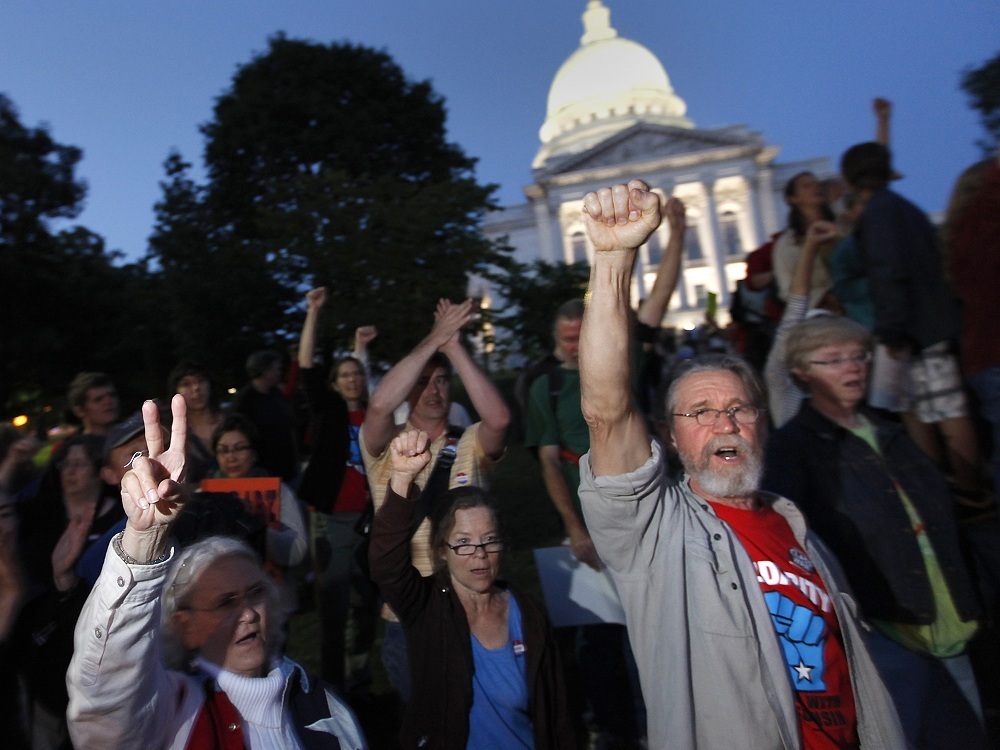
Wisconsin Gov. Scott Walker’s victory Tuesday over a union-driven recall effort could signal big changes for the nation’s unionized public-sector workers as voters grow increasingly supportive of efforts to roll back union pensions and power.
State and national public-sector union workers fueled the 15-month drive to oust Walker in Wisconsin after he passed laws stripping their collective bargaining rights and forcing them to contribute more money to their own pensions.
Recommended Stories


But voters sided with Walker, endorsing the reforms he imposed. That strong showing, combined with the vote by two California cities Tuesday to curb union pension benefits, raises the prospects that other states may seek similar limits on public employee unions in the name of cutting costs and balancing budgets.
“In states that have Republican governors and Republican legislatures, I think at the margins this will embolden people to further limit collective bargaining rights of public-sector unions,” University of Toledo law professor Joseph Slater told The Washington Examiner.
Even in heavily unionized Michigan, polls show the public is increasingly supportive of public-sector union reforms as the costs associated with union benefits begin to crush state and local budgets. Michigan Gov. Richard Snyder, a Republican, has so far moved incrementally to curb public-sector unions and reduce benefits but he has stopped far short of ending collective bargaining rights, in part to avoid the backlash Walker endured in Wisconsin.
Tuesday’s results could bring more aggressive reforms in Michigan, some theorize.
“If a progressive state like Wisconsin is able to withstand the national onslaught of the unions, it may bolster the government to stand up to public-sector employees here,” Tom Shields, a Republican pollster based in Lansing, Mich., told The Examiner.
There is ample evidence beyond Wisconsin that the public is increasingly eager to reform public employee unions, whose swelling pension costs alone have begun to consume larger and larger shares of state and local budgets.
In California, voters in both San Diego and San Jose on Tuesday approved separate measures that would reduce the cost of their public employee pension plans. Soaring pension costs have forced both cities to reduce municipal services, fueling public support for limits on union benefits.
In San Jose, where public union pensions account for 27 percent of the city’s budget, voters passed a measure that will require unionized public-sector workers to contribute as much as 16 percent of their pay to their pension plans or face reduced benefits. In San Diego, voters agreed to a measure that ends the pension system for new employees and reduces the payout for current employees.
Public-sector and private unions have been curtailed in other states. Rhode Island recently reduced pension benefits for new and current state workers. In Indiana, where public-sector collective bargaining rights were eliminated in 2005, the legislature just passed a right-to-work law that bans the automatic collection of union dues.
Still, the unions have been able to fight back successfully in places like Ohio, where voters in November overwhelmingly rejected a law that would have stripped union workers of their collective bargaining rights. The law’s proponent, Republican Gov. John Kasich, has since watched his approval rating sink to the low 30’s.
