

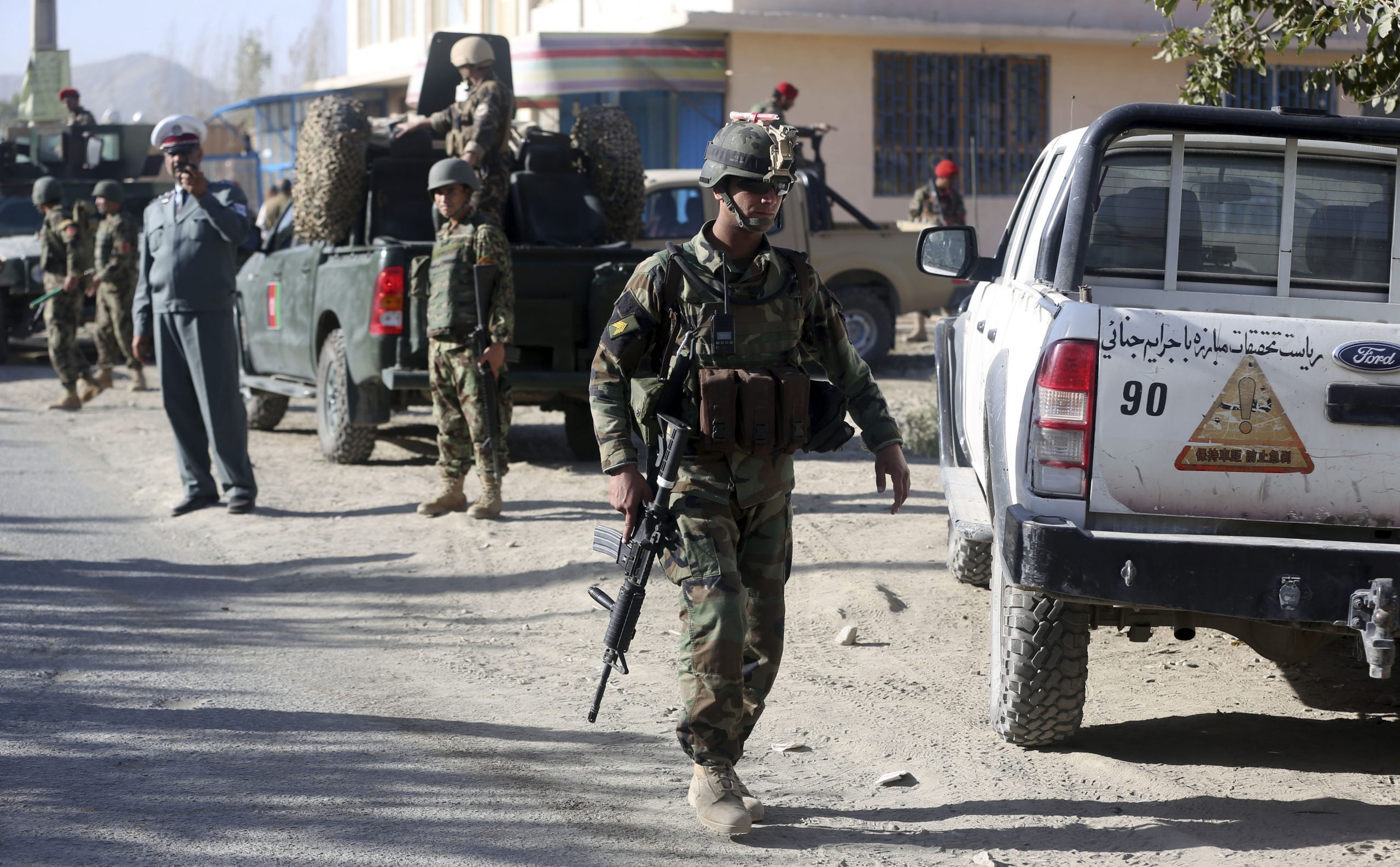
The commander of NATO forces in Afghanistan said Thursday he doesn’t think that country would fall into chaos like Iraq after Western troops withdraw, though he admits that the Taliban are winning the information war because that perception persists.
“The entire country of Afghanistan wants the coalition,” U.S. Army Gen. John Campbell told reporters at the Pentagon in a videoconference, noting that Afghan security forces “have done very well” since taking over the fight late last summer.
Recommended Stories


Campbell cited events of the past week, including Monday’s inauguration of President Ashraf Ghani Ahmadzai after a power-sharing deal and the signing Tuesday of a bilateral security agreement with the United States, as evidence that Afghanistan was headed toward a more stable future.
“I think that the BSA and the [NATO status of forces agreement] have really boosted the confidence of the Afghan people,” he said. “There’s nowhere that we have Afghan security forces that the Taliban can get the terrain, hold the terrain.”
Campbell did admit, however, that perceptions persist that the Taliban are winning on the battlefield. “We have not done a good job in telling that story,” he said.
Though the U.S. plans to end its combat mission in Afghanistan by the end of the year, President Obama announced May 27 that he would leave 9,800 troops as advisers through 2015 and half that number through 2016, joining nearly 3,000 troops from other NATO countries.
Campbell said those troops would focus on helping strengthen remaining weak spots in Afghan forces, such as logistical capabilities and close air support.
Many lawmakers, citing the rapid rise of the Islamic State of Iraq and Syria amid sectarian conflict in Iraq after the 2011 U.S. withdrawal, want Obama to revisit his plans for Afghanistan and commit to supporting the government in Kabul more strongly.
“We are witnessing now in Iraq what happens when the U.S. falters on that commitment and adopts a posture inconsistent with our security interests,” House Armed Services Committee Chairman Buck McKeon, R-Calif., said. “I hope that the president will view the [security agreement] as a roadmap for a robust continued engagement, and not a path to premature withdrawal.”
Any U.S. military presence in Afghanistan at all after the end of the year was in doubt until this week, since outgoing President Hamid Karzai had refused to sign the security deal before he left office. In keeping with his often-frosty relations with Washington that caused many Americans to wonder whether Afghanistan was worth the continued effort, Karzai blasted the United States in a Sept. 23 farewell speech, saying: “America pursued its own interests and did not want peace in Afghanistan.”
Campbell’s remarks Thursday included an implied criticism of Karzai, when he noted that Ghazni Ahmadzai’s inauguration made “an immediate impact” on the morale of Afghan police and soldiers, and said his administration is expected to change some of the policies of the previous government that had inhibited their ability to fight.
A collapse of the government in Kabul holds much higher political risk for Obama than events in Iraq, where he has always opposed U.S. involvement. The president campaigned in 2008 on the idea that the fight in Afghanistan was the “real war,” and doubled down on the U.S. commitment after taking office. As the number of U.S. troops and the intensity of the fighting increased, so did casualties — 75 percent of the 2,200 U.S. troops killed in Afghanistan have died since Obama took office.
The latest, Army Sgt. 1st Class Andrew T. Weathers, 30, of DeRidder, La., died Tuesday at Landstuhl Regional Medical Center, Germany, from wounds sustained Sunday in an enemy attack in southern Helmand province — a scene of heavy recent fighting. Weathers was assigned to 2nd Battalion, 7th Special Forces Group.
