

Fresh from his role moderating Wednesday’s “horrible” GOP debate, CNBC’s Carl Quintanilla has raised eyebrows again with a questionably worded comment, and this time it’s over China’s now-amended one-child policy.
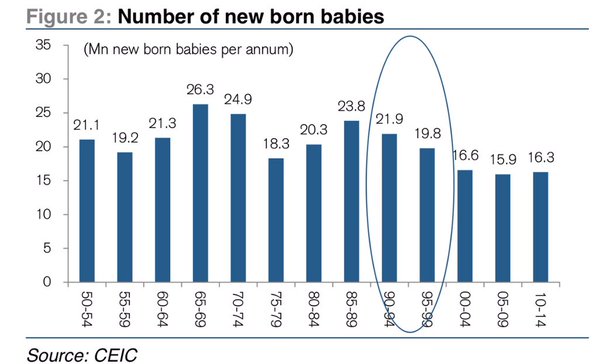
“One thing about China’s one-child policy: it worked,” he said on social media, linking to a Credit Suisse chart showing the sharp decline in the number of children born in China between 1990 and 1999.
Recommended Stories


The New York Times reported that China changed the policy over fears that “an aging population could jeopardize China’s economic ascent,” and noted it was a move away from the policy put in place by Deng Xiaoping.
As a matter of simple math, Quintanilla is not wrong, as China’s forced one-child policy has led to fewer births.
But his say-what-you-want attitude seemed to ignore the broader repercussions of China’s coercive approach to population control, which has included forced abortions, involuntary sterilizations and the sex-selective abortion of females, and left many social media users unimpressed.
I mean, say what you will about Pol Pot’s killing fields… https://t.co/h0IuSX1zrg
— Guy Benson (@guypbenson) October 30, 2015
Ladies and gentlemen, your CNBC GOP debate moderator: https://t.co/6Rl1nDD6kd
— Jeff B. (@EsotericCD) October 30, 2015
And? So did FDR’s forced slaughtering of livestock. Unintended consequences important to full story. Economics 101. https://t.co/42DkkFmcf6
— Andrew Kirell (@AndrewKirell) October 30, 2015
If your goal is dominating people. #CNBCisms https://t.co/50kCRHK3t4
— Richard Grenell (@RichardGrenell) October 30, 2015
Quintanilla later defended his comment on Twitter by saying, “[R]etweets are NOT endorsements.” But his original remark wasn’t a retweet, and was wholly his own.
Absent from Quintanilla’s brief analysis of China’s decades-old policy are details of how the country’s economy has been damaged by its approach to population control.
“As China’s population grows older, the country is experiencing a shortage of workers and consumers to keep the economy afloat,” one activist website, Victims of Communism, explained. “Despite being originally instituted for economic reasons, it is ironic that through this very policy China has written its own economic death sentence.”
As there is an economic incentive to produce male children, females are normally aborted so that couples can try again for a son.
Because of the widespread practice of sex selective abortion, “there are an estimated 37 million Chinese men who will never marry because their future wives were terminated before they were born,” the anti-Communism site noted, citing figures from a 2009 British Medical Journal study.
“This gender imbalance is a powerful, driving force behind trafficking in women and sexual slavery, not only in China, but in neighboring nations as well,” the report added.
A recent analysis in Current Biology found elsewhere that the Chinese social experiment, which has created a society made up entirely of people without any siblings, has birthed a generation that is, “less altruistic, less trusting, less trustworthy, more risk-averse and less competitive than the generations born before 1979.”
Also, as noted by Forbes contributor Alex Berezow, China’s one-child policy has created a situation where there are still plenty of elderly people, but not nearly enough young, working-age people to care for or support them.
Lastly, in perhaps the saddest analysis of all, Wang Feng, the director of the Brookings-Tsinghua Center for Public Policy in Beijing, suggested in a recent interview that the policy of forced abortion and sterilization wasn’t even necessary to lower the birthrate.
“[I]f you look at other countries around Asia — Thailand, South Korea, or even North Korea — fertility has come down in all those places to the level that’s very close to China, or not much higher,” he said in an interview with Public Radio International.
These countries, the PRI report added, “did that, without coercion, without the 300 million abortions linked to the One-Child policy, without the skewed gender gap, due to a preference for boys and selective abortions of female fetuses, or the 150 million only children now growing up as part of a shrinking workforce supporting an ever-larger elderly population.”
“Now, the ratio is 5 workers to every retiree. In 2030, it will be 2 to 1 — a burden for the state, and a drag on economic growth, unless both worker productivity and taxation increase considerably,” the report added.
