

Kim Jong Un is a dictator and a mass murderer and who retains political power by running his country as a concentration camp and threatening peaceful neighbors with nuclear war. Yet President Trump calls him a friend.
“We are friends,” Trump told a Hamptons’ crowd at a fundraiser on Friday night, between two missile launches by Kim.
Recommended Stories
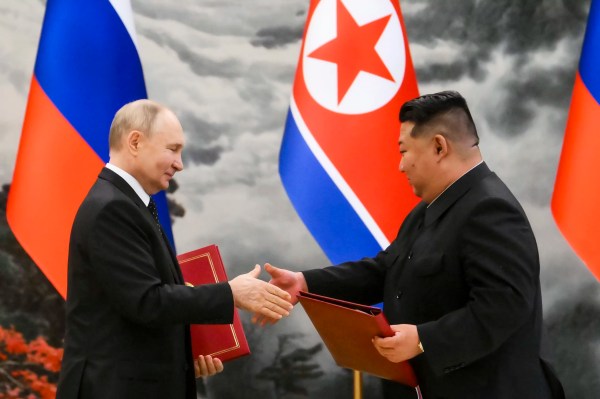
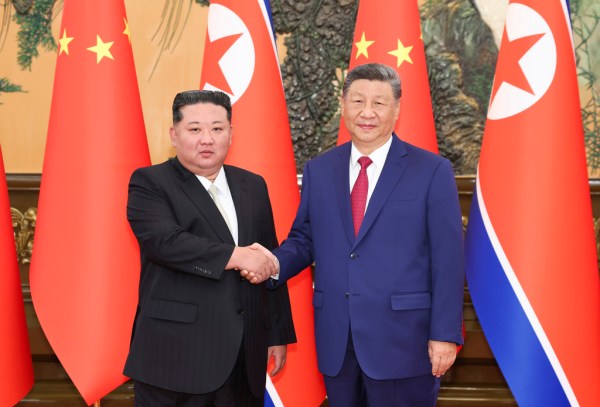
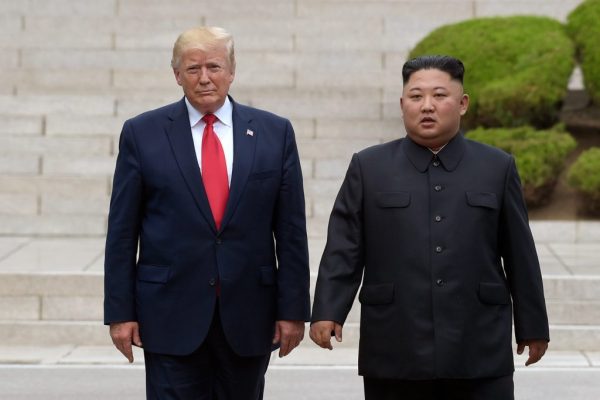
Trump’s fondness for Kim is baffling to decent people, but it fits into a pattern. Trump praised Kim earlier this month, stating “the potential as a country, Kim Jong Un’s leadership, is unlimited,” and saying Kim “has a great and beautiful vision for his country.” A year ago, Trump told supporters that he and him “fell in love.”
The pattern extends beyond Kim. Trump has praised Filipino strongman Rodrigo Duterte, whom he affectionately calls by his first name. Trump has praised Turkey’s Recep Tayyip Erdogan, also a brutal strongman whose abuse of protestors has even abridged U.S. sovereignty. Saudi Arabia’s ruling family and Russia’s Vladimir Putin are also among Trump’s favorite world leaders, if you go by Trump’s rhetoric.
Some critics on the Left have asserted that Trump’s warmth towards Putin is proof that Russians have kompromat on him. The simplest explanation, though, is that Trump is fond of brutal strongmen, and lacking discrimination in his choice of whom to praise.
This explanation is hardly a defense. In fact, it is shameful that a president of the United States should consistently praise dictators and brutal autocrats. It trashes our legacy as the shining city on the hill and the beacon of liberty.
We’re not being overly simplistic here. This editorial page has consistently opposed humanitarian interventionism to take out foreign leaders. We have also regularly acknowledged that Realpolitik is part of diplomacy, and that doing good things for America often involves working with bad regimes.
But while foreign policy requires compromise, it never requires calling good that which is evil.
The president of the United States is rightly called the “leader of the free world.” At the very least, this role requires a regular exaltation of freedom, consistent criticism of oppression and slavery, and never holding up oppressors and slavers as good leaders.
So why does Trump fall so short on this duty? Why does he praise the brutal rulers?
Maybe it’s because Trump, as a self-described “law and order” man, doesn’t realize that his “friends” in Pyongyang, Manila, Ankara, and Moscow, carry “law and order” to an excess. Certainly in part, the problem is that Trump is too easily flattered. Putin has praised Trump. Kim has sent Trump “beautiful letters” according to the President. Trump bragged about how Duterte rolled out the “Red Carpet” for him.
The president needs to be above such flattery. He needs to realize that the world turns to him for moral guidance, and that being a moral beacon begins with calling evil evil, and never calling it good.